Why a financial forecast is essential?
Projected financial statements are often treated as an unavoidable formality: a box to check to raise funds, convince a bank, or finalize an application. In practice, they are too often handled lightly, reduced to spreadsheets produced at the end of the process, sometimes with little connection to the project’s strategy.
That approach is a mistake. A financial forecast is not an accounting exercise, nor a projection meant to “sell a dream.” It is the result of rigorous analytical work, built on explicit assumptions that are documented and debatable. It is precisely these assumptions, not isolated numbers, that determine a project’s credibility and the quality of the dialogue with investors or lenders.
In an uncertain environment, and even more so for early-stage startups, projected financial statements are a core tool for structuring and decision-making. They help you set an ambition, understand its financial implications, and identify stress points before they become critical.
This article explains the real role of projected financial statements, how to build them seriously, and the concrete criteria investors and bankers use to evaluate them. The goal is not to predict the future, but to prepare a credible, shareable trajectory.
1. Why projected financial statements are indispensable?
Projected financial statements are neither an administrative exercise nor a simple accounting deliverable. Above all, they are the outcome of structured assumptions, designed to translate an entrepreneurial vision into a coherent financial trajectory. A sloppy forecast, meaning one built without serious thinking behind its assumptions, is useless, and can even weaken a project by creating an illusion of control.
A good forecast should not be judged by the apparent precision of its numbers, but by the quality of the assumptions that produce them. Price, volume, growth pace, cost structure, hiring, investments, or payment terms: every line is the direct consequence of a strategic choice. Numbers are never an end in themselves; they are the quantified expression of decisions and convictions.
That’s exactly what discussions with bankers or investors should focus on. A funder does not “approve” a target revenue figure or a desired profit; they want to understand how those results are supposed to be achieved. The conversation is about the credibility of the assumptions, their internal consistency, and their fit with market reality. A strong discussion around a forecast is therefore a discussion about assumptions, not about the totals at the bottom of a spreadsheet.
Projected statements translate a project’s strategic vision into the universal language of numbers. They set an ambition, define a direction, and make explicit how that ambition should materialize. Where a Pitch Deck defines the WHAT (the concept, the vision, the value proposition), the forecast explains the HOW, through quantified, debatable assumptions.
They are used in many contexts: company formation, fundraising, bank financing, internal management, or strategic trade-offs. In the case of a new business, costing comes only fifth in the path that runs from idea to business plan: building it before the need has been validated and feasibility checked amounts to putting numbers on assumptions nobody has tested yet. Their purpose is not to predict the future, but to anticipate it and make better decisions. A good forecast does not predict the future: it sets an ambition and enables planning. That is the meaning of the fundamental principle: plan to be able to act.
2. The three pillars of projected financial statements
Projected financial statements typically rest on three pillars: the income statement, the cash flow plan, and the balance sheet. Each offers a specific perspective on its own; analyzed together, they show how strategic assumptions translate into performance, funding needs, and financial structure.
2.1 The forecast income statement
The forecast income statement is the tool used to read economic performance. It helps analyze revenue growth, business-model profitability, and cost control.
It highlights the project’s economic logic: value creation, margin structure, and the split between fixed and variable costs. It also reinforces a fundamental rule: revenue is not profitability. Strong growth can hide a structurally loss-making model if margins are insufficient or expenses are poorly calibrated.
Built from assumptions on pricing, volumes, variable costs, and fixed costs, the income statement helps identify the break-even point and analyze how sensitive results are to the cost structure. It is a central tool for assessing the project’s economic risk.
2.2 The cash flow plan
Cash is often more critical than accounting profit. A company does not fail because it is unprofitable, but because it can no longer meet its obligations. Bankruptcy occurs when a company can't honor its financial commitments.
Conversely, a company can have a lot of cash without being profitable, especially when significant capital has been invested upfront. A cash flow plan makes these timing gaps visible and helps anticipate liquidity stress.
This is where you understand the project's true funding need and can determine what type of financing to mobilize: bank debt, fundraising, or a combination of both. Note that the two audiences read the same document very differently: a lender opens the cash flow plan first and runs five specific ratios on your forecast, each with a threshold to clear. For an investor, the cash flow plan is a key indicator of cash burn control and runway visibility.
2.3 The projected balance sheet
The projected balance sheet provides a structural, "balance sheet" view of the business. It helps assess the project's financial equilibrium and its ability to sustain growth over time.
It includes equity, debt, fixed assets, and working capital requirements. The balance sheet highlights the project’s financial strength, the quality of its funding structure, and its capacity to absorb phases of rapid development.
3. Assumptions: The heart of the forecast
A forecast is never better than the assumptions it relies on. Those assumptions form the foundation of the financial model and must be built with rigor, method, and intellectual honesty.
They can be commercial, operational, HR-related, or financial. Their consistency with on-the-ground reality, and with the project’s maturity level, is essential.
Best practices include making assumptions explicit, traceable, and justified using market data, benchmarks, or historical performance where available. The goal is twofold: to be exhaustive in identifying costs and precise in estimating their amounts. The strongest benchmark is not the sector average but a named one: your competitors' filed accounts give their actual margin rate and revenue per employee, which turns a cost assumption into a reasoned gap against comparable companies.
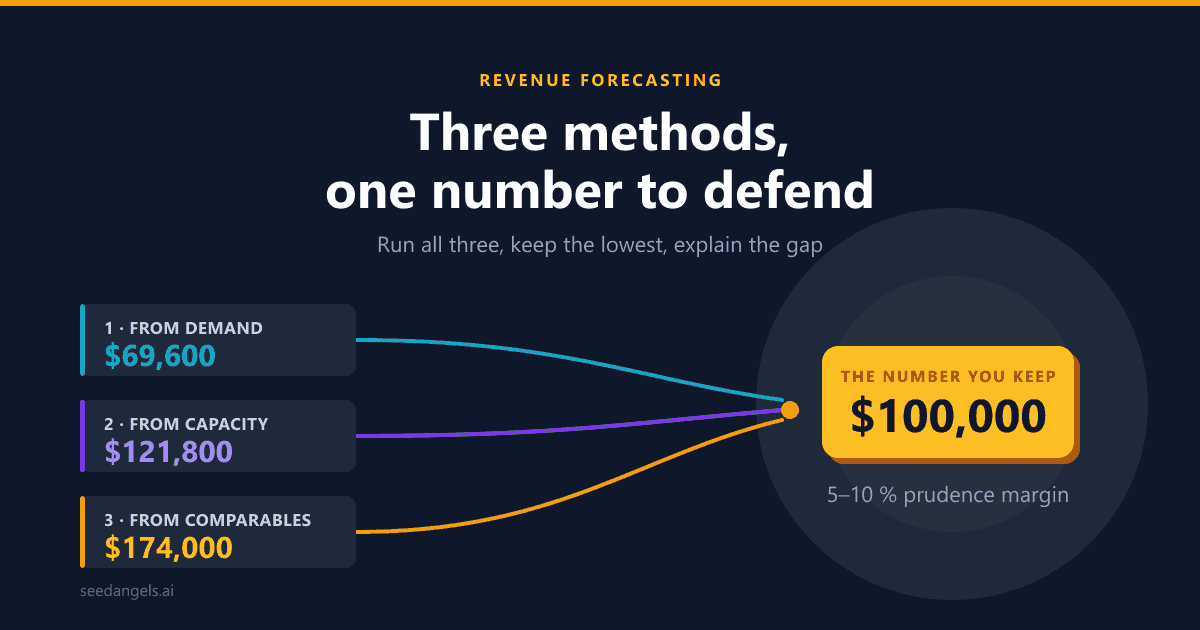
The revenue assumption is the one carrying the rest of the model. Rather than starting from a market-share percentage, it is far safer to start from a demonstrated market size and work back up through the number of customers you can realistically reach with your sales capacity. Turning that reachable market into the number you publish is a calculation in its own right, which we detail in our method for building a revenue forecast, downside and upside scenarios included.
This is also what decides who should build the forecast. An accountant can structure the statements and check their consistency, but never owns your assumptions: whichever route you take, you will be the one defending them in the meeting. We broke down what a financial forecast actually costs with an accountant, with software, or built yourself, and what each option really covers.
4. Forecast credibility: What investors really look at
Investors are not looking for an illusion of precision. Above all, they evaluate the overall logic and the coherence of the proposed trajectory.
They analyze alignment between the strategic vision, the product roadmap, and the financial projections. They care about the leadership team’s ability to understand the numbers, explain variances, and adjust strategy accordingly.
The first test of that alignment is about the past rather than the future: investors systematically check your projections against results you have already recorded. Knowing the traction metrics investors expect for your business model lets you anchor the forecast in real data rather than in a growth assumption.
In practice, many founders lose credibility when presenting their forecasts, not because of a small mistake, but because they did not take the exercise seriously. Vague assumptions, forgotten expenses, approximate figures, or an inability to explain a line item are immediately spotted by experienced investors or bankers.
Unrealistic growth, underestimated costs, or a lack of thinking about risks are all negative signals. Conversely, a clear, structured, well-mastered financial narrative greatly strengthens project credibility.
In practice, that narrative has to fit into two slides at first contact, with the full model only opened during due diligence. We explain how to condense your forecast into two slides without losing what makes it credible.
5. Forecasting, scenarios and decision-making: How to build alternative trajectories
A forecast built around a single scenario is, by nature, incomplete. In an uncertain environment, and even more so for early-stage startups, investors expect leaders to have considered multiple possible trajectories.
Building alternative scenarios does not mean multiplying spreadsheets; it means identifying the truly sensitive assumptions in the model: growth pace, pricing, sales-cycle duration, fixed-cost level, hiring capacity, or investment needs.
Based on that, it is useful to build at least three scenarios:
-
a base scenario, reflecting the trajectory the leadership team considers most likely;
-
a conservative scenario, factoring in delays, friction, or a slower ramp-up;
-
an ambitious scenario, based on fast execution and favorable assumptions.
Each scenario must remain coherent as a whole: you can’t slow growth without adjusting hiring, and you can’t accelerate sales without impacting cash. The value of the exercise is to measure differences in funding needs, profitability, and cash position depending on the assumptions.
Building three coherent scenarios by hand is where most spreadsheets break down, since every assumption has to propagate through the income statement, the cash flow plan and the balance sheet at once. This is precisely the kind of work AI-powered Business Plan tools handle well, provided they leave your revenue assumptions under your control. It is how our financial forecasting software works: the three statements stay linked and recalculate every time you change an assumption. If you would rather start from an existing structure, our free Business Plan templates already include the three statements, laid out by sector.
These scenarios become a real management tool. They help adjust the roadmap, size a fundraising round more precisely, and anticipate critical watch points. For an investor, they demonstrate an ability to operate under uncertainty, far more than a simple optimistic projection.
The forecast as a compass, not a promise
The value of a forecast lies neither in the elegance of its spreadsheets nor in the apparent precision of its numbers, but in the seriousness of the preparation that preceded it. A credible forecast is the result of a structured, methodical process, not an exercise done just to satisfy a formal requirement.
That seriousness shows up as clearly formulated, documented assumptions that are consistent with one another, and that rely as much as possible on verifiable information: market data, sector benchmarks, experience feedback, or early execution signals. The more explicit and supported the assumptions are, the more readable and usable the forecast becomes for third parties.
In a financing process, the goal is not to impose a numeric vision, but to build a shared discussion framework. A good forecast is one that enables investors or bankers to reach a consensus on the key assumptions, even before discussing valuation or financing terms. Once your forecasts are in place, use our free startup valuation calculator to see how they translate into a credible valuation range.
A forecast is therefore not a fixed promise about the future. It is a tool for dialogue and decision-making, designed to align leaders and financial partners on a realistic, understood, and owned trajectory. Used rigorously, it becomes a real lever for credibility and steering, far beyond a simple financial exercise.