Search "AI business plan generator" and you get a dozen tools all promising the same thing: a professional business plan, free, in minutes. They can't all be right, and the differences that matter aren't the ones on the homepages.
This is a comparison of the main AI business plan generators available in 2026. You'll see what each one is actually good for, how they price, and the single dimension most of them quietly get wrong: the financial data. We'll be upfront about where each tool wins and where it falls short.
Looking for the broader business plan software category, including non-AI tools like LivePlan, PlanGuru and ProjectionHub? See our comparison of business plan software and tools.
Which AI is best for a business plan? The short answer
If your plan will be read by a bank or investors, the best AI business plan generator is SeedAngels: it writes the whole package, but every figure comes from your own assumptions, so you can defend it. For other uses:
- A free first draft to react to → ChatGPT, Claude or Canva. Good writing, but they invent the figures unless you constrain them.
- Validating the idea before writing anything → IdeaBuddy.
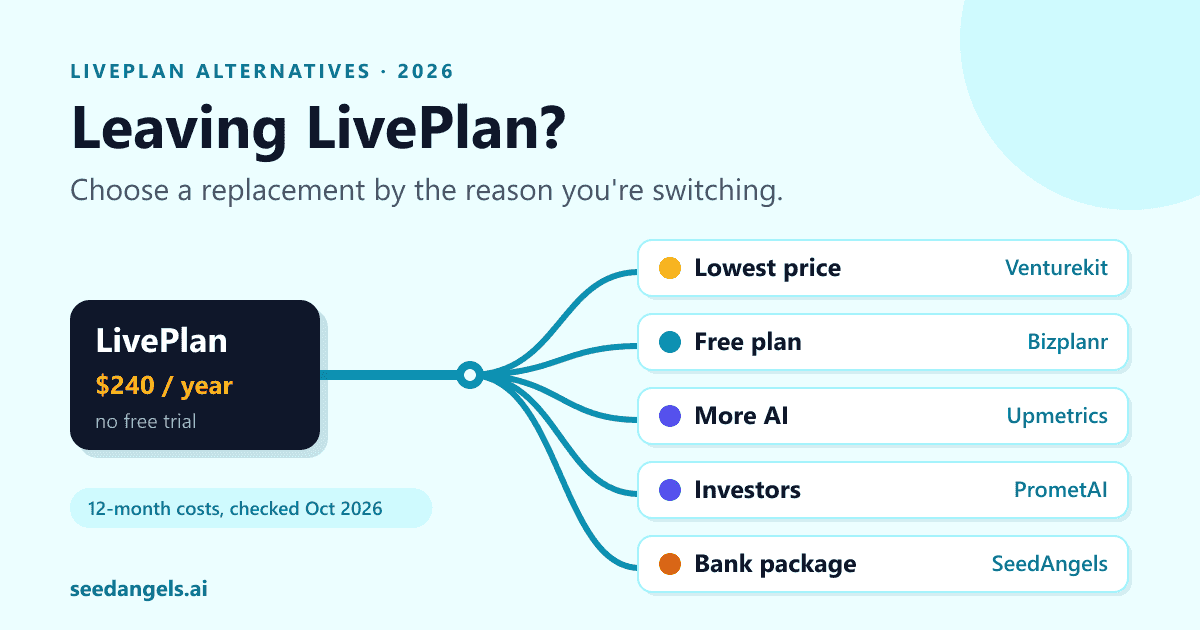
- An ongoing planning tool you'll keep updating → Upmetrics, or LivePlan for deeper financials.
The table below compares all 10 tools; the detailed reviews follow.
Quick comparison
Pricing changes often and several tools gate their prices behind signup: verify current pricing on each tool's site before relying on it.
| Tool | Best for | Pricing model | Financials approach |
|---|---|---|---|
| SeedAngels | Fundraising / financing package, keeping control of numbers | Free tier + paid (€90 one-time) | AI assistant + a real business-plan tool |
| Upmetrics | Structured, ongoing business planning | Subscription | AI suggests line items; you enter your assumptions |
| LivePlan | Mature, lender-friendly planning platform | Subscription | You build a full 3-statement model; AI assists writing |
| Venturekit | US small business + LLC formation | Free + Pro | Auto-generates full financials (incl. balance sheet) |
| 15minuteplan | A fast multilingual first draft | Paid (gated) | Generated from your inputs |
| PrometAI | A fast investor-style draft | Free tier + paid | Automated financials |
| Bizplanr | Starting free, upgrading for financials | Free + Pro | Financials on the paid tier |
| IdeaBuddy | Validating the idea before you plan | Free plan + low-cost tiers | Basic, manual |
| Canva (Magic Write) | A quick, well-designed free draft | Free (to a limit) + Canva Pro | Not a financial tool |
| ChatGPT / Claude | Exploring, brainstorming, drafting | Free / low-cost | None (invents figures unless constrained) |
The tools, one by one
1. SeedAngels: the best AI business plan generator for a plan you'll have to defend
SeedAngels is built for founders preparing a package for an investor, a bank or a grant body, and it solves the problem this whole comparison keeps coming back to: the AI does the work, but it never invents your numbers. You describe your idea, validate a Lean Canvas, then validate your own three-year revenue assumptions. Only then does SeedAngels write your business plan and your pitch deck, both from a single data source.
What the AI does for you, and what it never does:
- It researches and writes. Market size (TAM, SAM, SOM), competitors, personas, acquisition strategy, team, strengths and weaknesses: every section is written for you, and no statistic appears unless it comes from your forecast or from a listed source.
- It never sets your revenue. Your forecast is built from the prices and volumes you enter and validate, so every figure in the plan is one you can explain.
- It keeps everything consistent. The plan, the deck and the financial statements share one forecast: a number changed once is changed everywhere.
- It prepares you for the questions. Your dashboard shows what an investor or a banker checks first: implied valuation range, funding need, breakeven and gross margin.
- Best for: founders 0–12 months from a raise or a bank application who want a complete, credible package.
- Not for you if: you just want a quick draft nobody will scrutinise: a free general-purpose tool is enough.
- Pricing: €90 one-time, no subscription. Generating the full package is free; you only pay to unlock the market analysis and download your documents.
- Official site: seedangels.ai
Preparing a plan you'll have to defend in front of a bank or investor? That's exactly what SeedAngels is built for. Onboarding, your Lean Canvas and your forecast are free; you only pay the €90 one-time when you export the final documents. Build your package →
2. Upmetrics: best for structured, ongoing planning
The most credible dedicated competitor in this list. Upmetrics is built around a guided planning workflow: structured prompts, AI writing assistance, financial forecasting, and tools to refine and present. It positions itself for people who'll keep using the plan as a living document rather than producing it once. It is also the closest like-for-like replacement for LivePlan, down to tracking your plan against actuals from QuickBooks or Xero, which is why it ranks among the strongest options in our guide to LivePlan alternatives.
- Best for: founders and small teams who want an ongoing planning platform, not a one-shot document.
- Watch for: it's a subscription. Its AI suggests revenue streams and expense lines, but you enter the prices and volumes yourself.
- Pricing: from $14/month billed annually (more on monthly billing), with a 15-day money-back guarantee; checked October 2, 2026.
- Official site: upmetrics.co
3. LivePlan: best for a mature, lender-friendly planning platform
The veteran of the category (Palo Alto Software). LivePlan is a planning platform first and an AI tool second: its "LivePlan Assistant" adds AI writing on top of a full three-statement financial model (P&L, balance sheet, cash flow), 550+ sample plans, a pitch presentation generator and QuickBooks/Xero sync, rather than generating everything in one shot. Crucially, you build the financial model from your own inputs; the AI helps with the prose, not with inventing your revenue, which is the discipline this article keeps coming back to (the Premium plan now adds an AI forecast builder, so the same caution applies there).
- Best for: founders who want a deep, lender-friendly tool and don't mind a subscription and a bit of a learning curve.
- Watch for: it's subscription-based and US-oriented, and it's a full platform rather than a two-minute generator: more setup than the fast tools.
- Pricing: from $15–20/month (annual/monthly), Premium at $30–40/month; 35-day money-back guarantee, no free trial.
- Official site: liveplan.com
4. Venturekit: best for US small business + LLC formation
Venturekit bundles plan generation with US business formation (LLC filing, EIN, registered agent, compliance). It auto-generates a complete financial forecast (revenue, P&L, and balance sheet) and offers a pitch deck. It's clearly built for the US market.
- Best for: US-based small business owners who also want the legal/formation paperwork handled in one place.
- Watch for: it auto-generates your full financials, including revenue. Convenient for a draft; risky for a file you'll have to defend. Marketing claims like "3× more likely to get a loan" and "$350M raised by customers" are the company's own figures, to be treated as marketing, not verified benchmarks.
- Pricing: free plan (3 full business plans a month); Pro at $8/month billed annually. Checked October 2, 2026.
- Official site: venturekit.ai
5. 15minuteplan: best for a fast, multilingual first draft
A speed-first tool built on GPT-3.5/4. Its genuine strength is language coverage: it generates in many languages including French, Dutch, German, Spanish and Italian, which matters if you're not writing in English. It describes itself as "SBA-approved" and following bank templates; that's the company's own characterisation, so verify it against your specific lender's requirements.
- Best for: a quick, presentable first draft, especially in a non-English language.
- Watch for: speed is the pitch, which means the financials are generated for you: same caution as the others. Pricing isn't shown upfront (gated behind the form).
- Official site: 15minuteplan.ai
6. PrometAI: best for a fast investor-style draft
PrometAI promises "idea to investor-ready in two minutes," with automated financials, industry benchmarks and a free tier. Polished output, very fast.
- Best for: getting a structured, investor-styled draft on the page quickly to react to.
- Watch for: "investor-ready in two minutes" is exactly the framing to be careful with: a two-minute financial model is a generated one, not a defensible one.
- Pricing: free tier, then $55/month (about $25/month billed annually); DCF valuation is only included at $145/month (about $65/month billed annually). Checked October 2, 2026.
- Official site: prometai.app
7. Bizplanr: best for starting free
A free AI generator that produces a full narrative draft (market analysis, strategy, basic financials), then gates richer financials, visuals and investor-ready output behind a Pro tier.
- Best for: founders who want to start free and see a complete draft before paying.
- Watch for: the free draft's financials are AI-generated; the useful financial depth is on the paid tier.
- Pricing: free (download your plan as a PDF); the paid tier is "Upmetrics AI" at $14/month, so upgrading effectively moves you to Upmetrics. Checked October 2, 2026.
- Official site: bizplanr.ai
8. IdeaBuddy: best for validating the idea first
IdeaBuddy is built for the stage before the business plan: it turns a raw idea into a validated concept with a step-by-step "Idea Plan," market-potential and risk scoring, and only then a lightweight plan with basic financials. Its AI writing help is lighter than the dedicated generators: the point is to slow you down and pressure-test the idea, not to spit out a document.
- Best for: first-time founders and students still testing whether the idea is worth pursuing.
- Watch for: the financial projections are basic: you'll outgrow it the moment your plan has to stand up to a bank or investor, so treat it as a first step, not the final file.
- Pricing: genuine free plan plus low-cost paid tiers.
- Official site: ideabuddy.com
9. Canva (Magic Write): best for a quick, well-designed free draft
Canva's Magic Write (powered by OpenAI) drafts business plan sections inside Canva Docs, with the design tools you'd expect from Canva and export to PDF or DOCX. It's a general-purpose writing/design tool, not a fundraising tool.
- Best for: a fast, good-looking draft, or anyone already living in Canva.
- Not for you if: you need a real financial framework: Canva doesn't build a consistent P&L, cash flow and balance sheet.
- Pricing: free up to a usage limit; more with Canva Pro.
- Official site: canva.com
10. ChatGPT / Claude: best for exploring and drafting
General-purpose models are the cheapest, most flexible option for structuring your thinking, brainstorming competitors and channels, and drafting sections. They're also where the financial-hallucination problem is sharpest, because nothing constrains the output.
If you use ChatGPT or Claude for this, a few rules make the difference between usable and dangerous:
- Set context before asking for a deliverable (industry, geography, business model, stage): a bare "write me a business plan for a restaurant" produces generic filler.
- Ask for assumptions before numbers. "List the assumptions needed to estimate year-1 revenue" gives you a grid to fill in yourself, so the numbers become yours.
- Work section by section, validating each before moving on.
- Ask for sources and challenge them: "is this a verified figure or your estimate?" When it says "estimate," you know to confirm it (IBISWorld, Statista, census data, industry bodies).
- Never let the AI decide your revenue. That number is your commitment; the model can help you frame it but must never set it.
- Best for: the exploration and drafting phase.
- Not for you if: you need consistency across sections, real formatting, or a defensible financial model: that's where you move to a dedicated tool.
- Official sites: chatgpt.com · claude.ai
The problem almost every generator shares: the numbers
This is the dimension that separates a draft from a document you can defend, and it's where most tools in this list make the same choice.
Language models don't calculate your numbers, they generate them. Ask "what's the average first-year revenue of a 60-seat restaurant in Chicago" and the model returns a plausible value, one that resembles what business plans usually contain, without checking that it's right for your case. That's a hallucination: an invented number that looks credible.
Why it's dangerous specifically in a business plan:
- It's undetectable on the page. An experienced loan officer or investor spots numbers that don't hang together. You, not being a specialist, take them at face value.
- It propagates. One hallucinated revenue figure contaminates the margin, the cash flow, the funding need. The whole forecast becomes fiction.
- It sinks you in conversation. Present financial assumptions you can't defend (because an AI produced them) and two questions is all it takes to expose it.
Look back at the comparison through this lens and the tools split into two groups. Most (Venturekit, PrometAI, Bizplanr, 15minuteplan) auto-generate your financials, revenue included: fast and convenient, but it hands the most scrutinised part of your plan to a model that's guessing. The alternative is a tool that makes you set your own revenue, like SeedAngels or Upmetrics, and constrains the AI to the supporting work. That's the design choice behind SeedAngels, and it's the reason this whole section exists: not because generating financials is hard, but because generating them for you is the wrong thing to automate.
Whatever tool you pick, keep three habits:
- Have your numbers validated by an accountant or a financial mentor. An hour of review often secures a forecast. Our guide to projected financial statements covers what to check first: the three statements and the assumptions that connect them.
- Stress-test market research against the field. No AI can interview your future customers. A few prospect conversations and a couple of letters of intent are worth more than any generated market analysis. Our protocol for validating a business idea sets the threshold to clear at each stage, so you know when those conversations are enough.
- Have someone who doesn't know your project read the whole thing. If they can't grasp what you do and why it's viable in a few minutes, it's not ready: that's the exact filter your banker will apply. Our complete guide to writing a business plan sets out the structure that reader expects.
How to choose the right one for you
A short decision guide:
- You want a free draft to react to, fast → Canva or ChatGPT. Don't pay for a first pass.
- You're not writing in English → 15minuteplan's language coverage is a real advantage.
- You're still validating whether the idea is worth pursuing → IdeaBuddy, before you write a full plan.
- You're a US small business also needing LLC formation → Venturekit bundles it.
- You want an ongoing planning platform you'll keep using → Upmetrics, or LivePlan for deeper financials.
- You're preparing a package for a bank or investor and need to defend every number → a tool that keeps you in control of revenue. That's what SeedAngels is built for: one-time, no subscription, AI kept off your revenue line. Note that a plan going to investors rarely travels alone: it comes with a deck, and our guides to the investor pitch deck and to how fundraising actually works cover what has to line up around it.
The honest summary: for a quick draft, almost any of these works and the free ones are fine. The moment your plan has to survive a financially literate reader, the question stops being "which writes the nicest draft" and becomes "which one doesn't invent the numbers I'll have to defend." That's the whole game.
Frequently asked questions
What is the best AI business plan generator?
For a plan that will be read by a bank or investors, SeedAngels: it writes the whole package (business plan, pitch deck, forecast) but builds every figure from your own assumptions, so you can defend it, for €90 one-time. For other uses, free tools like Canva or ChatGPT are enough for a fast draft, and Upmetrics suits ongoing structured planning. The real differentiator isn't speed or price; it's how each tool handles the numbers.
Can AI write a business plan?
Yes, AI can write most of a business plan: the executive summary, market analysis, competition, marketing strategy and business model sections are well within what current tools do. What it cannot do reliably is produce the financial forecast on its own: a language model generates plausible-looking revenue figures rather than calculating them from your assumptions. Let AI draft the text, and keep the numbers based on your own hypotheses (prices, volumes, costs) so you can defend them.
Are AI-generated business plans any good?
The narrative sections (summary, market, competition, business model) are genuinely good with any capable tool. The weak point across almost every generator is the financials: most tools auto-generate revenue projections, and a language model doesn't calculate those numbers, it invents plausible-looking ones. That's fine for a first draft and dangerous for a document going in front of a bank or investor, where you have to defend every figure.
Will banks and investors accept an AI-generated business plan?
Whether a plan was written with AI or not doesn't matter to them. What matters is whether the document is consistent and whether you can defend your assumptions. A plan disqualifies itself through inconsistent numbers and indefensible projections, and tools that auto-generate your revenue produce exactly those. Accept AI help on structure and writing; keep control of the numbers.
What's the difference between a free AI generator and a paid one?
Most free generators give you a narrative draft and gate the financials, export, or editing behind a paid tier. Pricing models vary widely: some are monthly subscriptions ($15–55/month is common), a few offer one-time purchases. Over a year, a subscription you only need once can cost more than a one-time tool. Always compare total cost for how long you'll actually use it, not the sticker price.
Can you just use ChatGPT to write a business plan?
Yes, and for exploring and drafting it's excellent and cheap. Its limits are structural: no consistency across sections when you change a number, no usable formatting, and no reliable financial framework. It also invents figures unless you feed and constrain it carefully. Use ChatGPT to think and draft; use a dedicated tool to firm up the final package.
SeedAngels is a funding preparation platform that generates a Business Plan, Pitch Deck and financial projections from your project data, with AI deliberately kept off your revenue assumptions to avoid hallucinated numbers. €90 one-time, no subscription. Create your package →