Introduction: the right choice depends on your stage
Choosing a business plan software only makes sense in relation to what you plan to do with it. Preparing a loan application, raising capital from investors, validating the viability of your project before launching it: these are three different uses, and no single tool covers them all perfectly.
This comparison features the best business plan software and business planning tools available in 2026 for English-speaking entrepreneurs, free, AI-assisted, or paid. For each tool you'll find its positioning, strengths, limits and verified price. The goal: help you pick the right tool for your situation, without spending hours testing every option.
Business planning software comparison table
| Criterion | SeedAngels | LivePlan | Upmetrics | IdeaBuddy |
|---|---|---|---|---|
| Complete business plan | Yes | Yes | Yes | Yes |
| Investor pitch deck | Yes | Yes | Yes | Light |
| AI-assisted forecast | Yes | Yes | Yes | Limited |
| BP + Pitch synchronized | Yes | Yes | Yes | No |
| AI writing assistance | Yes | Yes | Yes | Limited |
| Free version | Limited | No | No | Limited |
| Entry price | €90 one-time | $20/mo | $14/mo | $12/mo |
Entry prices aren't all on the same basis: a one-time purchase for SeedAngels, a monthly subscription for LivePlan, an annually billed subscription for Upmetrics, a free plan plus low-cost tiers for IdeaBuddy. See each review for the detail.
Four tools aren't enough to represent the whole market: Bizplan, Enloop, PlanGuru and ProjectionHub round out the picture in the detailed reviews below.
The 8 business plan software in detail
1. SeedAngels: our top pick for a bank or investor package
Positioning: the business plan software built for one job: getting your project financed. Bank loan, investor round or grant application, SeedAngels produces the complete package (business plan, pitch deck and financial forecast) from your own project data. Co-founded by a former M&A director and business angel, it is designed around what the people reading your plan actually check.
Why it's our top pick:
- No blank page. The whole plan is written for you from what you validated: executive summary, market analysis with TAM, SAM and SOM, personas and competitors, acquisition strategy, team, strengths and weaknesses.
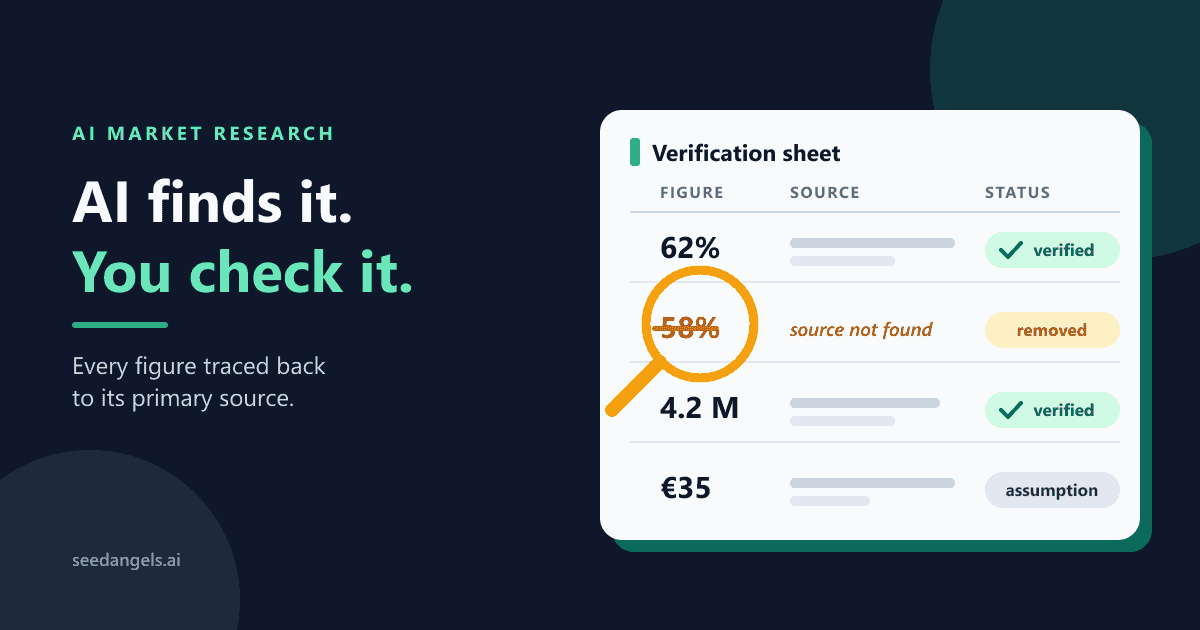
- Your numbers, not the AI's. You set and validate your own revenue assumptions; the AI writes the text but never invents a figure.
- Everything stays in sync. P&L, balance sheet, cash flow, financing plan and cap table feed the plan and the deck: change a number once and every document follows.
- Investor-ready from day one. The deck includes a valuation slide, and your dashboard shows what an investor checks first: implied valuation range, funding need, breakeven and gross margin.
- One price, once. €90, no subscription. Onboarding, validation and forecast input are free.
Limits: no day-to-day operational tracking (budget vs actual).
Best for: anyone who needs a credible business plan without spending weeks on it, whether it's a bank application or a fundraising round.
Price: €90, one-time purchase. Creation, validation and forecast input are free. Document download and market analysis are paid.
Official site: seedangels.ai
2. LivePlan
Positioning: the global reference for comprehensive business planning (Palo Alto Software).
Strengths:
- 550+ sample business plans across industries.
- Full 3-statement financial model (P&L, balance sheet, cash flow).
- AI writing assistant.
- Pitch presentation generator.
- QuickBooks Online and Xero sync, from the Standard plan.
- 35-day money-back guarantee.
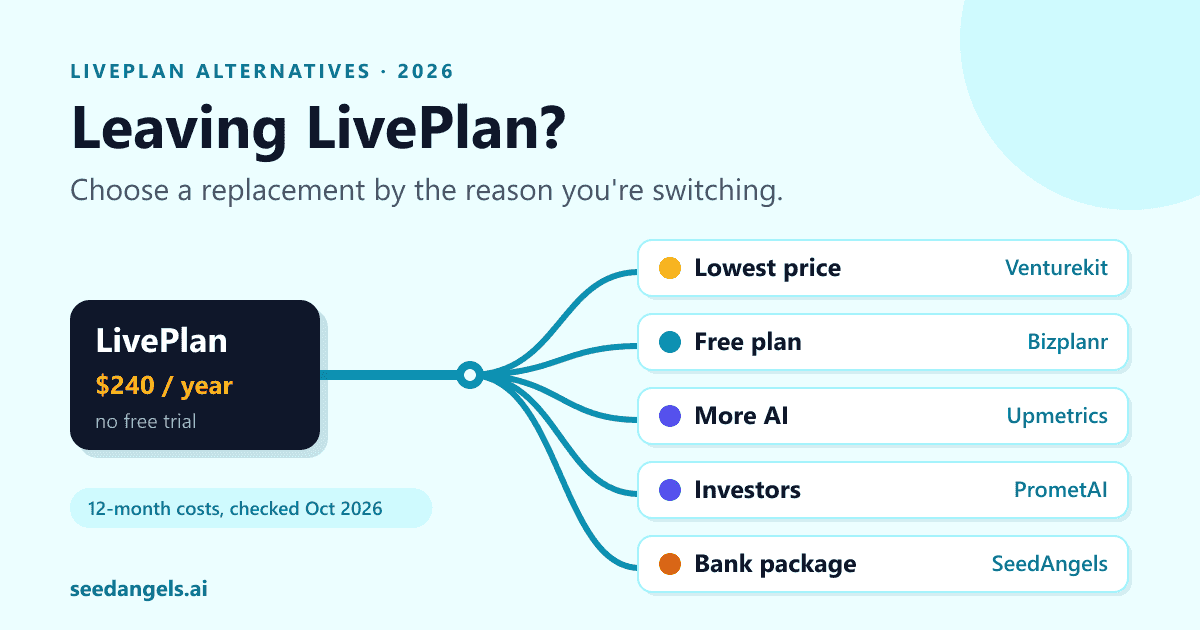
Limits: no free tier and no free trial; subscription pricing adds up over time; primarily oriented toward US audiences. If those limits are why you're looking elsewhere, our guide to LivePlan alternatives picks a replacement by reason for switching, with 12-month costs compared.
Best for: founders who want a mature, lender-friendly tool with deep financial features.
Price: from $20/month (Standard, billed monthly), $15/month if billed annually; Premium at $40/month ($30 annual).
Official site: liveplan.com
3. Upmetrics
Positioning: the most-cited LivePlan alternative, AI-assisted, collaborative, and more affordable.
Strengths:
- AI writing on all plans.
- Pitch deck builder.
- Multi-year financial forecasts.
- Real-time team collaboration.
- Plan-vs-actual tracking with QuickBooks or Xero (read-only sync).
- 400+ templates across industries.
- 15-day money-back guarantee.
Limits: English-only interface; some advanced features locked to higher tiers.
Best for: startups, teams and consultants working on plans together.
Price: from $14/month (billed annually; more on monthly billing); 15-day money-back guarantee.
Official site: upmetrics.co
4. Bizplan
Positioning: drag-and-drop plan builder, part of the Startups.com ecosystem.
Strengths:
- Visually clean step-by-step builder.
- Integration with Fundable for investor outreach.
- Templates and expert advice via Startups.com membership.
- Friendly UX for non-financial founders.
Limits: fewer tech-driven features than LivePlan; less depth in financial modeling.
Best for: founders focused on a clean investor-ready document and access to a fundraising network.
Price: from $20.75/month (billed annually).
Official site: bizplan.com
5. Enloop
Positioning: automated business plan writer that scores your plan for viability.
Strengths:
- Auto-writes and auto-scores your plan as you input data.
- Real-time viability score gives instant feedback.
- Financial projections generated automatically.
- 7-day free trial.
Limits: less hands-on customization than LivePlan or Upmetrics; less suited for highly unconventional businesses. As of October 2, 2026, Enloop's pricing page states it is "not currently accepting new registrations", so new users may not be able to sign up.
Best for: non-technical users who want a quick automated draft with a viability check.
Price: Detailed plan at $19.95/month ($11/month billed annually), Performance at $39.95/month ($24/month billed annually); 7-day free trial.
Official site: enloop.com
6. IdeaBuddy
Positioning: step-by-step business planner built for the idea and validation stage.
Strengths:
- Educational approach that slows you down to validate assumptions before writing.
- Market potential and risk scoring.
- Affordable pricing tiers.
- Genuine free plan available.
- 15-day free trial on paid plans.
Limits: financial projections are basic; you'll outgrow it once the idea is mature; one project per user on entry plans.
Best for: first-time founders and students still testing whether their idea is worth pursuing.
Price: free plan plus low-cost paid tiers.
Official site: ideabuddy.com
7. PlanGuru
Positioning: advanced financial planning and budgeting software, built for serious forecasts.
Strengths:
- Deep budgeting, rolling forecasts, multi-year scenarios.
- Built for accountants and FP&A teams.
- QuickBooks and Xero integrations.
- Strong analytics and KPI dashboards.
Limits: not a "plan writer": it's a financial modeling tool, so you'll pair it with another tool for the narrative; steeper learning curve.
Best for: businesses past the ideation stage that need real financial planning depth, or professionals preparing investor-grade projections.
Price: subscription-based, higher than entry-level tools.
Official site: planguru.com
8. ProjectionHub
Positioning: specialized financial projection tool tailored for SBA-compliant business plans.
Strengths:
- Built specifically for SBA loan applications.
- Industry-specific templates with embedded benchmarks.
- 3- to 5-year financial projections out of the box.
- Lender-friendly output formatting.
Limits: narrow scope (financial projections, not full plan narrative); US-centric.
Best for: US founders applying for an SBA loan who need lender-ready projections fast.
Price: subscription and one-time-purchase templates available.
Official site: projectionhub.com
Is there free business plan software?
Yes, but with caveats. IdeaBuddy offers a genuine free plan that's well-suited to the idea-validation stage. Most other quality tools (LivePlan, Upmetrics, Bizplan, Enloop) rely on free trials or money-back guarantees rather than a permanent free tier.
For US-based founders applying for SBA loans, SCORE (a nonprofit partner of the U.S. Small Business Administration) offers free business plan templates and free mentor support, though it's a template library rather than a planning tool. The SBA's own website also publishes free templates and guidance.
On the AI-assisted side, SeedAngels' onboarding, validation and forecast input are free; only unlocking the final documents is paid (€90, one-time). A reasonable approach: start free to clarify your project, then invest once the file is serious and needs to be presented to a third party.
You can also browse our library of free business plan templates to download and get started outside of any software.
How to choose your business plan software
Is software mandatory?
No, you're not legally required to use it. But a business plan is essential as soon as you apply for a loan, a grant, or external investment, and strongly recommended even without external financing, just to pressure-test the viability of your project. Software saves you time, prevents calculation errors, and ensures the right format for your audience.
Free or paid?
Free tools (IdeaBuddy's free plan, SCORE templates) are perfect for a first draft. For a document destined for investors or a demanding lender, a paid tool brings financial precision, credible presentation and, for the best ones, a pitch deck ready to present. Whichever you pick, the tool never replaces the thinking behind the numbers: our guide to projected financial statements covers the three statements and how your assumptions connect them.
What's the difference between a business plan and a pitch deck?
The business plan is the detailed document (15–30 pages) that demonstrates the viability of the project: market, model, team, financials, funding.
The pitch deck is the synthetic presentation (10–15 slides) that captures an investor's attention in a few minutes.
Both should tell the same story with the same numbers, which is why tools that keep them automatically synchronized have an edge.
Should you use ChatGPT instead?
ChatGPT and Claude are excellent for drafting and structuring, but they will invent financial numbers if you let them. Use them for prose, never for financial assumptions. Dedicated software keeps you in control of the numbers. If you specifically want AI generators, see our dedicated comparison of AI business plan generators, and its warning on hallucinated financials, before you commit to one.
Conclusion: the right tool for your need
If your plan has to convince a banker or an investor, SeedAngels is the software we recommend: it writes the complete package (plan, deck and forecast) from your own numbers, keeps the three in sync, and costs €90 once instead of a yearly subscription. For other needs, the choice depends on your stage and your goal:
- You want to start for free → IdeaBuddy's free plan or SCORE templates.
- You're preparing a credible bank application → SeedAngels, and check your numbers against the five ratios lenders run on a financial forecast.
- You're preparing a fundraising round → SeedAngels.
- You want deep financial modeling → LivePlan or PlanGuru.
- You're working with a team → Upmetrics or Bizplan.
- You need SBA-compliant projections → ProjectionHub.
- You're still validating the idea → IdeaBuddy.
Whatever tool you land on, the deciding factor stays the same: a tool speeds up the formatting, never the thinking. The software that suits you is the one whose assumptions you can still defend, line by line, in front of the person reading your file.
Frequently asked questions
What is the best business plan software in 2026?
For a plan that has to convince a bank or investors, SeedAngels: it writes the complete business plan and pitch deck from your own numbers, keeps them in sync and costs €90 one-time. Other tools win on narrower needs: LivePlan or PlanGuru for deep financial modeling, IdeaBuddy for idea validation, Upmetrics for real-time team collaboration, ProjectionHub for SBA-style projections.
Is there free business plan software?
Yes, with caveats. IdeaBuddy offers a genuine free plan suited to the idea-validation stage. Most other quality tools (LivePlan, Upmetrics, Bizplan, Enloop) rely on free trials or money-back guarantees rather than a permanent free tier. SCORE, a nonprofit partner of the U.S. Small Business Administration, provides free business plan templates and mentor support. On the AI-assisted side, SeedAngels offers free onboarding, validation and forecast input; only unlocking the final documents is paid (€90, one-time).
Is business plan software mandatory?
No, you're not legally required to use it. But a business plan is essential for securing a loan, convincing investors, or pressure-testing your project before committing your savings. Dedicated software saves you time, prevents calculation errors, and ensures your document follows the format your audience expects.
What's the difference between a business plan and a pitch deck?
The business plan is the detailed document (15–30 pages) that demonstrates the viability of the project. The pitch deck is the synthetic presentation (10–15 slides) that captures investor attention. Both should tell the same story with the same numbers, which is why tools that keep them synchronized have an edge.
How much does business plan software cost?
Prices range from $0 (IdeaBuddy free plan, SCORE templates) to roughly $20–$40/month for premium tools like LivePlan or Bizplan. One-time purchase models hover around €90 (SeedAngels). Compare that to the $1,000–$5,000 a consultant or accountant typically charges for a full business plan. We detail those quotes, and why they vary so widely, in our guide to what a financial forecast costs.
SeedAngels is a fundraising-prep platform that generates Business Plan, Pitch Deck and financial forecast from your project data, with AI deliberately constrained on the numbers to avoid hallucinations. €90, one-time purchase. Create your file in a few clicks →