An investor takes less than 3 minutes on average to form a first impression of a Business Plan. Three minutes to decide whether to keep reading, or move on to the next file.
The problem is that the same mistakes come up in the vast majority of submissions. Not formatting mistakes. Not spelling errors. Fundamental errors in financial construction and strategic reasoning that immediately signal a lack of preparation.
After several years analyzing Business Plans from both the investor and entrepreneur side, we've identified 5 recurring mistakes, ones that, on their own, are enough to disqualify a submission. This finding aligns with the SBA's guide to writing a Business Plan, which emphasizes that forecast rigor is a primary criterion for evaluating a funding application.
This guide shows you what to avoid, why these mistakes are deal-breakers, and how to build a Business Plan that withstands scrutiny from demanding financiers.
1. Unjustified Growth Forecasts
This is the most common mistake. And often, the most critical.
What to avoid:
- "We talked to other founders who told us what they achieved."
- "We did some research on the internet."
- "We started with the expenses we want to make and added revenue to cover them."
These statements are immediate red flags. Not because the numbers are wrong, nobody knows what reality will look like, but because they reveal an absence of structured reasoning behind the assumptions.
What the investor actually evaluates: they don't judge the number. They judge the reasoning behind the number. It's the construction logic that creates conviction, not the promise of a result.
How to justify growth forecasts at launch
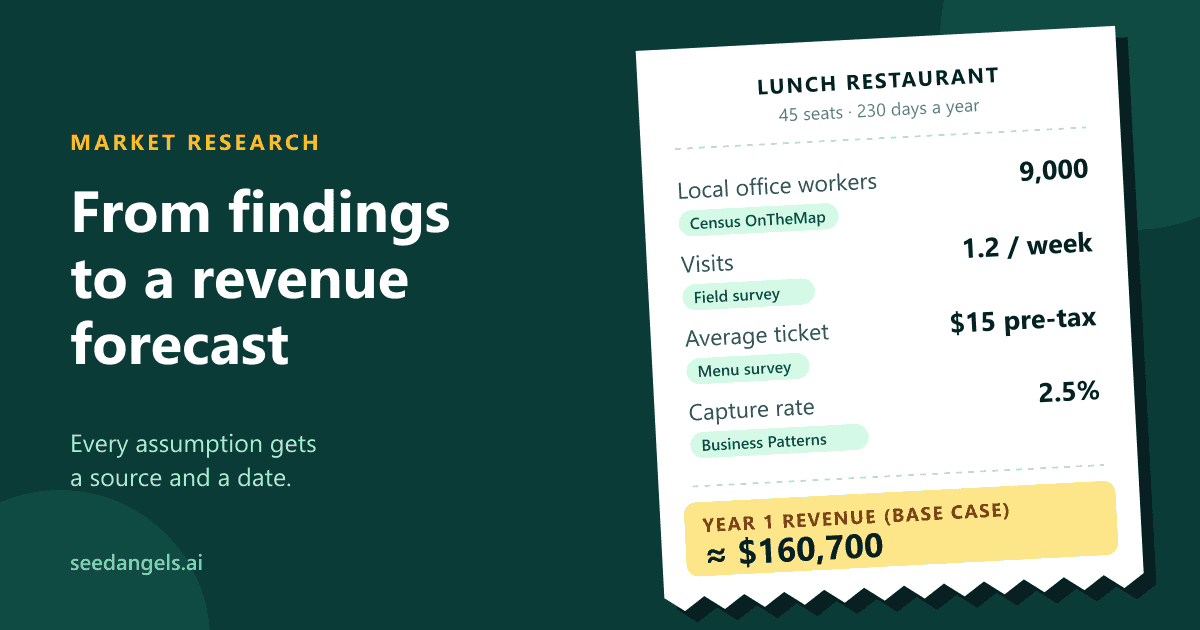
Your revenue assumptions must be directly linked to your acquisition strategy and the resources you're dedicating to it. To dive deeper into building your financial assumptions, see our complete financial forecasting guide. As soon as you have your first customers, the strongest reasoning is to ground your growth in real metrics (conversion rate, acquisition cost, observed retention) rather than in an annual growth percentage. Even before your first customers, the method is to build revenue from volumes (capacity, fill rate, average basket) because those three variables, not the total, are what an experienced reader tests one by one.
A concrete example: a company announcing significant sales volume in the first few weeks with SEO as its only strategy isn't credible. Organic search takes months to produce results. However, a substantial paid acquisition budget can explain a fast start, provided the acquisition cost is modeled. The strongest justification predates the document itself: a handful of pre-orders or letters of intent secured while validating the idea in the field turn month one from an assumption into an order book.
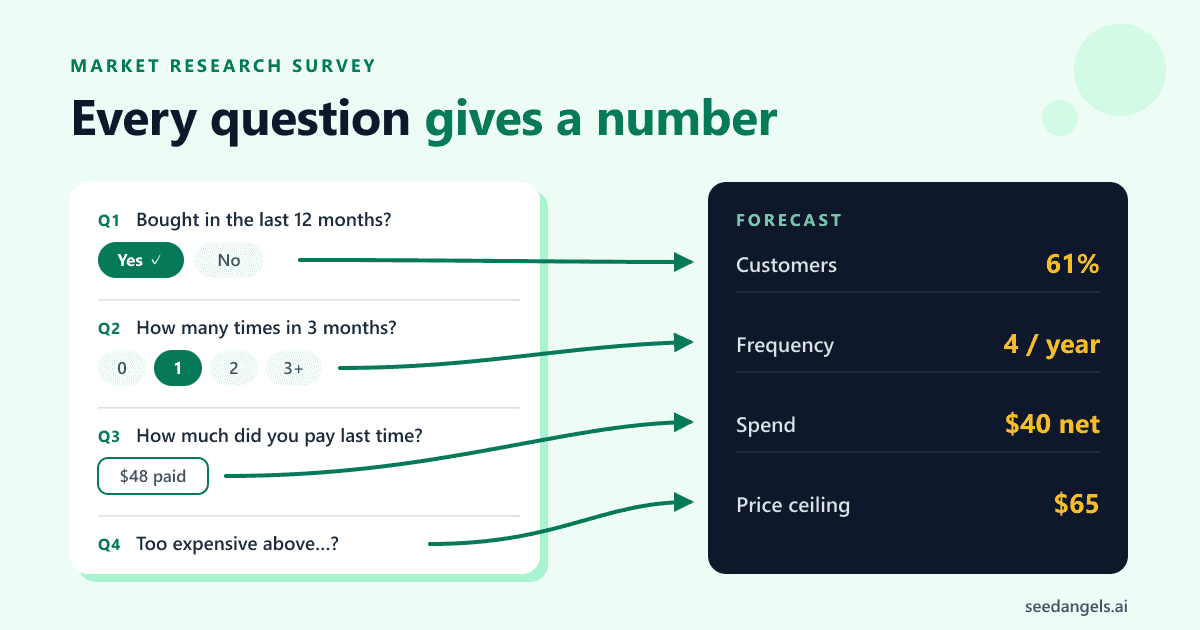
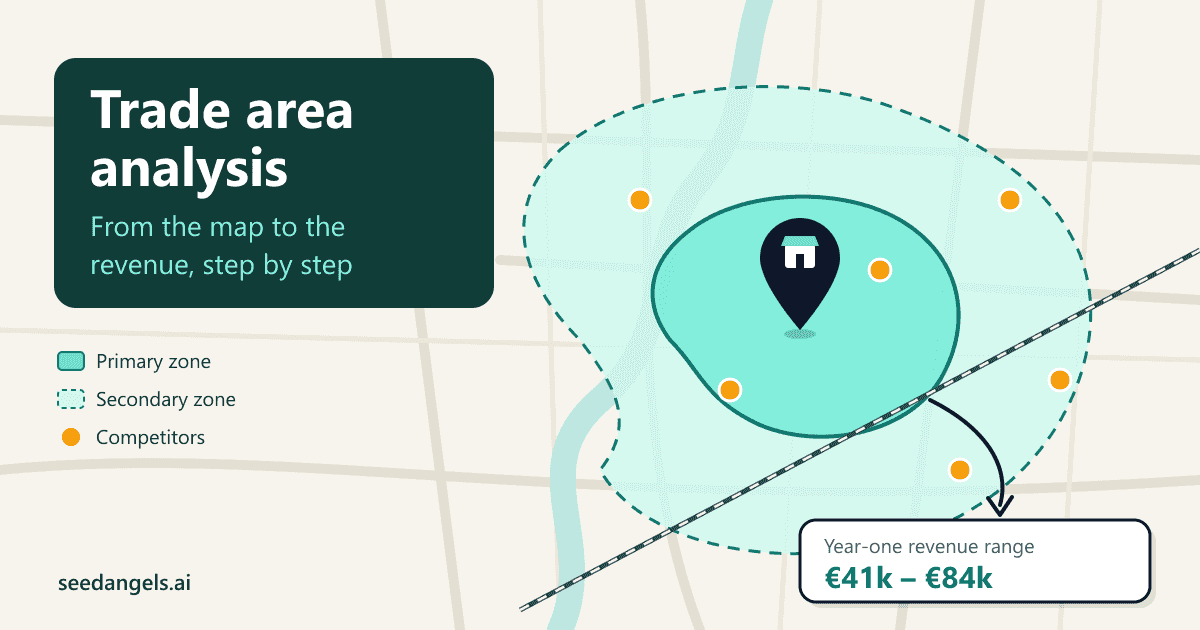
Your forecasts should also reflect your level of differentiation from the competition. A truly disruptive service can justify faster market penetration. An aggressive pricing strategy, like what Free did when entering the French broadband market, can also explain it. But in both cases, the reasoning must be explicit, and it rests on observed data: a quantified competitive analysis (prices charged, lead times, slots nobody covers) turns "we are differentiated" into a measurable gap that justifies your pace of customer acquisition.
What about after the first years?
Beyond the launch phase, other parameters come into play. The growth of your reference market, for instance: a savvy investor will verify this data and seek to understand whether you're outperforming your market, and if so, why and how.
Macroeconomic factors also matter. Some premium-positioned sectors suffer when purchasing power drops or unemployment rises. This data is public and accessible, the Bureau of Labor Statistics and the U.S. Census Bureau publish sector-level economic indicators, for example. Integrating this data and its sources into your narrative will give substance and credibility to your forecast.
2. An Inconsistent Margin Rate
Second classic mistake: presenting a constant margin rate over the entire Business Plan, or worse, a rate copied from an industry study without understanding its components.
What we see far too often:
- "We projected a constant margin rate from year 2 onward."
- "According to our research, our competitors achieve X% margin on this service."
The issue isn't having a high or low margin rate. The issue is not being able to explain it.
Why it's a deal-breaker
The overall margin rate directly influences your break-even point. And break-even is one of the first metrics a banker or investor will examine during a fundraise. If your margin is poorly constructed, the entire forecast falls apart.
How to build a credible margin
You must be able to detail your unit margin per product or service. Concretely, this means identifying the most significant costs for each offering and checking their behavior: does a cost category increase as volumes increase? If so, even if that cost is shared across multiple products, a portion must be allocated to each product's margin.
Don't forget the optimization effects that occur over time: economies of scale on purchases, process optimization, transitioning from leasing to purchasing equipment once initial validations are complete.
The mix effect: the classic trap
Your different products probably won't follow the same growth trajectory. If they have different margins, each one's contribution to overall revenue will evolve, and with it, your overall margin.
Take a simple case: two products A and B, each representing 50% of sales. A has a 10% margin, B has a 20% margin. Your overall margin is 15%. Now, if A outperforms and rises to 75% of the mix, the overall margin drops to 12.5%. Without any change in cost structure, your profitability has declined.
Maintaining a constant margin rate without considering product mix evolution is one of the most common traps, and one of the most easily detected by an experienced investor.
3. Fixed Costs That Never Change
Third mistake: presenting perfectly stable fixed costs over 3 to 5 years, as if company growth had no impact on the cost structure.
What we see far too often:
- "Our personnel costs remain stable throughout the Business Plan."
This is one of the clear signs of a theoretical Business Plan, disconnected from operational reality.
Threshold effects
Take a concrete case. You start in offices that accommodate 10 people. Business grows faster than expected. Very quickly, you need to hire technical support, customer service, maybe an additional salesperson. Your offices are no longer sufficient.
These thresholds are predictable. They're not a surprise, except when you've built your Business Plan in a rush.
Fixed costs evolve in steps: hiring a new team member, moving to larger offices, investing in new tools. Not modeling them means presenting a scenario that will quickly appear unrealistic.
The exercise is to identify the activity thresholds at which new costs become necessary, and to integrate them into the financial forecast at the right time.
4. A Funding Need Estimated by Guesswork
Fourth mistake, and the one that can have the most direct consequences during a fundraise: not knowing precisely how much you need to raise, and why.
What we see far too often:
- "We've planned for 30% overflow beyond the need, just in case…"
- "Tell me how much you're willing to invest, and I can design a roadmap accordingly."
The first statement reveals an approximate estimate. The second is even worse: it tells the investor you don't have a plan, that you'll adapt to whatever you're given.
Why it's an immediate red flag
An amount estimated without rigorous methodology indicates a lack of financial mastery, and immediately raises the question of your management ability and the trust an investor can place in you. And if you don't master your funding needs, why would an investor entrust you with their money? The same problem replays identically on the document investors read first: a vague ask is one of the equivalent mistakes in a pitch deck, with the same consequences. Remember that the size of your fundraise will influence your final dilution, and therefore implicitly the negotiation of your articles of association and shareholders' agreement.
The right methodology: the cash flow statement
The only reliable way to determine your funding need is to build a month-by-month cash flow statement. Not a back-of-the-envelope calculation, a detailed cash forecast that tells you concretely, each month, how much you need, how much cash your business generates or consumes.
Key elements to consider:
Initial investments. They don't appear in your income statement (they're on the balance sheet), but they consume cash: website, machinery, equipment, software. They must be integrated separately into your cash flow plan.
Cash consumption in the first months. Until your business generates cash, your operational losses drain the treasury. This "burn" must be funded, and therefore must be planned.
Existing loan repayments. Only interest appears in the income statement. The principal repaid is a cash flow that reduces your availability.
Working capital requirements (WCR) and their evolution. The more your business grows, the more your WCR increases. This is a real funding need that many Business Plans ignore, sometimes with critical consequences for cash flow. The SBA's guide to managing cash flow details the methodology if you want to explore this further.
If your file is headed to a bank rather than to investors, this cash flow statement is the document the analyst opens first, and a single negative month in year one is enough to sink the application. Check your numbers against the five ratios lenders run on a financial forecast before you send anything.
5. A Business Plan Frozen in Time
Last mistake, and not the least: treating your Business Plan as a document you produce once, then file away in a drawer.
What we see far too often:
- "This was the forecast established when we started the raise a few months ago."
- "We haven't had time to update it, between client meetings and investor meetings, it's been hectic."
Why it's a missed opportunity
A Business Plan that isn't updated signals a lack of rigor in running the business. But beyond the image, it's above all a wasted opportunity.
If you're in discussions with investors and your last reported period is from January while you're sharing the document in May, you're losing 4 months of real data. Four months that could show your traction, validate your assumptions, prove that your market exists.
At this stage of your company, things move too fast for your Business Plan not to move with them.
How to keep your Business Plan alive
A good Business Plan should be revised every month or at every important milestone: significant new client, model pivot, key hire, market shift. And systematically before every investor meeting.
The ideal is to have a tool that centralizes your data and automatically updates your forecast and Pitch Deck when your assumptions change. This is precisely what a platform like SeedAngels enables: all your data simultaneously feeds your Business Plan and Pitch Deck, so a single change propagates everywhere, without re-entry.
Summary: The 5 Most Costly Mistakes
| Mistake | What it signals to the investor |
|---|---|
| Unjustified growth forecasts | Lack of market mastery |
| Inconsistent margin rate | Lack of understanding of the business model |
| Fixed costs that don't evolve | Lack of mastery of cost structure |
| Approximate funding need | Lack of financial mastery |
| Frozen Business Plan | Lack of rigor in management tools |
These 5 mistakes aren't details. They're the foundations of your file. An investor who detects any one of them questions your entire project, not because your idea is bad, but because your preparation isn't up to standard.
Build a Business Plan Without These Mistakes
SeedAngels is the platform that helps entrepreneurs prepare their fundraise with a Business Plan and Pitch Deck aligned with investor expectations.
AI assists you in building your assumptions. The financial forecast includes AI-powered cost generation. And all your data automatically syncs between your Business Plan and Pitch Deck, so your file always stays up to date.
You can also start by exploring our free Business Plan templates or estimating your startup valuation with our free tool.
FAQ: Business Plan Mistakes
What are the most common mistakes in a Business Plan?
The most common mistakes are unjustified growth forecasts, a poorly constructed or constant margin rate, fixed costs that don't evolve with growth, a funding need estimated without rigorous methodology, and a Business Plan that's never updated. These are fundamental errors, not formatting issues, and they're what disqualify submissions most quickly with investors.
How do you avoid mistakes in financial forecasts?
To avoid mistakes in your financial forecast, build each assumption by linking it to verifiable reasoning: acquisition strategy, unit costs, public market data. Detail your margin by product, anticipate fixed cost thresholds, and build a month-by-month cash flow statement to determine your real funding need.
What does an investor look at first in a Business Plan?
An investor first looks at the coherence of the reasoning behind the numbers, not the numbers themselves. They verify that growth forecasts are linked to the acquisition strategy, that the margin rate is understood and detailed, and that the funding need is justified by a rigorous cash flow forecast.
Why should my Business Plan be updated regularly?
A frozen Business Plan loses credibility with every month that passes without an update. Integrating your actual results, even partial ones, validates your initial assumptions and shows investors that you're actively managing your business. It's a signal of rigor that considerably strengthens trust.
How do you calculate funding needs in a Business Plan?
The most reliable method is to build a month-by-month cash flow statement that integrates your projected revenues, operating costs, investments (which don't appear on the income statement), loan repayments, and changes in working capital requirements. The lowest point of your cumulative cash flow indicates your minimum funding need. To go further, you can also estimate your startup valuation to prepare your discussions with investors.