Why the same forecast costs $300 or $3,000
You request three quotes for the same financial forecast and get three prices that differ by a factor of ten. That isn't a scam or an anomaly. It's the direct consequence of how professional fees actually work, a mechanism almost nobody bothers to explain.
Most articles on the subject list ranges, "between $500 and $5,000", and stop there. That information is unusable: it doesn't tell you where you fall, or whether the quote sitting in your inbox is justified.
This article does the opposite. It gives the prices actually observed in 2026, then explains the mechanism that produces the spread. You'll be able to read a quote line by line, identify what's negotiable, and decide knowingly between hiring a professional, using software, or getting free expert help.
1. Real prices in 2026
Let's start with the numbers.
| Service | Observed range | When it's justified |
|---|---|---|
| Standalone projections, simple business | $500 to $1,500 | Straightforward launch, familiar industry |
| Projections, complex case | $1,500 to $3,000 | Acquisition, multi-entity, complex structure |
| Full business plan | $1,000 to $5,000 | Loan application or fundraising |
| Specialized consultant | $5,000 to $10,000+ | Large project, significant amounts |
| CPA hourly rate | $150 to $400/hour | Basis for most flat-fee quotes |
| Compiled or reviewed statements | $1,000 to $5,000+ | Required by the lender |
| Forecasting software | $20 to $50/month | Autonomy with automated calculations |
| Spreadsheet template | $0 to $100 | Strong financial modeling skills |
These are observed market prices, not official rates. The next section explains why no official rate schedule exists, or can exist.
1.1 Standalone projections
For the financial statements alone, projected income statement, cash flow plan, funding plan, the most commonly observed range is $500 to $1,500 for a straightforward business.
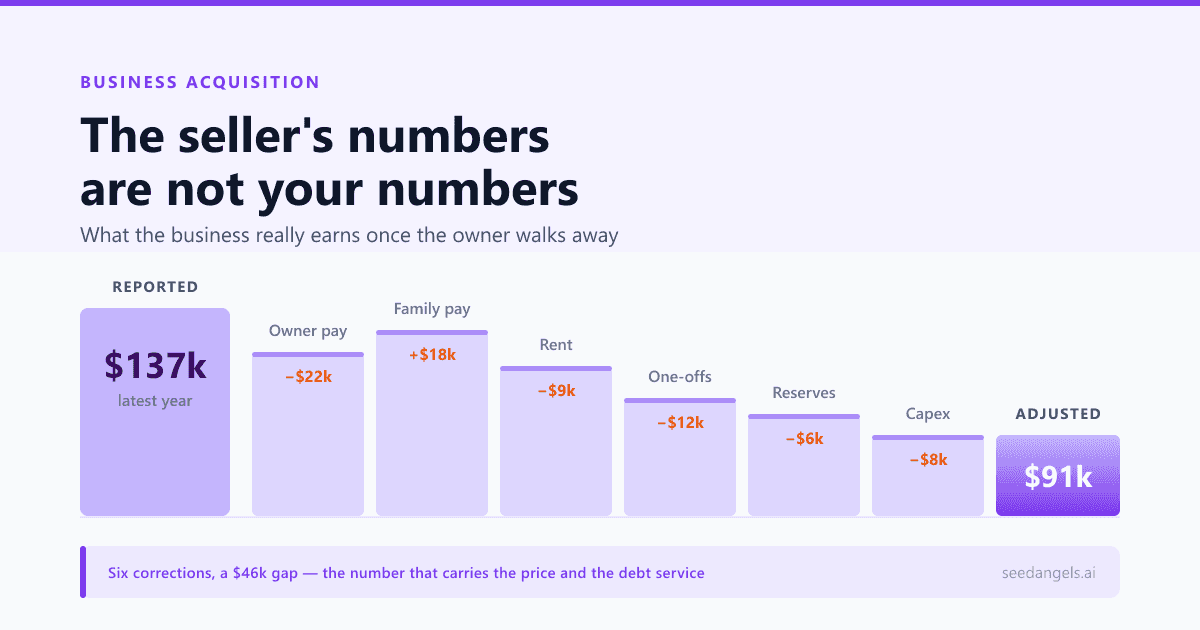
The price climbs to $1,500 to $3,000 as soon as the case gets complicated: acquiring an existing business with historical accounts to restate, multiple revenue lines, heavy seasonality, or a financing structure drawing on several sources. The premium is explainable: on an acquisition, most of the work goes into restating the seller's accounts and structuring the funding plan for the purchase price, two exercises we detail in our guide to the business plan for a business acquisition.
Understanding the underlying arithmetic helps. CPA hourly rates commonly run $150 to $400, with staff accountant time at $75 to $175. A flat-fee quote is almost always an estimate of hours multiplied by a rate. A $600 quote means roughly three to four hours of work, enough to format data you've already prepared, not to rebuild your assumptions from scratch.
1.2 The full business plan
A full business plan adds the narrative: project description, market research, go-to-market strategy, legal structure. Expect $1,000 to $5,000 depending on depth and the provider's positioning.
Beyond that, you're changing provider category entirely. Independent consultants specializing in funding-ready plans commonly charge $5,000 to $10,000 or more, and project-based consulting engagements run from $1,000 to $10,000+ depending on scope. These levels don't apply to a conventional small business launch.
Watch for one frequently forgotten line item: if your project requires primary market research conducted by a professional, budget several thousand dollars on top. It's a separate engagement, never included in the price of a business plan.
1.3 Reviewed and compiled statements
This is a distinct service, and often misunderstood. A compilation or review is not the forecast itself: it's a document through which a CPA attaches their professional responsibility to specific information.
Prices scale with the level of assurance provided. A compilation, the accountant presents your projections in proper format without verification, sits at the lower end. A review involves analytical procedures and inquiry, and costs meaningfully more. A full audit is rarely requested for startup projections and is more expensive again.
If your lender asks for reviewed statements covering your forecast, note that this cost stacks on top of building the forecast itself. Ask precisely which level of assurance they require, the terms are often used loosely, and a compilation may satisfy a request phrased as "certified."
2. Why quotes vary so much
Here is the explanation almost every article on the subject omits, even though it makes the entire price grid readable.
Accounting fees are unregulated, and no official rate schedule exists. Professional bodies do not publish reference pricing, doing so would raise antitrust concerns. Fees are set firm by firm, and four factors drive the number:
- Billable hours required: the real volume of work your file demands.
- Complexity of the case, the technical difficulty of your situation.
- Firm overhead, office location, staffing, technology.
- Market positioning: reputation, specialization, and demand.
That's why a $500 quote and a $2,500 quote for what looks like "the same" forecast can both be entirely legitimate. They rest on different estimates of hours and different cost structures.
There is a meaningful ethical constraint worth knowing: professional standards restrict contingent fees for many attest services. An accountant generally cannot bill you a percentage of the funding you obtain on engagements where independence is required.
What this changes for you: the number on a quote isn't a rate, it's a proposal. It rests on the firm's estimate of four parameters, and two of them, work volume and complexity, depend directly on how well you prepare. That's where your leverage lives.
3. What drives the price up
The four pricing factors translate into measurable differences in practice.
| Factor | Impact on price | Negotiable? |
|---|---|---|
| Metro vs. smaller market | Significantly higher in major metros | No, unless you go remote |
| Remote vs. local firm | Often meaningfully cheaper remote | Yes, it's your choice |
| Acquisition vs. new launch | Clearly higher for acquisitions | No, inherent to the file |
| Rush timeline | Substantial premium | Yes, plan ahead |
| Quality of your input data | Major impact on billable hours | Yes, your main lever |
| Time of year | Tight capacity January–April | Yes, shift if you can |
Two factors deserve detail.
Location. Firms in major metropolitan areas charge materially more than equivalent firms in smaller markets. The gap reflects overhead, not quality. For a one-off engagement like a forecast, geographic proximity has little value, the work happens fine remotely.
Your preparation. This is the most underestimated factor, and the only one you control entirely. A firm receiving structured data, gathered quotes and documented assumptions will spend two to three times fewer hours than one reconstructing everything through successive meetings. Since billing largely follows time spent, the saving is direct. At $150 to $400 an hour, eliminating five hours of back-and-forth is worth $750 to $2,000.
4. The "free" forecast: what it really costs
Many firms offer the forecast at no charge, provided you sign up for ongoing bookkeeping or tax services. The offer is entirely legitimate and often sensible, but it deserves to be calculated.
The engagement letter is the contract that defines scope and fees before work begins. The "free" forecast appears in it as a service included in a broader commitment.
Let's do the honest math:
| Arrangement | Year-one cost |
|---|---|
| Forecast paid standalone | $500 to $1,500, no strings |
| "Free" forecast + $250/month retainer | $3,000 |
| "Free" forecast + $900/month retainer | $10,800 |
Monthly retainer plans commonly range from $250 to $900, and many small businesses spend $1,500 to $5,000 annually on accounting overall.
The arrangement isn't a trap: it's a trade-off. If you're forming a corporation and would have hired an accountant for bookkeeping and taxes regardless, then the forecast genuinely is free: you're paying only what you'd have paid anyway. But if you didn't need ongoing accounting, a simple sole proprietorship you manage yourself, you've just committed thousands of dollars for a document that costs $800 as a standalone engagement.
Three questions to ask before signing:
- What's the commitment term, and on what conditions can I exit?
- What exactly does the retainer cover: bookkeeping, tax return, payroll, advisory?
- What would the forecast cost standalone, with no ongoing commitment? The answer reveals the real value of the discount.
5. The 4 ways to build your forecast
| Solution | Cost | Your time | Reliability | Accepted by lenders |
|---|---|---|---|---|
| Accountant / CPA | $500 to $3,000 | Low | High | Yes, assurance available |
| Specialized software | $20–50/month | A few hours | Good if assumptions are solid | Yes |
| Spreadsheet | $0 to $100 | High | Variable, error-prone | Yes, if coherent |
| SBDC / SCORE mentoring | Free | Moderate, by appointment | Good, expert review | Yes |
An accountant brings maximum credibility and the option of compiled or reviewed statements. They bring a risk perspective: the job isn't to produce flattering numbers, but a defensible document. This is the route to favor on complex files.
Specialized software automates calculations and formatting, and above all lets you test multiple scenarios quickly, a tedious exercise in a spreadsheet. It's the best cost-to-reliability ratio for a conventional launch, provided you own the thinking behind the assumptions. Our business plan software comparison covers the options, and our article on AI business plan generators examines what automation genuinely contributes, and what it must never do on your behalf. To see in practice what such a tool automates, you can try our financial forecasting software for free.
A spreadsheet is free but deceptive. Building a monthly cash flow plan that reconciles with an income statement and a projected balance sheet requires real financial modeling skill. A formula error or an inconsistency between statements is immediately visible to a credit analyst. Sector business plan templates reduce that risk by providing a proven structure.
Free mentoring is the most under-documented route. SBA resource partners provide substantive help at no cost: Small Business Development Centers deliver "professional, high quality, individualized business advising and technical assistance" covering "small business planning, strategy, operations, financial management," while SCORE mentors offer advice on financing and business planning "at no cost." Women's Business Centers provide "free, to low-cost counseling and training." The trade-off is pace, appointments are spaced out. But for a founder with time and a tight budget, this is often the best option, and it remains dramatically underused.
Whichever route you take, the construction method is the same: our guide to projected financial statements covers the three statements and how assumptions connect them.
6. Do you actually need to pay?
Let's answer plainly, without steering toward one solution.
Paying is fully justified when:
- You're acquiring an existing business, restating historical accounts is technical work where errors are expensive.
- The amount borrowed is large relative to your contribution and income.
- The lender requires reviewed or compiled statements: you have no choice.
- Your structure is complex: holding company, multiple partners with differentiated contributions, several activities.
- You're not comfortable with numbers and will still have to defend the file in a meeting.
Paying is less justified when:
- It's a simple launch in an industry you know well.
- The amount requested is moderate and your contribution comfortable.
- Your business has no inventory and no long operating cycle, so limited working capital needs.
- You understand basic financial mechanics and accept spending time on it.
One point deserves emphasis, because it's widely misunderstood: no legal requirement forces you to have projections certified for a new business. Claims to the contrary circulate widely, often on sites published by firms selling the service. A professional signature reassures the analyst, but it attests to the arithmetic coherence of your statements, not the reality of your market. We cover this in detail, along with the ratios actually calculated on your file, in our article on the financial forecast for a bank loan.
The real question isn't "how much will I pay?" but "what level of support does my file genuinely require?" A $2,000 forecast built on assumptions you can't defend in a meeting is worth no more than a $0 forecast you understand line by line.
7. Paying less without losing credibility
Six concrete levers, from most to least effective.
-
Prepare your data upfront. By far the first lever. Gather your quotes, your pricing, your volume assumptions with their sources, your itemized investment plan. You're acting directly on billable hours, the single largest component of the fee.
-
Get two or three quotes. Because fees are unregulated, spreads for identical work are real. This is the direct consequence of having no rate schedule.
-
Compare engagement letters line by line, not prices. A $700 quote covering only the statements and a $1,600 quote including two working sessions and a compilation aren't comparable. Scope explains nearly every gap.
-
Consider a remote firm. Overhead differences between markets are significant. For a one-off engagement with no need for in-person presence, the constraint is minimal.
-
Separate the narrative from the financials. Write the project description, market research and go-to-market strategy yourself, you know them better than anyone, and hand the professional only the financial statements. The saving is substantial and the quality often better.
-
Avoid January through April. Firms are saturated with tax season. A file arriving outside that window gets more attention, shorter turnaround, and a more open negotiation.
One final piece of advice, valid in every case: never economize on understanding your own numbers. Whether you pay $0 or $3,000, you'll be alone in front of the lender defending every assumption.
FAQ
How much does a financial forecast cost with an accountant?
Expect roughly $500 to $1,500 for standalone projections on a straightforward business, and $1,500 to $3,000 or more for a complex case or an acquisition. A full business plan including the narrative typically runs $1,000 to $5,000. Since most firms bill hourly, the amount of preparation you bring drives the final number.
Why do quotes vary so much between firms?
Because accounting fees are unregulated and there is no official rate schedule. Firms price on billable time, the complexity of your case, their overhead, and their market positioning. Two very different quotes can both be legitimate, the gap almost always reflects scope, not value.
Do I need an accountant to build a financial forecast?
No. No legal requirement forces you to hire an accountant to build projections, including for a loan application. Some lenders request reviewed or compiled statements on larger loans or acquisitions. A well-documented, internally consistent forecast remains acceptable without a professional signature.
Is a free forecast bundled with a service agreement really free?
No, it is folded into an ongoing engagement. Firms often waive the forecast fee if you sign up for monthly bookkeeping. At $250 to $900 per month, that represents $3,000 to $10,800 over a year. It is a fair trade only if you needed those services anyway.
Can you negotiate accounting fees?
Yes. Because fees are unregulated, they are negotiable before you sign the engagement letter. Prepare your data in advance to cut billable hours, request two or three quotes, and compare the exact scope of each. Avoid January through April, when firms are saturated with tax season.
How much does a CPA charge per hour?
CPA hourly rates commonly range from $150 to $400, depending on expertise, location and complexity. Staff accountant time runs lower, around $75 to $175. Specialized work such as business valuation or financial restructuring can exceed $500 per hour. Most forecast engagements are quoted as a flat fee derived from these rates.
Are there reliable free options?
Yes. SBA resource partners provide no-cost help. Small Business Development Centers deliver individualized advising on business planning and financial management, and SCORE mentors offer guidance at no cost. Free spreadsheet templates also exist, but require solid financial modeling skills to avoid calculation errors.
The price of a forecast isn't a rate: it reflects a scope and a number of hours. Once you understand that mechanism, the question changes shape. It's no longer about finding the cheapest quote, but about determining what level of support your file genuinely warrants, then preparing your data so you only pay for what adds value.
SeedAngels generates your Business Plan, financial forecast and cash flow plan from your project data, as a one-time purchase with no subscription, with assumptions you keep under your own control so you can defend them.