What your lender actually calculates
Your lender does not read your forecast the way you wrote it. They extract five ratios from it, and those ratios decide. You spent weeks on your spreadsheets, refined your revenue assumptions, double-checked your totals. The analyst opens the file and looks first for a handful of specific numbers, numbers most founders don't even know are being calculated on their application.
The stakes are real. According to the Federal Reserve Banks' Small Business Credit Survey, only about half of employer firms that applied for financing were approved for at least some of what they requested, and fewer still received the full amount. Unlike markets where approval is near-automatic, US small business lending is genuinely selective, which makes the quality of your forecast the variable you actually control.
This article approaches the problem backwards from most guides. Instead of telling you how to fill in spreadsheets and hope they land well, it starts from the calculations the analyst performs and works back to the lines in your forecast that produce them. You'll know exactly which number to fix, and why.
1. What a lender really does with your forecast
First, a naive assumption worth dismantling: the lender does not read your forecast from the first line to the last. They underwrite it. That's extraction, not reading.
The analysis happens in two stages, and confusing them is a common mistake.
The first stage is mechanical. The analyst pulls a few aggregates from your tables (operating cash flow, annual debt service, contribution, leverage, monthly cash position) and compares them to internal thresholds. This step is largely standardized and often partly automated. At this point your project is not being judged on how interesting or original it is. It's being judged on ratios. An application that fails here usually goes no further.
The second stage is human. If the ratios clear, the analyst and relationship manager turn to you: your background, your industry experience, your personal financial management, your ability to defend your numbers. The SBA frames eligibility around whether businesses "must meet SBA size standards, be able to repay, and have a sound business purpose", with repayment ability sitting at the center.
The order matters enormously. Many founders prepare brilliantly for the second stage (the story, the conviction, the presentation) and neglect the first, which is the eliminating one.
In practice, three documents get opened first, in this order:
- The monthly cash flow projection, where short-term failure risk becomes visible.
- The funding plan, showing whether the need is properly covered, working capital included.
- The projected income statement: giving profitability and the cash flow base for the repayment calculation.
If you only have time to perfect one table, make it the first. That is precisely the reverse of the order in which most forecasts get built.
2. The 5 ratios lenders run on your forecast
Here are the five calculations that decide your application. For each: the formula, the observed threshold, and above all the line in your forecast that produces it.
| Ratio | Formula | Common threshold | Line involved |
|---|---|---|---|
| Down payment | Contribution ÷ total need | 10 to 30% | Funding plan (sources) |
| Repayment capacity | Operating cash flow ÷ debt service | ≥ 1.25x | Income statement + amortization schedule |
| DSCR | (EBITDA − cash taxes) ÷ (principal + interest) | ≥ 1.25x, often higher | Cash flow projection |
| Leverage | Total debt ÷ equity | Below 2 to 3 | Projected balance sheet |
| Minimum cash | Lowest monthly balance | Always > 0 | Monthly cash flow plan |
These thresholds vary by lender, program and industry. None of them is a regulation, they are observed orders of magnitude, not binding rules.
2.1 Your down payment
This is the first filter, and the easiest to anticipate. Expect to contribute roughly 10% to 30% of the total funding need, depending heavily on the loan program. Government-guaranteed programs advertise "lower down payments, flexible overhead requirements, and no collateral needed for some loans," while conventional commercial loans sit at the higher end of that range. This ratio is worth checking before you build the file rather than after: it is one of the criteria in a business feasibility study, which sets your available equity against the real funding need and tells you whether the project is financeable in your situation or whether its scope has to come down first.
But the amount is only half the story. What the lender reads in your contribution is savings capacity and shared risk. A down payment accumulated over several years of saving does not read the same as one funded entirely by a last-minute family loan. The first demonstrates sound financial management; the second simply relocates the risk.
Note a point that is often missed: lenders favor financing durable assets (vehicles, equipment, machinery) over financing the operating activity itself. A funding need made up mostly of startup working capital is structurally harder to finance than an equipment need of the same size.
2.2 Repayment capacity
This is the central calculation. The lender compares your operating cash flow to your total annual debt service (principal plus interest).
The working rule: cash flow should cover at least 1.25 times the debt service.
Here's the arithmetic. A business generating $125,000 in available cash flow supports roughly $100,000 of annual debt service. If your amortization schedule shows $130,000 of annual payments against that same cash flow, the application fails, regardless of how strong everything else looks.
The 1.25 coefficient isn't arbitrary: it's the lender's safety cushion. It means that even if your actual cash flow comes in 20% below your forecast, you still meet your obligations.
The practical consequence is decisive: if your ratio doesn't clear, the fix is not to inflate your projected revenue, the most common and most counterproductive reflex. It's to extend the loan term, which lowers the annual payment, or to reduce the amount borrowed by increasing your contribution.
2.3 DSCR: the ratio that decides
The Debt Service Coverage Ratio is the refined version of the calculation above. Corporate Finance Institute gives the standard formula:
DSCR = (EBITDA − cash taxes) ÷ (principal + interest)
In plain terms: for every $1 of payment due, how many dollars of cash do you actually generate?
A DSCR of 1.0 means you repay to the dollar with no margin at all, untenable at the first surprise. The benchmark is clear: "most commercial banks and equipment finance firms want to see a minimum of 1.25x but strongly prefer something closer to 2x or more." Many lenders write 1.25x as a minimum covenant directly into loan agreements, meaning you must maintain it for the life of the loan, not just at approval.
Below 1.0x, the reading is unambiguous: the company "owes more money to creditors per year than it generates in cash per year."
The distinction from repayment capacity matters: DSCR reasons in cash, not accounting profit. It captures the gap between when you collect and when you pay. A business that is profitable on paper but paid on 60-day terms will show a materially weaker DSCR than its income statement suggests.
2.4 Leverage: the breaking point
This ratio compares your total debt to your equity. Lender behavior shifts sharply from one band to the next:
- Below 2: the application clears without particular difficulty.
- Between 2 and 3: the lender may proceed, but will require additional collateral.
- Above 3: denial becomes close to automatic.
Commercial real estate is stricter still, with thresholds often set between 1 and 1.5 depending on the institution.
This ratio has a direct consequence for how you structure your request: past a certain level of borrowing, every additional dollar requested mechanically degrades your application. There is a point where borrowing less increases your odds of approval, and where borrowing more costs you the whole deal.
2.5 Your lowest cash month
This is the point almost no guide highlights, and it is the most discriminating of all.
A forecast that is profitable in year one can still be rejected over a single month. If your cash flow projection dips below zero in month 7 (even by $3,000, even once) the analyst reads failure risk. It doesn't matter that your annual result is positive: a business doesn't fail because it isn't profitable, it fails because it can't pay on the due date.
That is exactly why monthly granularity is required. A forecast presented only in annual totals hides these troughs, and an experienced analyst knows it. Presenting year one in annual figures is often read as concealment, or at best as unfinished work.
The most common cash trough falls between month 4 and month 8: costs have been running since launch, the initial contribution is depleted, and revenue hasn't reached cruising speed. If your forecast shows no trough at all, that isn't reassuring: it's suspicious.
3. Translating ratios back into forecast lines
This is where a forecast that clears diverges from one that fails. Every line you write triggers an inference in the reader. Here are the most frequent ones.
| What you write | What the lender infers |
|---|---|
| Revenue up 40% in year two with no hiring or investment | You haven't connected growth to capacity |
| No seasonality across 12 months | The cash flow plan wasn't genuinely built |
| Margin 15 points above the industry average | Unsourced assumption, and the doubt spreads to the whole file |
| No working capital line in the funding plan | Cash shortfall risk from day one |
| Cash that skims zero without ever dipping below | Numbers tuned to land just right |
| Owner compensation absent or symbolic in year one | Either the forecast is wrong, or you can't live off this business |
That last point deserves particular attention: many founders remove their own salary to artificially improve cash flow. It backfires. The analyst knows you have to live, and will mentally add a realistic salary back in, concluding that your numbers are fragile.
The rule that governs everything else: every material assumption must rest on a verifiable source. A signed quote for an investment, a lease or appraisal for rent, an industry salary survey for payroll, market research for volumes, an observed average transaction for price. The key to a strong forecast isn't perfect numbers: it's being able to justify each one.
This is also what separates recoverable errors from fatal ones. A debatable but documented assumption opens a conversation. An unverifiable assumption closes the file. For the mechanics of building each statement, our guide to projected financial statements covers the full method, and our article on Business Plan mistakes catalogs the costliest traps.
4. The downside case: the real stress test
Here is a counterintuitive reversal many founders resist: volunteering a downside case strengthens your application rather than weakening it.
The logic is simple. The lender is going to stress your numbers anyway: that's the job. The only question is whether you run that exercise, with your assumptions and your prepared answers, or whether they run it without you, using harsher assumptions than yours.
The commonly used stress parameters:
- Revenue: −20% to −30% against the base case.
- Costs: +10%, absorbing the usual overruns.
- Longer customer payment terms, typically 15 to 30 additional days.
The test to pass is precise: in the downside case, your cash must stay positive and your coverage ratio must hold. That is what the lender is checking. A business that stays solvent at −25% revenue is financeable, even if its base case is modest.
Build three trajectories (conservative, base, ambitious), keeping each internally coherent: you don't slow growth without adjusting hiring, and you don't accelerate sales without a working capital impact.
5. Do you need a certified forecast?
In most cases, no legal requirement forces you to have your forecast certified by an accountant. It's worth being precise about what a professional review actually buys you.
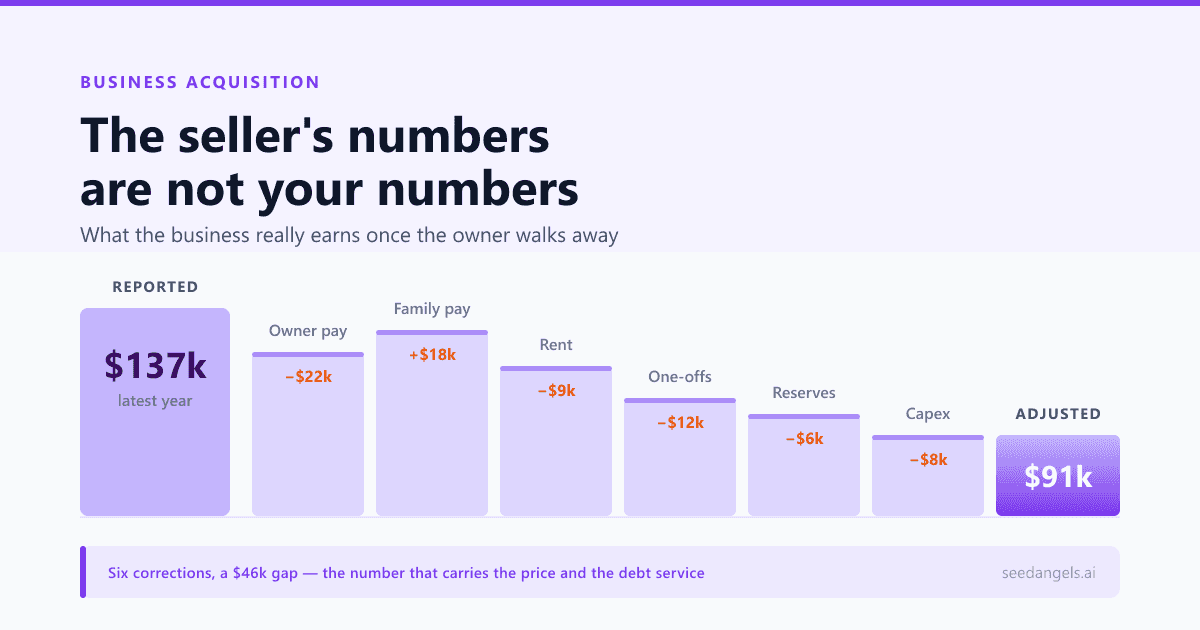
What it provides: verification that your statements are internally consistent, and a signal of seriousness that reassures the analyst. On an acquisition, where existing accounts must be restated, that contribution is real and often decisive. The restatement itself (seller's compensation, non-recurring charges, property rent) determines the EBITDA the lender uses to compute your debt service capacity; we give the line-by-line method in our guide to the business plan for a business acquisition.
What it does not provide: the soundness of your assumptions. An accountant attests to the arithmetic coherence of your projections, not to the reality of your market. A reviewed forecast built on implausible revenue will still be rejected, a professional signature does not turn a false assumption into a credible one.
Three situations, three answers:
- Simple launch, moderate amount, industry you know well → a rigorous, well-documented forecast is generally enough.
- Acquisition, complex structure, large amount → professional support is fully justified, and some lenders will require it.
- The lender explicitly requires reviewed statements → you have no choice, but negotiate the scope of the engagement.
One practical note in every case: the more prepared your data and documented your assumptions when you arrive, the less the engagement costs, fees are largely a function of time spent.
6. Guarantees: what you actually pledge
Ratios determine whether the lender lends. Guarantees determine what you personally lose if things go wrong. This subject is often rushed, even though it puts your personal assets on the line.
The personal guarantee is the most common. You commit your own assets to repay if the business no longer can. The protection offered by a limited liability structure becomes partly theoretical at that point. Most lenders require it from any owner holding a significant stake.
A security interest in business assets (equipment, receivables, inventory) does not touch your personal estate, which makes it the preferable option whenever it's available.
Government-backed guarantee programs cover a significant share of the loan if it defaults, reducing the lender's exposure accordingly. One point is widely misunderstood and worth stating plainly: these programs do not eliminate your personal guarantee. They frequently allow it to be capped or limited to the uncovered portion, but lenders typically still require one. The negotiation is about the scope of your commitment, not its existence.
Before signing, always ask three questions: what exact amount does my guarantee cover? For how long? Does it decline as principal is repaid? A capped, declining guarantee is a completely different instrument from an unlimited joint-and-several one.
7. The pre-meeting checklist
Documents to bring
- Complete Business Plan, narrative and financial sections
- Monthly cash flow projection, 12 months minimum
- Balanced funding plan (sources = uses)
- Three-year projected income statement
- Amortization schedule for the requested loan
- Quotes for every budgeted investment
- Proof of your contribution and its origin
- Resume and evidence of industry experience
- Personal bank statements for the last 3 months
- Market research or commercial validation
Consistency checks before you leave
- Total uses equals total sources exactly
- Working capital appears in the funding plan
- Debt service in the schedule matches the income statement
- Cash never drops below zero, downside case included
- Your compensation appears and is livable
- Every material assumption has an identifiable source
Numbers to know without looking at the file
- Your operating cash flow in year 1 and year 3
- The exact amount requested and its term
- Your break-even point, in revenue and in months
- Your lowest cash balance and the month it occurs
Three questions to prepare
- "What happens if you lose your largest customer?"
- "How do you pay yourself in year one?"
- "Why this loan amount exactly, and not 20% less?"
These three come up almost every time. Answering with numbers, rather than conviction, changes how your file is perceived.
Before the meeting, have your file reviewed by someone else. Our free Business Plan analyzer flags the inconsistencies and weak points lenders most frequently catch. You can also start from a sector Business Plan template already structured with a forecast and cash flow plan.
8. If the bank says no
A denial is not a verdict on your project. It's information, provided you extract the actual content.
Ask for the specific reason. This is the first step and the most neglected. A documented denial tells you exactly which ratio failed. Without it, you'll submit the same file elsewhere and get the same result. In the US, lenders are generally required to provide the specific reasons for a credit denial on request.
Fix it before reapplying. Depending on the reason, the levers differ sharply: strengthen your contribution, extend the term to lower the annual payment, reduce the amount by staging investments, or seek an external guarantee to lower the lender's risk.
Approach several institutions. Risk appetite varies substantially between lenders, and with their current sector exposure. Approval rates differ markedly by lender type, so one denial is not a market verdict.
Use support programs. Small Business Development Centers and SCORE mentoring provide free help revalidating assumptions and tightening the file. Community Development Financial Institutions often approve applications that conventional banks decline, particularly for younger or smaller businesses.
Keep the underlying statistic in mind: with roughly half of applicants approved for at least part of what they request, the gap between approval and denial is usually something inside the file, which means something you can fix.
FAQ
How many years should a financial forecast cover for a bank?
Three years is the expected standard for a business loan application. Year one must be broken down month by month in the cash flow plan, that is the document the analyst opens first. Years two and three can stay annual, provided your growth assumptions are properly justified.
Do I need an accountant to certify my forecast?
In most cases, no legal requirement forces you to have a forecast certified. Some lenders ask for reviewed or compiled statements on larger loans or acquisitions, and a professional review reassures the analyst. But it never compensates for weak assumptions: a well-documented uncertified forecast beats a reviewed one built on implausible numbers.
How much of a down payment do lenders expect?
Expect to contribute roughly 10% to 30% of the total funding need, depending on the loan program and your profile. Beyond the amount itself, your contribution demonstrates savings capacity and shared risk. Lenders read a down payment built from accumulated savings very differently from one borrowed at the last minute.
How does a lender calculate my repayment capacity?
Lenders divide your operating cash flow by your total annual debt service, principal plus interest. Most commercial lenders want to see a debt service coverage ratio of at least 1.25x. In practice, $125,000 of available cash flow supports roughly $100,000 of annual debt service, leaving a safety margin.
What most often causes a forecast to be rejected?
A negative cash balance in one or more months of year one, revenue assumptions with no verifiable source, and a mismatch between commercial targets and the resources planned to hit them. Omitting working capital from the funding plan is another frequent and costly oversight.
Does a loan guarantee remove my personal guarantee?
Usually not. A government-backed guarantee reduces the lender's exposure, which can shrink what you are asked to pledge personally. But most lenders still require a personal guarantee from owners with significant stakes. The negotiation is about the scope and cap of that commitment, not its existence.
What should I do if the bank turns me down?
Ask for the specific reason for the denial, then fix that exact point before reapplying elsewhere. Depending on the cause, you can strengthen your contribution, extend the term to lower the annual payment, reduce the amount requested, or seek a guarantee program to lower the lender's risk.
A forecast built for a lender is not an exercise in persuasion: it's a demonstration of solvency. The five ratios covered here aren't arbitrary hurdles, they express a single question the lender asks from start to finish: can this business repay, even if things don't go to plan?
Build your forecast around that question, and most of the work is done.
SeedAngels generates your Business Plan, financial forecast and monthly cash flow plan from your project data, with assumptions you keep under your own control, the prerequisite for defending them in the meeting.