Someone Already Built My Idea: Should I Quit?
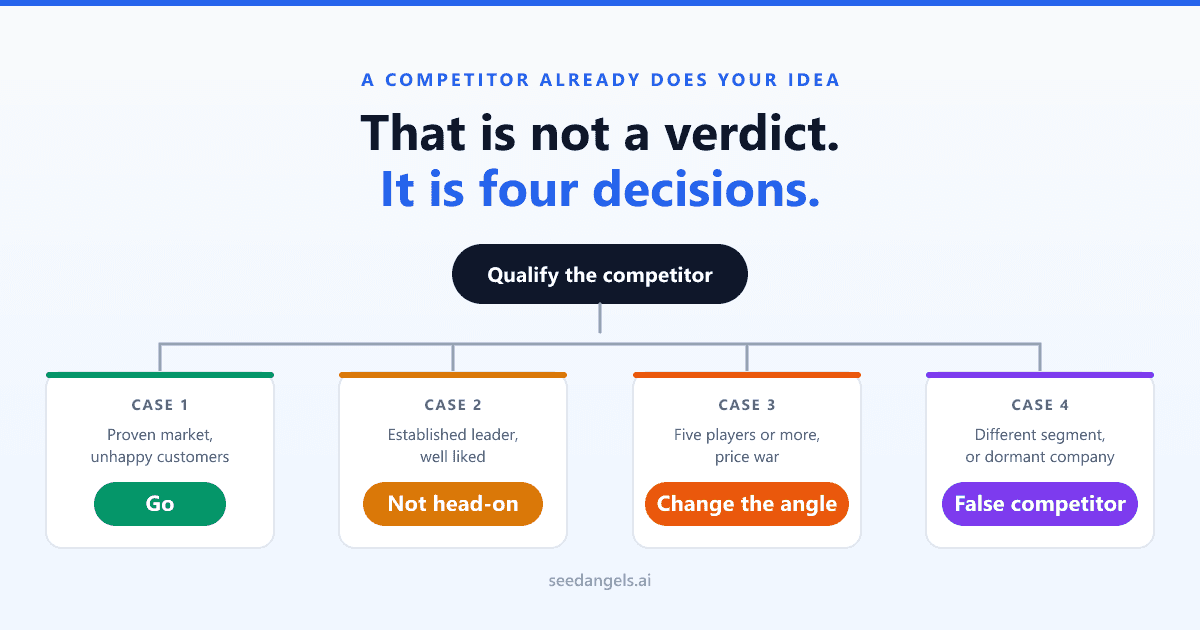
Table of contents
- The bad news is not the one you think
- Before you panic: qualify the competitor in 6 checks
- The 4 cases: which one are you in?
- The case study that should reassure you
- What actually differentiates you (and what does not)
- How to answer when someone says « that already exists »
- Conclusion
- FAQ
The bad news is not the one you think
You type your idea into a search engine and land on a company doing exactly that, better, with a thirty-person team and a funding round announced last year. The thought « someone already built my idea » has just formed in your head, and with it the urge to stop everything. That reaction is normal. It is also, in most cases, a reasoning error.
What you have just found is not a verdict: it is information. And depending on its exact nature, it leads to four radically different decisions - go hard, go around, change the problem, or realise there was no competitor at all.
No, the existence of a competitor almost never justifies quitting on its own. It justifies changing the question: you are no longer trying to find out whether your idea is good, but which market segment you can serve better than the incumbent. That question can be answered in a week.
Start with the reversal that breaks most intuitions. The genuinely worrying signal is not « somebody already does this ». It is « nobody does this, and nobody ever tried ». A market with no competitor at all is almost always a market with no customer: either the problem is not painful enough to pay for, or others tried and stopped for a reason you have not identified yet. Conversely, a living competitor invoicing real customers is the only free proof you will ever get that someone reaches for a payment card over this problem.
Is being first an advantage? Far less than people assume. In a study that became canonical, Peter N. Golder and Gerard J. Tellis analysed roughly 500 brands across 50 product categories and measured a 47% failure rate among pioneers, against 8% for the leaders who entered later; the pioneers' mean market share was 10%, against 28% for those later leaders (Golder & Tellis, "Pioneer Advantage: Marketing Logic or Marketing Legend?", Journal of Marketing Research, vol. 30, no. 2, May 1993, full text).
One figure deserves reading twice: those durable leaders entered their market an average of thirteen years after the pioneer. The mechanism is not mysterious. The first entrant pays for market education, design mistakes and technological dead ends; whoever comes next buys that knowledge at the price of observation. Research relayed by the Kellogg School of Management puts the cost of imitation at roughly two-thirds of the development cost borne by the pioneer (Kellogg Insight).
In other words: arriving second is not a fallback position. Statistically, it is the better seat - provided you arrive informed.
Before you panic: qualify the competitor in 6 checks
Before deciding anything, verify that the competitor frightening you is genuinely one. Half the companies that trigger a founder's decision to quit are dormant, address a different need, or do not serve the target segment. Six checks, half a day of work.
- Are they alive? Date of the last announcement, the last job posting, the last product update. A website that exists proves nothing; a company that has published nothing for eighteen months is often a company that has stopped.
- Are they healthy? In most jurisdictions, registered companies must file annual accounts publicly - in the UK, for instance, filings and accounts are searchable on the Companies House register. Our guide to reading a competitor's filed accounts sets out what to look at first when you are not an accountant - the gap between the public narrative and the profit-and-loss statement is often the most useful discovery of the week.
- Do they really serve your segment? Read their pricing page and case studies, not their homepage: the price grid says who actually pays. A tool marketed « for small businesses » whose first tier starts at $900 a month does not serve microbusinesses.
- Are they funded, and by whom? A recent round gives the incumbent the means to buy customer acquisition at a loss for two years. That is not disqualifying, but it rules out meeting them through the same channel.
- Do their customers like them? Public reviews, LinkedIn discussions, professional forum threads. A well-established but disliked competitor is the best news of your week; a competitor whose customers praise them unprompted is a serious warning.
- How many are there? One competitor is information; seven competitors are a consolidated market. The count changes the diagnosis more than any individual identity does.
If those six answers reveal several serious players rather than one, the exercise changes nature: you are no longer qualifying a company but mapping your direct and indirect competitors, including substitutes and the status quo, which usually captures more customers than every identified company combined.
Where to look, concretely
Four sources are enough, in this order:
- Search engines, using your customers' words. Search for the problem the way your target phrases it, not the way your product describes itself. « Wasting time chasing unpaid invoices » surfaces competitors that « B2B collections software » never shows, and vice versa.
- A trademark database, to see whether a name is already taken, by whom, and since when. The USPTO trademark search covers US filings; national and regional offices run equivalents.
- A company register, to tell an active business from an empty shell. A registered trademark and a live website prove no trading activity whatsoever.
- The forums and groups where your audience talks, to hear what customers hold against the current solutions. That is where underserved segments are found - never in press releases.
⚠️ One clarification that prevents an expensive misunderstanding. A trademark search checks the availability of a name, logo or distinctive sign. It does not protect an idea, and it does not tell you whether someone is running the same concept as you. Intellectual property is explicit about what each right covers: a trademark protects a word, phrase or design that identifies your goods or services; a patent protects technical inventions; copyright protects created works fixed in a tangible medium (USPTO). None of them covers an idea as such. What protects you is execution and the lead you accumulate.
The 4 cases: which one are you in?
With your six checks done, your situation necessarily falls into one of four configurations. Each calls for a different verdict, and that is the whole point: the answer to « my idea already exists » is not universal, it depends on the structure of the market you have just discovered.
Case 1: the market is proven but badly served
How to recognise it. One or two competitors have paying customers, but reviews are poor or lukewarm; the product has not evolved in years; support is absent or billed separately; an entire segment - small organisations, one region, one profession - is visibly ignored by their pricing.
What it means. Someone has paid to educate the market on your behalf. Customers know this kind of solution exists, they already hold a budget for it, and some of them are actively looking for better.
The verdict: go. This is the best possible configuration, by a wide margin.
Your angle of attack. Enter through the worst-served segment, not the core of the market. The core is where the incumbent is strongest and most attentive; the fringe they neglect is where your offer looks obvious and where your acquisition cost will be lowest.
Case 2: an established leader with no visible weakness
How to recognise it. A dominant, well-funded player whose customers speak well of them, who is hiring and whose market share is growing. The negative reviews are about details, not about the promise.
What it means. The core of the market is well served. A head-on attack - same product, same target, same channel - pits you against someone with more money, more data and more recognition than you. It is lost in advance without a structural advantage.
The verdict: not head-on. This is not « give up », it is « not like that ». The distinction is decisive: your project can survive, your battle plan cannot.
Your angle of attack. Look for the niche the leader cannot serve without degrading their own model. The mechanism is economic, not psychological: the bigger a player gets, the better their reasons to refuse a segment too small to move their growth, a specific regulatory requirement that complicates their product, a vertical integration that breaks their standardisation, or a labour-intensive service that damages their margins. Those refusals are rational on their side and constitute your space on yours.
Case 3: the market is consolidated
How to recognise it. Five players or more, slowing growth, aggressive discounting and generalist advertising, acquisitions under way between competitors. Everyone offers roughly the same thing, and the industry's topic of conversation has become price.
What it means. Competition is no longer fought on product but on customer acquisition cost, meaning what you must spend on marketing and sales to win a customer. On that terrain, the biggest balance sheet wins, and it is not yours.
The verdict: change the problem, keep the audience. This is the only one of the four cases where the original idea genuinely has to be abandoned in its current form.
Your angle of attack. Move up or down the value chain: serve the same customer on an adjacent need nobody covers. Your knowledge of that audience stays valid, and so does your access to it; only the offer changes. That is a far cheaper restart than switching markets entirely.
Case 4: the false competitor
How to recognise it. At first glance they do the same thing. Looked at closely, they target a different customer size, a different business model, a different geography, a different distribution channel - or their accounts show a business that has stopped trading.
What it means. You compared two homepages, not two companies. Two offers that describe themselves with the same words can serve markets that never intersect.
The verdict: this is not a competitor. It is the most frequent case, and the one that kills the largest number of perfectly viable projects.
Your angle of attack. Restate your value proposition by the segment you serve, not by the feature you ship. As long as you describe yourself by what your product does, you will look like everyone else; the moment you describe yourself by who you serve and in what context, the confusion disappears, including inside your own head.
| Dominant signal | Verdict | First action |
|---|---|---|
| Active competitors, unhappy customers | Go | Target the worst-served segment |
| Dominant, well-liked leader | Not head-on | Find the niche they refuse to serve |
| Five players or more, price war | Change the problem | Same audience, adjacent need |
| Different segment or model, or dormant | Not a competitor | Restate the offer by segment |
Once you have identified your case, the next step is to test the chosen angle against reality before investing months in it: our startup idea validator puts your positioning through a structured check in a few minutes, free.
The case study that should reassure you
Doctolib, now the dominant medical appointment booking platform in France, did not invent online medical scheduling. Its main competitor, MonDocteur, operated in the same market with a comparable model and near-identical pricing - €106.80 a month against €109 - and worked with 10,000 healthcare professionals when Doctolib claimed 45,000. The story ended in July 2018 with Doctolib acquiring MonDocteur (TechCrunch).
On teleconsultation, the company was not first either. French health insurance reimbursement for remote consultations took effect on 15 September 2018, opening the market to players already positioned on that segment; Doctolib opened its own service in January 2019, after a test phase with 500 practitioners (TechCrunch).
Twice in the same market, priority of entry did not determine the outcome. What determined it lies elsewhere: the density of equipped professionals within a given area, which is what makes the platform useful to patients, and on-the-ground sales work that is hard to catch up on. Those things cannot be copied in a quarter - and that is exactly the criterion separating a real differentiator from a homepage claim.
What actually differentiates you (and what does not)
Faced with an established competitor, most founders formulate a differentiation that does not survive a quarter. Here is the sorting.
What does not count:
- « We'll be simpler. » Simplicity is a product decision, not a barrier. Your competitor can simplify their onboarding in six weeks the moment they see they are losing customers over it.
- « We'll have a better interface. » An interface gets redesigned, and yours will be copied faster the better it is: by construction, it is public.
- « We'll be cheaper. » A price is cut in one meeting. If your cost base matches theirs, all you have done is invite a fight with whoever holds more cash.
- « Our team is passionate. » That is true of every team in the industry, including the ones that failed. A professional reader hears an absence of argument.
What counts:
- Privileged access to a distribution channel, a professional network or a dataset nobody else has the right or the means to exploit.
- A structurally lower cost, coming from how you produce, not from a sacrificed margin.
- A local network effect, where each new customer makes the service better for the next ones in the same area.
- A regulatory or contractual lock: an approval that takes a long time to obtain, an exclusivity, a certification your customers require.
- Deep domain knowledge of one specific segment, translating into product choices a generalist cannot guess.
The common rule is simple: what differentiates you is what a funded competitor cannot reproduce in a quarter. Building a defensible competitive advantage takes dedicated work, which we cover separately; at this stage, what matters is not building your entry strategy on an item from the first list.
How to answer when someone says « that already exists »
The line will come back in investor meetings, in customer interviews and from people around you. The winning answer never denies the competitor: denying what the other person can see destroys your credibility in one sentence. It names the underserved segment, and proves it.
The three-part structure: « Yes, [competitor] serves [segment A]. We serve [segment B], which represents [size], and which stays underserved because [structural reason]. »
The third part is what makes the difference. A structural reason explains why the incumbent will not come after you tomorrow morning: an incompatible business model, a margin constraint, a sales organisation that does not fit.
B2B example: « Yes, [player] equips firms of twenty staff and above, and does it well. We serve firms of two to five people, around 18,000 of them in this market, which their model cannot serve: their offer assumes a $4,000 implementation and an internal champion, two things a three-person firm does not have. »
Local B2C example: « Yes, [platform] covers every major city. We cover towns under 20,000 inhabitants, where their advertising model cannot make acquisition pay, and where we go through local retailers and associations rather than buying keywords. »
Both answers name the competitor, acknowledge their quality, and explain the mechanism that keeps them at a distance. They reassure far more than « we'll be different » - and they force you to have done the work.
Conclusion
Discovering a competitor does not change the value of your project. It changes the question you have to ask: no longer « is my idea good? », but « which segment can I serve better than them? ». The first question has no answer; the second is settled in a week with the six checks and the four-case sort.
Remember the hierarchy. A badly served market is an invitation. A solid leader rules out the head-on attack, not an entry through a niche they cannot make profitable. A consolidated market forces you to change the problem while keeping the audience. And in the most frequent case, the company that scared you simply was not serving your customers.
Golder and Tellis supply the rest: pioneers failed 47% of the time, and the durable leaders entered an average of thirteen years after them. The informed second entrant regularly beats the improvised first one. What remains is turning your positioning into quantified assumptions - addressable market, pricing, acquisition cost, trajectory - which SeedAngels structures section by section inside your business plan.
FAQ
My idea already exists. Should I give up?
Almost never on that basis alone. A competitor proves a market exists and that someone else has paid to educate it. The real question is which configuration you are in: an underserved market, an unassailable leader, a consolidated market, or a false competitor. Only the third case justifies changing the problem, and the second one, avoiding a head-on fight.
How do I find out whether my idea already exists?
Combine four sources: a search using the words your customers use for the problem, not your product vocabulary; a trademark database to see whether a name is already taken; a company register to check that a business is genuinely active rather than dormant; and the forums or groups where your target audience discusses the tools they use today.
Is being first to market an advantage?
Far less than people assume. Golder and Tellis found that pioneers failed 47% of the time, against 8% for the leaders who entered later, and held an average market share of 10% against 28%. The first entrant pays for market education and design mistakes; whoever follows buys that knowledge at the price of observation.
How do I differentiate from an established competitor?
Not through features, interface or price: all of that can be copied in a quarter. Differentiate on what cannot be replicated quickly, such as privileged access to a channel or a dataset, a structurally lower cost base, deep domain expertise in one specific segment, or a regulatory constraint you know how to handle.
What should I say when someone tells me my idea already exists?
Do not deny the competitor, it destroys your credibility. Name precisely the segment they serve, then the segment you serve, its size, and the structural reason it stays underserved. An answer that names a competitor and explains why they cannot follow you is far more reassuring than a defensive one.
Several competitors are already in my market. Is that fatal?
One competitor is information; five or more signal a consolidating market where competition is fought on customer acquisition cost rather than on product. Product differentiation is no longer enough there: you are better off serving the same audience on an adjacent unmet need than entering a price war you cannot fund.
Can I protect my idea so nobody copies it?
An idea in itself cannot be protected. You can protect a name with a trademark, a technical invention with a patent, a creative work with copyright, and confidential information with a non-disclosure agreement. But real protection comes from execution and accumulated lead, not from a filing.
Write your Business Plan in a few clicks
SeedAngels generates a complete, tailored Business Plan (financials, forecasts, pitch) ready to send to your bank or investors.
Try for free →