The question nobody answers well
An investor asks you « what stops someone from copying you? », and you answer with your team, your execution or your head start. The meeting continues politely, but something has just closed. It is not that your answer is false: it is that it does not address the question that was asked.
The question was not « why are you good ». It was « why will you still be ahead when a funded competitor decides to copy you ». Teams get poached. Execution gets matched by hiring. A head start shrinks mechanically the moment a better-capitalised player takes an interest in your market. None of those three answers survives being restated.
The problem comes from how competitive advantage is treated everywhere else: as a box to fill. A line in a business plan, a slide in a pitch deck, a paragraph written by scanning for whatever you do better than the others. Framed that way, everyone finds an answer, and almost nobody has a solid one.
This article takes a different angle. Your competitive advantage is not a box: it is a hypothesis to test. The right question is not « what is my advantage? » but « what is left of it in eighteen months if someone seriously decides to take my market? ».
To answer it we will do three things. First, separate advantage from barrier, two ideas that get constantly conflated and that do entirely different jobs. Then work through the six advantages founders claim most often that are not advantages at all, with the reformulation that rescues each one. Finally, run a four-question test on your own position, and see how to write it honestly when the barrier is not built yet.
What a competitive advantage actually is
A competitive advantage is a superiority that meets three cumulative conditions: it creates value the customer perceives, your competitors do not offer it at the same level, and it is hard to imitate or substitute. All three count together. A genuine strength that any competitor can reproduce in a few months is not a competitive advantage: it is a temporary head start.
That three-condition filter already eliminates most of the advantages claimed in business plans. Valuable know-how the customer never sees fails the first condition. A quality three competitors also advertise fails the second. A brilliant feature that can be rebuilt in a quarter fails the third, by far the most common failure.
The three conditions, in the order you should check them:
- Perceived value: the customer notices it, talks about it, and either pays for it or chooses you because of it. An advantage only the founder can perceive does not exist commercially. This is the same test market research is meant to settle: does the offer solve a customer problem the incumbents leave unsolved, and can you show it (U.S. Small Business Administration)?
- Real difference: your direct competitors do not offer it, or not at the same level. Write down three competitors and ask whether they could put the same sentence on their own site. If they could, it is not a differentiator, it is a market standard.
- Difficulty of imitation: reproducing it costs time, money, or access to something that cannot be bought. This is the condition that decides, and it is the one people skip.
Competitive advantage and value proposition are not the same thing
The confusion is constant and it costs meetings. The value proposition is what you promise the customer. The competitive advantage is what lets you keep that promise better than anyone else.
« We cut the time it takes to prepare a financing file by three » is a value proposition: a customer benefit, stated from their point of view. It says nothing about your defensibility: any competitor can promise the same thing on their homepage tomorrow morning.
The competitive advantage sits behind it: the ten thousand annotated files feeding your model, the licence that lets you process that data, the integration into the tool your customers already use. That layer is what an investor is looking for, and it is the one people forget to write down.
Advantage or barrier: the distinction that changes everything
Here is the distinction that structures the rest of this article, and that most content on the subject never states plainly.
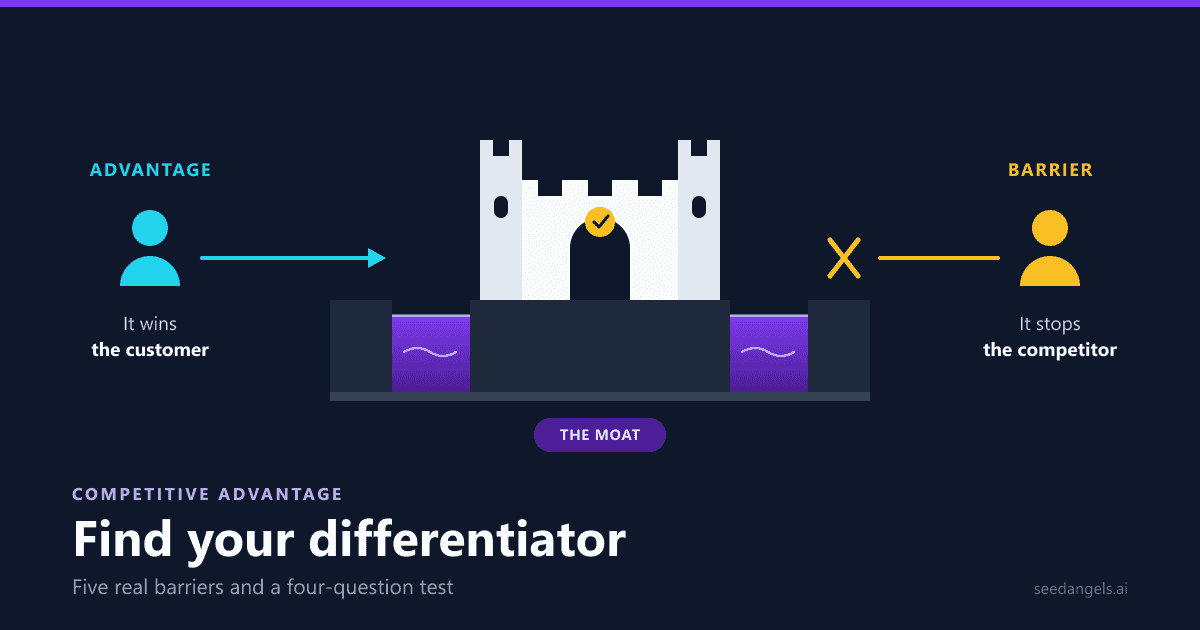
An advantage explains why a customer chooses you today. A barrier explains why a competitor cannot take that customer from you tomorrow.
They are two different mechanisms with two different horizons. The advantage acts at the point of sale: it wins the customer. The barrier acts afterwards: it keeps them, and above all it discourages the entrant who would have come looking. A business plan with only the first describes a good launch. It does not describe a defensible company.
The practical consequence is direct. If you list five advantages and not one barrier, you are explaining to an investor why you will succeed in year one, and why anyone can do the same in year two.
| What wins the customer (advantage) | What stops you losing them (barrier) |
|---|---|
| An interface simpler than the competition's | The data the customer has built up with you and would lose by leaving |
| A price 20% below the market | A structurally lower cost base that makes that price sustainable |
| A 48-hour delivery window | A logistics network that would take two years and millions to replicate |
| Human support customers appreciate | The processes and multi-year contract that make switching vendors expensive |
| A feature nobody else has yet | The patent, licence or exclusivity that makes copying it illegal |
Note that the right column does not oppose the left one: it extends it. Each barrier is what turns a point-in-time advantage into a position you can hold.
What a barrier to entry actually means
The term has a precise economic meaning worth keeping. A barrier to entry is a fixed cost a new entrant must bear that incumbents did not have to bear, regardless of how much they end up producing or selling (Barriers to entry, Wikipedia). Economists distinguish structural barriers, caused by inherent industry conditions such as upfront capital investment, economies of scale and network effects, from strategic barriers, which incumbents create or reinforce deliberately: exclusive supply or demand contracts, for instance.
Two things follow. First, a barrier is not necessarily legal: an entrenched buying habit, a locked distribution network or an accumulated database are structural barriers with no filing involved. Second, some barriers are built rather than inherited, which is precisely the subject of the section on trajectories further down.
The moat, or the ditch around the castle
In investor vocabulary this idea has a name: the moat. The metaphor is simple: your company is a castle, your profits are what it shelters, and the moat keeps at bay the competitors trying to erode your market share, your pricing power and your profitability (Trustnet).
The expression is associated with Warren Buffett, who has used it more than twenty times in Berkshire Hathaway shareholder letters since 1986 (Economic moat, Wikipedia). It survived because it forces the right question: not « are you good? », but « what surrounds you? ».
The fake advantages (and how to rescue them)
Six formulations show up in almost every business plan. None of them is a lie; all of them fail the three-condition test as written. For each: what the investor actually hears, and the reformulation that makes it admissible when one exists.
« Our team »
What is heard: « I have nothing else ». A team is a mobile asset: it gets poached, it gets tired, it gets hired elsewhere. It fails the third condition head-on. And at the earliest stage the point is sharper still: before the company exists, the strengths and weaknesses in any SWOT analysis are essentially the founders' own, which means every project in the room has exactly the same thing to offer. That does not differentiate anyone.
The reformulation that rescues it: it is never the team in general, it is a specific, non-reproducible experience of this exact problem. « We spent seven years running procurement for three of the sector's buying groups, we know the buyers by name, and we know why the existing tools get rejected internally. » That, a competitor cannot buy.
« Our UX » or « our design »
What is heard: « one quarter of delay for a funded competitor ». An interface can be looked at, taken apart and rebuilt. There is no protection on a user experience, and the best ones get copied faster precisely because they are obvious once seen.
The reformulation that rescues it: UX stops being an argument in itself and becomes the engine of a measurable barrier. « Our onboarding takes time-to-first-use from 40 minutes to 6, which lifts activation from 22% to 61% and lets us acquire at a cost our competitors cannot sustain. » The advantage is no longer the design: it is the unit economics the design produces.
« We were first »
What is heard: « and the second one will arrive better funded ». Being early is not a barrier: it is a window. The first entrant pays to educate the market; the next one benefits for free. Golder and Tellis put a number on that reversal - pioneers failed 47% of the time - which is also why arriving after an established competitor is almost never a verdict in itself.
The reformulation that rescues it: earliness only counts through what it let you build in the meantime. Installed base, accumulated data, multi-year contracts signed, search visibility established. « We arrived eighteen months before the others, and we used those eighteen months to sign seven of the sector's ten largest players on three-year contracts. » The head start is not the argument; the lock it allowed you to install is.
« Our price »
What is heard: « a price war you will lose ». A low price without a structural cost advantage is not a strategy, it is a sacrificed margin. The better-capitalised competitor can play that game longer than you can, and it is their preferred method for clearing a market.
The reformulation that rescues it: show the cost, not the price. « Our automated process handles a file in 4 minutes of labour against 90 minutes for the industry standard: we are 30% cheaper while holding 62% gross margin. » A low price becomes an advantage the day it is the visible symptom of a cost base the others do not have.
« Our technology »
What is heard: « how long to rebuild it? ». Absent an enforceable patent or a genuine lock (access to data, a licence, specific infrastructure), the question is not whether the technology exists but the catch-up time. A technical investor will estimate that delay in seconds, and it is almost always shorter than the founder believes.
The reformulation that rescues it: quantify the catch-up and anchor it to something that cannot be coded. « The model is trained on 12,000 annotated files collected from our customers since 2023; reproducing that corpus would take two years of collection, and the volume grows with every new user. » Here the technology is not the barrier: the data feeding it is.
« Our customer service »
What is heard: « real, but fragile ». This is probably the most honest of the six: excellent service genuinely wins customers. It rarely holds on its own, because it costs an opponent nothing more than a hiring budget.
The reformulation that rescues it: service becomes a barrier the day it produces switching costs. Configuration done jointly with the customer, history of handled cases, an account manager who knows their organisation, internal processes shaped around yours. « At our 40 largest accounts, our team configured the internal reference data; switching vendors would mean redoing that work with the operating teams. » At that point, service quality has turned into a lock.
The five real sources of barrier
Five mechanisms durably protect a position: network effects, switching costs, structural cost advantage, intangible assets and efficient scale (Economic moat, Wikipedia). The objection arrives immediately, and it is fair: « I am not Coca-Cola ». It does not hold. Each of the five mechanisms has a version available to a small company, and that version is the one that concerns you.
Network effects
The service gains value as the number of users grows. Every new arrival improves the experience of the previous ones, which makes leaving costly and makes a competitor's entry hard: they would have to start with an empty product.
The accessible version: the small-company version is not global, it is local or sector-specific. A marketplace between tradespeople and contractors within one region, a professional community, an industry directory everyone consults because everyone is in it. On a defined territory, density substitutes for scale: a competitor arriving with ten members against your eight hundred has nothing to sell.
Switching costs
Switching costs are what a customer would have to pay, in time, money or risk, to move to someone else. They are not imposed: they accumulate, and they are why a mildly dissatisfied customer stays anyway.
The accessible version: integration into the customer's management system, the data history they would lose by leaving, the training already delivered to their teams, internal procedures written around your software, a compliance constraint that makes any vendor change slow to approve. None of those five requires capital: they require consistency and an interest in the customer's operations rather than in their purchase alone.
Structural cost advantage
Producing or distributing durably more cheaply, through process, automation, location or privileged access to a resource. The important distinction is between cost and margin: selling cheaper by shaving your margin is not a cost advantage, it is a temporary subsidy to your customers.
The accessible version: an automated process on the most labour-heavy step, direct sourcing that removes an intermediary, a location that halves logistics cost in your area, a model without a sales force in a sector that employs one. The test is simple: if your competitors matched your prices tomorrow, would they lose money where you make it?
Intangible assets
Brands, patents, licences, approvals. These are the most legible barriers because they are enforceable, and also the category where founders wrongly assume they are excluded, because they think « patent ».
The accessible version: a regulatory approval that takes a long time to obtain, a demanding certification few players in your area hold, rare know-how, a documented local reputation: four hundred verified reviews at 4.8 in a market where the runner-up has thirty. Reputation is only a barrier under that evidence condition: what protects you is established loyalty, not hoped-for loyalty.
Efficient scale and the niche
Unit cost falls as volume rises, which widens the gap with a smaller entrant. Its useful cousin for small companies is the niche: in a narrow market, a well-established player discourages entry because the pie does not feed two. A competitor arriving would split an already tight market, and the arithmetic deters them before they try.
The accessible version: dominate a segment large players find too small and small players find too technical. It is the most underrated barrier available to a company of fewer than fifty people, and often the sturdiest.
| Source of barrier | Well-known example | Version available to a small company |
|---|---|---|
| Network effects | A global marketplace | Local marketplace, professional community, reference industry directory |
| Switching costs | An ERP deployed across a large group | Integration into the customer's tool, data history, trained teams, procedures written around you |
| Cost advantage | A continental logistics network | Automation of the most manual step, direct sourcing, model without a sales force |
| Intangible assets | A patent portfolio | Regulatory approval, rare certification, specific know-how, local reputation documented by reviews |
| Efficient scale | A dominant industrial player | Dominant position in a niche too narrow for two profitable players |
The four-question test
Now take the advantage you wrote in your business plan and put it through four questions. They derive from the VRIO framework (value, rarity, imitability, organisation), a resource-based analysis attributed to management scholar Jay Barney, formulated in the early 1990s and later completed with the organisational dimension. The history of the framework matters little here: what matters is that the four questions are asked in this order, and that only one of them decides.
- Value: does this advantage let you win a customer or reduce a cost, measurably? If you cannot tie it to a conversion rate, an average order value, a retention rate or a cost line, the answer is no. « Customers appreciate it » is not a measurement.
- Rarity: how many of your direct competitors could write the same sentence today? Do the exercise literally: open three competitor sites and look for your own argument. If it is there, you are describing a market standard, not a rarity.
- Imitability: how much time and how much money would a properly funded competitor need to reproduce this advantage? Answer in months and in euros, not in « it's hard ». Six months and €200,000: not a barrier. Three years, a regulatory approval and a database that cannot be bought: that is one.
- Organisation: is your company genuinely structured to exploit it? An advantage nobody uses in the sales narrative, the pricing or the product is dormant potential, not a position.
How to read the results: three positive answers out of four almost never suffice, because question 3 is the one that decides. An advantage that is valuable, rare and well exploited but copyable in a quarter gives you a good quarter. Conversely, a modest advantage that is genuinely hard to imitate beats a superiority claimed across six dimensions.
The market test that confirms the internal one
The four questions are declarative: you answer them yourself, with the bias that implies. One external indicator corrects for it: are your margins durably higher than those of your direct competitors?
It is the most reliable symptom of a real barrier. A protected company does not need to discount to sell: it keeps its pricing power. Conversely, a margin aligned with the sector year after year generally indicates a position without particular protection, whatever advantages the brochure claims. Competitor accounts are public in most jurisdictions and give an order of magnitude sufficient for this comparison; it is also what an investor checks before asking you the question. The procedure (finding the right legal entity, pulling the accounts and extracting the margin rate) takes a few minutes per competitor, and we set it out in our method for analysing your competitors' figures.
Building a barrier when you do not have one yet
Here is what most articles on the subject leave out: at the earliest stage, you almost never have a constituted barrier. That is normal, and pretending otherwise is the worst possible answer, because it is the one that gets disproved in ten minutes.
What matters at this stage is not the barrier: it is the trajectory. Which barrier is what you are doing today building? An investor does not expect to find a dug moat at an eighteen-month-old company. They expect you to know which one you are digging.
Three realistic trajectories, to pick according to your model:
1. Accumulate proprietary data through usage. Every use of your product should leave behind something only you own: annotated files, performance histories, enriched reference data. The barrier does not exist at launch, it is deposited month after month, and it has the rare property of thickening on its own. The milestone to announce is a volume: « at 5,000 files, our model reaches an accuracy level an entrant cannot replicate without two years of collection ».
2. Create switching costs through integration. Stop selling a standalone tool and connect to what the customer already uses: their ERP, their accounting software, their CRM. Every integration delivered turns a cancellable customer into an installed one. The milestone is a rate: « 60% of our base connected to at least one third-party system within twelve months ».
3. Lock down a distribution channel. An exclusive partnership, a listing with an industry prescriber, a slot in a buying group. The barrier is not in your product but in the path leading to it, and that path, once taken, is no longer available to the next entrant. The milestone is a signed contract, with its duration.
What you can honestly say to an investor
« Today our protection is weak: our product could be rebuilt in about nine months by a team of three developers. What could not be rebuilt is the corpus we are accumulating. We have 1,800 annotated files, we add 400 a month, and we estimate that at 5,000 the accuracy gap becomes hard to close. Our eighteen-month roadmap is built around that threshold. »
That answer is stronger than a barrier asserted without evidence, for a simple reason: the investor is testing your clear-sightedness as much as your position. A founder who knows exactly where they are vulnerable is a founder who will correct it. This dated, milestone-anchored reasoning is what an investor looks for across your whole deck, which we break down slide by slide in our pitch deck guide.
To lay this thinking flat before writing it up, the Lean Canvas generator is a good starting point: the format includes an « unfair advantage » box you have to fill in one line, which forces you to decide what is genuinely defensible and what is not.
How to write it in a business plan or a pitch
With the analysis done, it remains to write it. And the phrasing changes with the reader, because they are not looking for the same thing.
For a lender, the competitive advantage has to explain why your revenue forecast is achievable against the players already in place. Their question is not domination, it is repayment: where will those customers come from, given that today they are somebody else's? A defensible position makes the forecast credible; without one, your acquisition assumptions read as a wish. This is what connects the section to the rest of your market analysis, whose construction we detail in our complete business plan guide.
For an investor, the advantage has to explain why growth does not stop when a competitor raises money. Their horizon is the exit: they are buying a position five years out, not this year's sales. That is why they will press on the barrier rather than the advantage, and why an answer centred on execution leaves them cold. Dealing with competition by avoiding the subject is one of the costliest mistakes in fundraising, which we cover among the classic pitch deck mistakes.
The standard formulation, in one sentence
Whoever the reader is, a good formulation contains three elements in this order: the advantage, the evidence, the barrier.
B2B example: « We process a financing file in 4 minutes against a 90-minute industry average (advantage), confirmed by the 1,200 files run through our tool since January at a 0.4% error rate (evidence); that performance rests on a corpus of 12,000 annotated files accumulated since 2023 that would take an entrant more than two years to assemble (barrier). »
Local B2C example: « We are the only approved centre in the region for this procedure (advantage), with 430 verified reviews at 4.8/5 where the runner-up has 40 (evidence); the approval takes 18 months to obtain and requires equipment whose amortisation demands a volume the local market only supports for one operator (barrier). »
Three sentences of that calibre beat a page of adjectives. If you cannot fill in the third element, do not disguise it: write the trajectory from the previous section instead. In a deck, that sentence becomes the subtitle or the right-hand column of your competition slide, which has to carry the barrier and not just the comparison table.
That is exactly the work SeedAngels structures for you: the business plan asks you to name your advantage, anchor it to quantified evidence and test it against your competitive analysis, section by section, rather than leaving it floating in an introductory paragraph.
Conclusion
A competitive advantage is not a box to fill with whatever you do best. It is a hypothesis, and like any hypothesis it gets tested: measurable value, rarity verified against three competitors, catch-up time quantified in months and euros, actual exploitation inside your organisation.
That test is harsh, and what you had written probably does not survive it as written. This is not a failure: it is simply the gap between an advantage, which wins a customer today, and a barrier, which stops you losing them tomorrow. Most young companies only have the first, and saying so clearly while showing which barrier you are building, with a dated milestone, is stronger than claiming an imaginary protection.
Keep the hierarchy in mind: a modest but honestly tested advantage beats a superiority claimed across six dimensions. The first fits in one sentence with a number in it. The second collapses at the first follow-up question.
FAQ
What is a competitive advantage?
It is a superiority that meets three cumulative conditions: it creates value the customer perceives, your competitors do not offer it at the same level, and it is hard to imitate or substitute. All three matter. A genuine strength that any competitor can reproduce in a few months is not a competitive advantage: it is a temporary head start.
What is the difference between a competitive advantage and a barrier to entry?
The advantage explains why a customer picks you today; the barrier explains why a competitor cannot take that customer from you tomorrow. A barrier to entry is a cost a new entrant must bear that incumbents did not: a patent, a licence, an established brand loyalty, a capital-heavy asset. A solid business needs both.
What are the types of competitive advantage?
Traditionally two: cost advantage, which lets you produce or distribute more cheaply, and differentiation, which rests on the offer, the brand or specific know-how. But the useful question is not the category, it is durability: five sources of protection actually hold over time: network effects, switching costs, structural cost advantage, intangible assets and efficient scale.
How do I know if my competitive advantage is durable?
Ask it four questions, derived from the VRIO framework. Does it create measurable value for the customer? Is it rare among your competitors? How much time and money would a funded competitor need to imitate it? Is your company organised to exploit it? The third question is the one that decides: if the answer is counted in months, it is not a barrier.
What is an economic moat?
The moat is the metaphor popularised by Warren Buffett for whatever durably protects a company's profits, the way a moat protects a castle. He has used it more than twenty times in Berkshire Hathaway shareholder letters since 1986. Five sources are usually distinguished: network effects, switching costs, cost advantage, intangible assets and efficient scale.
Can a small company have a durable competitive advantage?
Yes, as long as you stop looking for the large-company version. A documented local reputation, proprietary data accumulated through usage, a regulatory approval that is hard to obtain, a technical integration that is expensive to unwind, or a dominant position in a niche too narrow for two players are all real barriers, available without a patent or a marketing budget.
What should you answer when an investor asks what protects you?
Do not say « our team » or « our head start ». Name the barrier you are building, say where you are on it, and give the date it becomes effective. A barrier under construction, dated and consistent with your roadmap, is more credible than protection claimed without evidence. The investor is testing your clear-sightedness as much as your position.