What your competitive analysis has to produce
You do not have a concept to understand, you have a section to fill. Somewhere in the middle of the market research part of your business plan sits a heading called "Competition" with two blank pages underneath it. This article starts from what you have to produce, not from the theory.
The expected deliverable is two to three structured pages, in four blocks, and it is the same whether you are writing for a bank, a startup programme or an investor:
- The mapping: who your direct competitors, indirect competitors and substitutes are.
- The comparison grid: 3 to 5 competitors set side by side on the criteria a customer actually decides on.
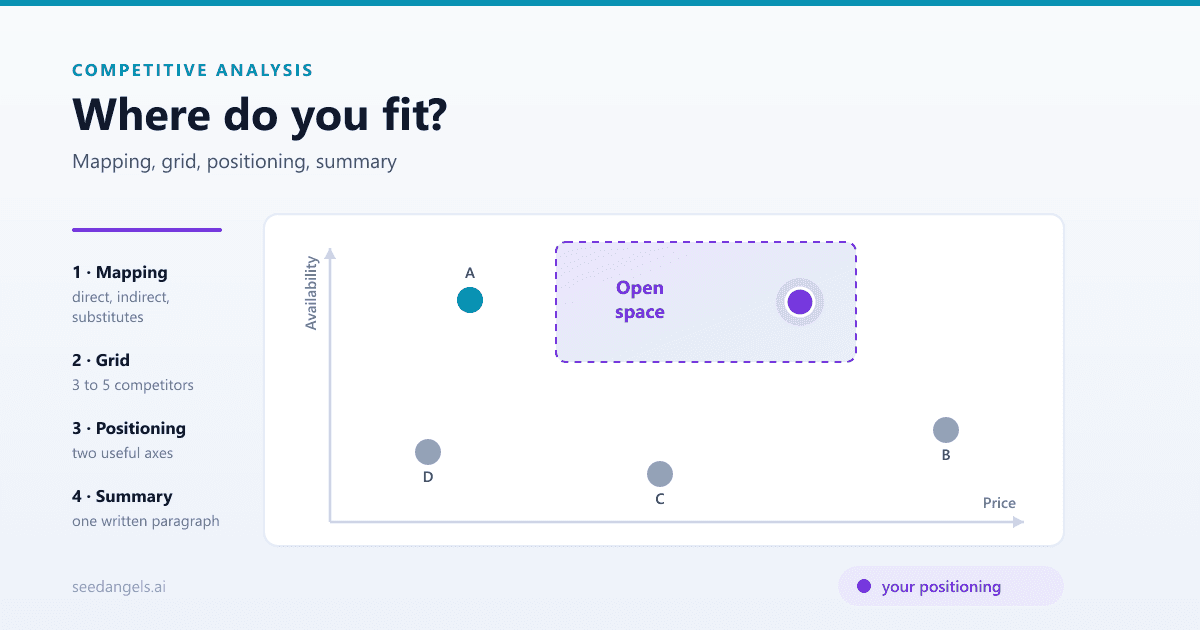
- The positioning: a two-axis map showing where everyone sits, and where space is left.
- The summary: a written paragraph that states your position and defends it.
This section gets read closely, for a precise reason: it is the best available detector of a project that was imagined rather than researched. A financial forecast can be invented in an evening. A documented competitive landscape, with prices you collected, trading histories you verified and weaknesses you named, cannot. Your reader is not trying to find out whether you are better than the others. They are trying to find out whether you know who the others are.
To keep everything connected, one worked example runs from beginning to end of this article: a dog grooming salon with a day-care service, opening in a town of 60,000 people. You will watch it move from a list of competitors to a fully written summary, without switching examples halfway through.
The questions a lender expects you to answer
Before you open a spreadsheet, know what you are answering. The U.S. Small Business Administration sets out what a competitive analysis should establish: identify the competition by product line and market segment, then assess market share, strengths and weaknesses, your window of opportunity to enter the market, the barriers that may hinder you, and the indirect or secondary competitors who may affect your success.
Reduce that to five questions you can actually write against:
- How many of them are there?
- Where are they?
- What do they offer?
- At what prices?
- Why would a customer choose you over them?
These five are your editing filter. Everything in the section should serve one of them; anything that serves none of them can be cut without loss. The paragraph on the history of the industry since 1980, the textbook definition of perfect competition, the reminder that "the market is highly competitive": none of that answers any of the five.
The exercise does not stop at itself either. What you find here feeds directly into the rest of the plan: the prices you collect from competitors become your pricing assumptions, and their trading volumes frame your volume assumptions.
Step 1: map every competitor
Direct competitors, indirect competitors and substitutes
A direct competitor offers a similar product to the same audience: two pizzerias on the same street. An indirect competitor meets the same need with a different offer: the supermarket selling sandwiches across from the lunch restaurant. A substitute removes the need to buy your category at all: the customer solves the same problem by an entirely different route.
On the worked example, that produces three distinct families:
| Type | Who, specifically | What they capture |
|---|---|---|
| Direct | The 3 grooming salons in the area, the mobile groomer who visits customers at home | The same customer, for the same service |
| Indirect | The 2 veterinary practices offering grooming alongside treatment, the retail-park pet store with its self-service wash station | The same need, by another route |
| Substitutes | The owner who clips the dog themselves, the £80 clipper bought online, the neighbour or relative who looks after the animal | The purchase disappearing altogether |
The minimum benchmark is at least three direct and three indirect competitors. The reason is less about completeness than about being honest on risk. Customer attrition rarely comes from the direct competitor you watch closely; it comes from the workaround the customer finds elsewhere, often cheaper and less convenient but good enough. A business plan that lists only direct competitors mechanically understates its commercial risk, and an experienced reader spots that immediately.
The competitor everyone forgets: the status quo
Your most serious competitor appears on no register: it is whatever your customer does today instead of buying from you.
They do nothing and postpone the decision. They improvise with a spreadsheet. They keep the supplier they complain about but never replace. They ask a friend. Those four behaviours are the four faces of the status quo, and for a new offer they almost always capture more potential customers than every named competitor combined. They have zero cost on their side, no adoption effort, and the fact that nobody has to justify a change to anybody. Those workarounds cannot be deduced from a register: they are observed in interviews, which is exactly what the process of validating a business idea produces, a customer who has already improvised a solution has named your real competitor at the same time as they proved the pain.
This is also the structural answer to the reflex "I have no competitors". You always have one: inertia. And how you write it changes everything. The opposite reflex, "someone already does exactly this, so it is over", deserves the same rigour: six checks are enough to qualify an established competitor and separate the player who genuinely holds the ground from the one who merely announced it.
Before: "There is no direct competitor offering this service in the town."
After: "Of the estimated 4,200 dog-owning households in the catchment area, we estimate 55% groom their animal themselves, 30% use one of the three existing salons, 10% go through their vet and 5% do not groom at all. Our primary competitor is therefore home grooming, against which we position on time saved and the associated day-care service."
The first version tells the reader you did not look. The second tells them you counted, and it hands you the structure of your sales argument as a by-product, because you now know exactly whose customers you are taking.
How many competitors to keep
Three to five, analysed in depth. The selection criteria matter more than the count: same catchment area, same customer segment, comparable size. Always add one market leader as a high reference point, even if they do not compete with you head-on: they set the standard your customers have in mind. For a shop, listing the competitors in your trade area takes an industry code and a free public business register.
A list of fifteen names without a single figure is less impressive than a detailed comparison of three genuinely relevant players. Length of list is not a signal of rigour; depth of each line is.
Step 2: the comparison grid, filled in
This is the heart of the deliverable, and it is where most business plans stop at a blank template downloaded from somewhere. Here is that same grid, filled in on the worked example.
| Competitor | Type | Trading since | Staff | Offer | Average price | Target | Channel | Strength | Weakness |
|---|---|---|---|---|---|---|---|---|---|
| Central Grooming | Direct | 14 years | 2 | Full grooming | £48 | Owners aged 50+ | Town-centre footfall | Local reputation, loyal customer base | No online booking, closed Saturday afternoons |
| Paws & Scissors | Direct | 3 years | 1 | Grooming, scissor work | £58 | Pedigree, show dogs | Instagram, word of mouth | Recognised technical specialism | Three-week waiting list, single operator |
| GroomVan | Direct | 2 years | 1 | Mobile, at the customer's home | £66 | Working owners, reduced mobility | Online booking | No travel at all for the customer | Capacity capped at 4 dogs a day |
| Lime Tree Vets | Indirect | 22 years | 6 | Grooming alongside treatment | £42 | Existing veterinary clients | Internal referral | Clinical trust, captive volume | Secondary service, few slots |
| Home grooming (status quo) | Substitute | n/a | n/a | Owner's own clipper | ~£13 a year amortised | All | n/a | Near-zero cost | Uneven results, 90 minutes of work |
| Our project | n/a | 0 | 2 | Grooming + day care | £53, plus £19 per day of care | Working owners aged 30-50 | Online booking, referral partnerships | Open 7:30am-7:30pm, combined offer | No reputation, limited opening cash |
Three things make this grid useful, and they copy across to any sector.
The columns are decision criteria, not characteristics. Keep only what a customer genuinely weighs when choosing: price, availability, proximity, specialism. The square footage of the premises or the year the website was redesigned enters no purchase decision, and therefore no column.
Your own row contains a weakness. The grid where your column ticks every box while each competitor misses at least one is the most immediate naivety signal a plan can send. Nobody believes a new entrant is superior on every axis. Writing "no reputation, limited opening cash" does not weaken you: it proves you looked at the market without a filter.
The figures are verifiable. Prices come off websites and shop windows. For headcount, revenue and margin, filed company accounts are public: in the UK, the Companies House register lets anyone search a company and view its filed accounts for free, and most jurisdictions have an equivalent. Cross-check against sector benchmarks from your national statistics office or trade association so you can place a competitor against its sector average rather than in the abstract. The difficulty starts when a competitor is a sole trader or files abridged accounts: our method for retrieving a competitor's figures works through the reconstruction from headcount and average basket in exactly that case.
One warning worth taking seriously: benchmarking against revenue observed at comparable competitors is sound method, but importing figures from another town or region without adjusting them is not. A city-centre salon and a small-town salon share neither basket size nor rent.
Step 3: the positioning map
The positioning map is a two-axis chart on which you place each competitor according to two customer decision criteria. Its purpose is simple: to make the space nobody occupies visible.
Everything hinges on the choice of axes, and this is the part almost nobody handles seriously. A price/quality map is useless, because everyone declares themselves high-quality: you get a cluster of dots in the top-right corner, yourself included, and the chart says nothing. Good axes meet two conditions at once: competitors genuinely spread out along them, and customers genuinely decide on them.
Some pairs that work, by type of business:
- Local services: opening hours × price level, or degree of specialism × breadth of offer.
- Retail: depth of range × level of service, or price × immediacy of availability.
- B2B and software: degree of customisation × total cost of ownership, or size of customer served × speed of implementation.
On the worked example, the two axes that actually discriminate are price level and availability for a working customer (opening hours, waiting time, online booking).
   High availability
            │
            │   GroomVan ●          ● Our project
            │     (£66)             (£53 + day care)
            │
   ─────────┼──────────────────────────────────────►  Price
   low      │                                   high
            │  Vets ●         ● Central Grooming
            │  (£42)               (£48)
            │                  ● Paws & Scissors
            │                     (£58, 3-week wait)
   Low availability
The open space appears at the top, in the middle: high availability at a market price. GroomVan owns availability, but at a premium and with a four-dog daily ceiling. The established salons hold the market price, but on hours built around customers who are free during the day. The project sits precisely between the two, and the day-care service is what justifies pricing slightly above Central Grooming.
One honest note about this tool: the positioning map is as much an instrument of communication as of analysis. You choose the axes, so you partly choose the result. That does not disqualify it, and it forces you to articulate what you differentiate on, but it imposes one rule: choose your axes before you look at where you land, never after.
Step 4: SWOT and five forces, without the lecture
Neither framework should take up half your section. They exist to summarise what the grid and the map have just produced.
SWOT applied to your own project
SWOT crosses two diagnoses: an internal one, covering what you are responsible for (strengths and weaknesses), and an external one, covering what you are subject to (opportunities and threats). That dividing line is the only thing you need to hold in mind before filling the boxes.
There is a point specific to a business that has not started trading: with no company yet in existence, the strengths and weaknesses are first and foremost those of the founding team. No market share to claim, no customer book: what you have is a track record, a set of skills and a network.
On the worked example:
| Strengths (internal) | Weaknesses (internal) |
|---|---|
| 8 years of salon experience, professional grooming qualification | No local reputation on opening day |
| Open 7:30am to 7:30pm, unique in the area | Limited personal contribution, tight cash for the first 6 months |
| Combined grooming and day-care offer, no local equivalent | Two people only: heavy dependence on the owner |
| Opportunities (external) | Threats (external) |
|---|---|
| Two new residential developments completing by 2027 | Central Grooming could extend its hours in response |
| No competitor open before 9am or after 6pm | Animal boarding regulation: demanding premises and standards |
| Continued growth in spending per pet | Squeezed household budgets on a non-essential service |
Two or three short items per box is enough. A matrix with eight lines per quadrant is no longer a summary, it is an inventory, and it will not be read.
Porter's five forces in half a page
The five forces model assesses whether a sector is structurally profitable, not merely whether your direct competitors are numerous. As Harvard's Institute for Strategy and Competitiveness frames it, the model helps assess industry attractiveness and find better strategic positions within the industry. For a founder, each force reduces to one useful question:
- Rivalry among existing competitors: do the incumbents fight on price, or coexist?
- Threat of new entrants: what stops someone opening across the street next year? Required qualification, capital outlay, scarce location, exclusive contract: these are your barriers to entry, and they protect the incumbents just as much as they would protect you.
- Threat of substitute products or services: what can your customer replace your offer with, without buying from a competitor?
- Bargaining power of suppliers: do you depend on a single supplier, or on a platform that sets the rules?
- Bargaining power of buyers: are your customers concentrated, and is switching free for them?
That last question deserves its own point: switching costs. A customer who would have to re-enter data, learn a new tool or rebuild a relationship of trust changes supplier far less readily. On the worked example, a dog accustomed to the day-care creates a genuine emotional switching cost, an asset the grid does not show.
Be clear-eyed about when to use this framework. In a structured market, with concentrated suppliers or powerful buyers, Porter gives you real analytical leverage. For a local business it is often filler: the five forces collapse into local rivalry and substitutes, and filling in all five boxes on principle adds a page without adding information. In that case, cover the two forces that matter in three sentences and move on.
Step 5: writing the summary
Everything above is worth nothing unless it closes on a written paragraph. This is what your reader will retain, and it is the part almost no business plan gets right. Here is the summary for the worked example, as it would appear in the document:
Competitive summary. The catchment area contains three grooming salons and two veterinary practices offering grooming alongside treatment, serving roughly 4,200 dog-owning households. None of these operators opens before 9am or after 6pm, and two close on Saturday afternoons. The primary competition, however, remains home grooming, practised by a majority of owners: near-zero in cost, but requiring ninety minutes of work for an uneven result. Our positioning targets the space this configuration leaves open: opening hours of 7:30am to 7:30pm combined with full-day care, at £53, in line with the local market. That combination addresses working owners aged 30 to 50 whose constraint is not price but scheduling. Our weakness is identified: we open with no reputation against a salon that has traded for fourteen years and holds a loyal customer base. The first six months therefore rest on referral partnerships with the two veterinary practices and on online acquisition, budgeted as such in the funding plan.
That paragraph contains five elements, and you can reuse them in this order:
- The market observation: how many players, against what demand, with a figure.
- Where the players stand: what they all do, and what none of them does.
- The open space: the one the positioning map exposed, named explicitly.
- The claimed advantage: your particular combination, and the customer segment it matters to. This is the point where you have to be able to explain why the advantage holds over time, not just on opening day.
- The acknowledged weakness, and how you handle it: the most important element. Admitting a disadvantage against an established competitor does not weaken the case: it is what makes the previous four points credible. A summary with no shadows in it reads as a sales pitch, and a sales pitch does not get financed.
Point 4 is the one that resists hardest: a combination of offers is copied within a season if nothing protects it, and turning a claimed advantage into a real barrier means anchoring it to a mechanism (switching costs, a network effect, an intangible asset) rather than to quality of execution.
If you want to formalise the positioning that comes out of this summary before writing it up, our Business Model Canvas generator lays out value proposition, customer segments and channels in a few minutes from your idea. It doubles as a coherence test: if the value proposition will not fit in one sentence, the competitive summary will not write itself either.
Once the section is drafted, it has to connect to the rest of the document: the prices you collected become your revenue assumptions, the weaknesses you acknowledged become cost lines. SeedAngels builds the full business plan while keeping that link between market analysis and forecast, and flags the inconsistencies between the two.
Where this section goes, and how long it should be
The competitive analysis belongs in the market research part, after market sizing and segmentation, and before the go-to-market strategy. The order is not cosmetic: it follows the reasoning your reader is doing anyway. Market size says whether there is room; the competitive analysis says who already occupies it; the commercial strategy says how you take your share. Check it against the full structure of a business plan and you will find the same sequence.
That sequencing assumes the market has been sized first, which is the job of the TAM SAM SOM method: it answers "how big is this market" where this section answers "who occupies it, and where is there space left". The two are read together, and a large market facing a saturated competitive landscape tells a very different story from the same figure in an emerging one.
On length, adapt to the reader:
- Bank business plan: two to three pages, with the grid inside the body text.
- Investor document: one dense page, weighted towards synthesis and positioning, with the full grid moved to an appendix.
- In every case: all four blocks present. What counts is not the page count but the fact that none of the four is missing.
Mistakes that discredit the section
- Claiming you have no competitors. Fix: describe how your customers currently meet the need, status quo included, in percentages.
- The grid where your column ticks every box. Fix: put at least one real weakness on your own row, and address it later in the document.
- Competitors named without a single figure. Fix: at minimum one collected price and one trading history per competitor, with two cross-checked sources per line.
- The price/quality map where you sit alone in the top-right corner. Fix: switch to two axes on which the players genuinely spread out.
- Forgetting substitutes and the status quo. Fix: always add a "what the customer does today" line to your mapping.
- Copying an analysis found online without adapting it to your area. Fix: prices, headcounts and competitive density are local; a figure imported from another town is a wrong figure.
- Confusing competitive analysis with running competitors down. Fix: describe weaknesses in factual, verifiable terms (hours, waiting times, capacity), never as value judgements.
Conclusion
A successful competitive analysis does not prove that you are better. It proves that you know what you are walking into: who holds the ground, at what price, with what limits, and what space is left once everyone is plotted on the map. It is an exercise in clear sight, not advocacy.
Go back to your section with a single test. Using only what you have written, could a reader who does not know your sector name your three main competitors, say what they charge, and explain why a customer would come to you? If the answer is no, it is not the wording that needs work: it is the fieldwork that needs doing again.
To fold this analysis into a complete, coherent business plan, from market research through to the financial forecast, Try SeedAngels for free →
FAQ
How do you write a competitive analysis for a business plan?
Work in four blocks. Map your direct competitors, indirect competitors and substitutes, including the status quo. Fill in a comparison grid covering 3 to 5 competitors on the criteria customers actually decide on. Plot everyone on a two-axis map to expose the open space. Close with a written summary that states your position and owns it.
What is the difference between a direct and an indirect competitor?
A direct competitor offers a similar product to the same audience: two pizzerias on the same street. An indirect competitor meets the same need with a different offer: the supermarket selling sandwiches across from the lunch restaurant. Substitutes, a form of indirect competition, are often the largest source of lost customers.
How many competitors should you analyse?
Three to five, analysed in depth. Selection matters more than count: same catchment area, same customer segment, comparable size. Add one market leader as a high reference point. A list of fifteen names with no figures is less convincing than a detailed comparison of three genuinely relevant competitors.
What if I think I have no competitors?
Widen your definition. Your competitor is whatever your customer does today instead of buying from you: a spreadsheet, an existing supplier, a friend, or nothing at all. The status quo is almost always the main competitor of a new offer. Claiming no competitors suggests either that the market does not exist or that the research was never done.
Should a business plan include a SWOT analysis?
Yes, as a summary rather than a substitute for the analysis itself. SWOT crosses an internal diagnosis (your strengths and weaknesses) with an external one (market opportunities and threats). For a business that does not trade yet, the strengths and weaknesses are mostly those of the founding team. Place it after the comparison grid.
How long should the competition section be?
Two to three pages in a business plan written for a bank, one dense page in an investor document that favours synthesis. The detailed comparison grid belongs in an appendix. What matters is not the length but the presence of all four blocks: mapping, comparison, positioning, summary.
Where can I find information about my competitors?
Combine three sources. Filed company accounts give revenue, margin and headcount for registered companies. Field sources (websites, published prices, customer reviews, a visit) give the offer and the positioning. Official statistics and trade bodies give sector context. Always cross-check at least two sources per competitor.