
The same as any startup (problem, solution, market, competition, team, financials, ask), with the weight on subscription mechanics: recurring revenue, price per customer, gross margin and break-even. That is why the Signal design opens on a "numbers that matter" page.
Free SaaS Startup Pitch Deck Template and ExamplePDF example + PowerPoint template
The complete pitch deck of Paramedic, SaaS software for home care agencies raising a $180,000 seed round. 28 slides in the Signal design, from the problem to the valuation, free to download.
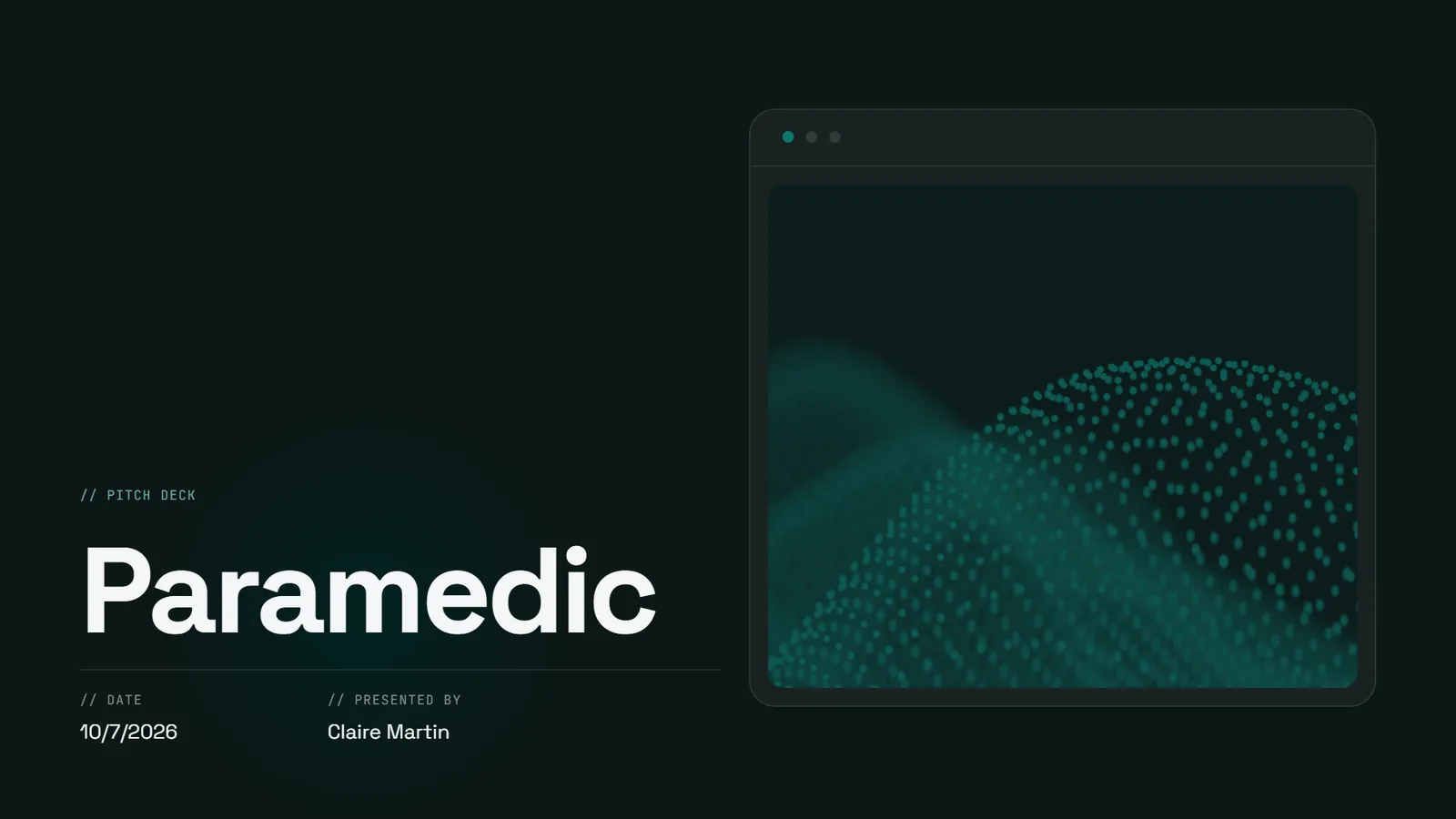
SaaS startup pitch deck, free downloads
PDF with no sign-up. PowerPoint sent by email.
The company in this example
Paramedic sells scheduling, online booking and billing software to non-medical home care agencies in the United States. The deck covers:
- Two plans: Essential at $59 a month and Advanced at $139 a month
- An $18bn market (TAM), $1.8bn serviceable (SAM) and $18M within reach (SOM), growing 6.4% a year
- Five competitors compared: AxisCare, AlayaCare, WellSky Personal Care, eCaring and Logicly
- Revenue of $31k in 2026, $203k in 2027 and $477k in 2028, profitable from 2027
- A $180,000 seed round for 26% of the company, a $679k valuation
- An appendix: sales growth, gross margin, expenses, EBITDA and investor return sensitivity
The pitch deck, slide by slide
The slides that matter most to an investor, and what they say about Paramedic.
- 01
The numbers that matter
Before the story, six numbers: total market, reachable market, 2028 revenue, EBITDA margin, break-even year and the amount raised. An investor knows within ten seconds whether to keep reading.
- 02
The problem
Three concrete pains of agency coordinators: scheduling across spreadsheets and calls, unbilled hours, caregivers who can't see their shifts. Each is told from the point of view of the person living it, before the product appears.
- 03
The market: TAM, SAM, SOM
Three sourced figures: $18bn, $1.8bn and $18M. The SOM is built from a number of customer agencies and an average price, which makes it checkable.
- 04
Where we stand
A two-axis map places Paramedic against its five competitors; the next slide details their strengths and weaknesses. Investors distrust a deck with no competition.
- 05
How we make money
Revenue streams (two subscriptions, paid implementation, premium modules) next to the customer segments that pay for them.
- 06
The team
A CEO from the industry, a CTO who has built caregiver apps, a head of sales who knows the buyers: each profile answers one risk of the project.
- 07
The numbers
Revenue, gross margin, operating expenses, EBITDA and net profit over 3 years in one table, under a headline that states the conclusion: $477k revenue in 2028.
- 08
The ask
$180,000 in equity for 26% of the company. The amount ties back to the forecast: it covers the cash need until break-even.
- 09
The valuation
The calculation is shown step by step: 2028 EBITDA × multiple = value at the end of the forecast, divided by the return investors expect. Investors can challenge an assumption, but they don't have to guess the method.
What this example teaches about SaaS pitch decks
A SaaS pitch deck is judged on subscription mechanics: what a customer pays, what it costs to serve them, and when the company turns profitable. Paramedic shows a 94% gross margin and break-even in 2027: those are the first two numbers an investor looks for, and the Signal design puts them up front.
Slide titles state the conclusion ("$477k revenue in 2028", "Raising $180k") rather than the topic ("Financials"). A deck sent by email should make sense from its titles alone. For the traps to avoid, see our guide to pitch deck mistakes.
SaaS pitch deck: frequently asked questions
Enough to reach the next milestone, usually 18 to 24 months of building and selling. Paramedic raises $180,000 for 26% of the company: the share follows from the valuation, itself derived from the last forecast year's EBITDA.
With the multiples method: 2028 EBITDA ($153k) times 8.6 gives $1.3M at the end of the forecast, brought back to today with the return investors expect (25% a year, 1.95x their money over 3 years): $679k after the round.
Yes. The PowerPoint file imports into Google Slides and opens in Keynote. Text, tables and charts stay editable; if a font is missing, the closest one is used.
Paramedic is a fictional company, but its market, competitors and sources come from real research run by SeedAngels, and its forecast is computed like any project's. The sources are listed on the last slide.
This pitch deck was made with SeedAngels
Get yours, built on your market and your own numbers.