A deck never fails for a single reason
A pitch deck almost never gets rejected for one spectacular error. It gets rejected by accumulation: three slides that leave a question unanswered, a number that does not match the previous one, a curve that nothing explains. Each of these signals is minor on its own. Together they produce a silent conclusion in the reader's mind ("this one isn't ready"), and you will never be told.
That is what makes diagnosis so hard: rejections are rarely explained. You get a "not for us at this stage" that teaches you nothing, or you get nothing at all. And the market leaves little room for approximation. Crunchbase data shows that seed deal counts have fallen since the 2021-2022 peak while more than half of seed dollars went into rounds of $10 million or above: bigger checks, fewer of them, and a materially harder landscape for the typical young startup. Screening happens earlier, and faster.
This article is not one more list of things to avoid. Every mistake is treated in three parts: the signal that reveals it in your deck, the reason the investor disengages at exactly that point, and the concrete fix, meaning what to write instead. At the end you will find a self-assessment checklist to apply directly to your document.
Why an investor stops reading
To understand the mistakes, you have to understand the real reading conditions. Your deck is not studied: it is skimmed, quickly, often on a phone, between two meetings, among a dozen others received the same week. The live format is no more generous: in a French angel network, Bpifrance Création notes that a first pitch to the selection committee runs ten to fifteen minutes at most, and angel groups elsewhere work to comparable formats.
Here is the counter-intuitive part: on a first read, the investor is not looking to be convinced, they are looking for a reason to eliminate. That is not bad faith, it is attention economics: they cannot go deep on twenty companies, but they can set fifteen aside quickly and work seriously on five. So your deck's job is not to prove everything, but to offer no easy grounds for elimination, and to make the next conversation worth having.
That changes the hierarchy of mistakes. Some hand over an immediate reason to pass: they concern the substance: the numbers, the market, the problem, the ask. Others cost attention and credibility without closing the door: they concern the finish. The first four mistakes in this article belong to the first category, the next six to the second, and that is the order in which to spend your correction time. To place each mistake against what a deck should actually contain, our guide breaks down the expected pitch deck structure slide by slide.
The 4 deal-breaking mistakes
These four share one trait: you cannot recover from them in the meeting, because they prevent the meeting from happening.
Mistake 1: financial projections with no assumptions
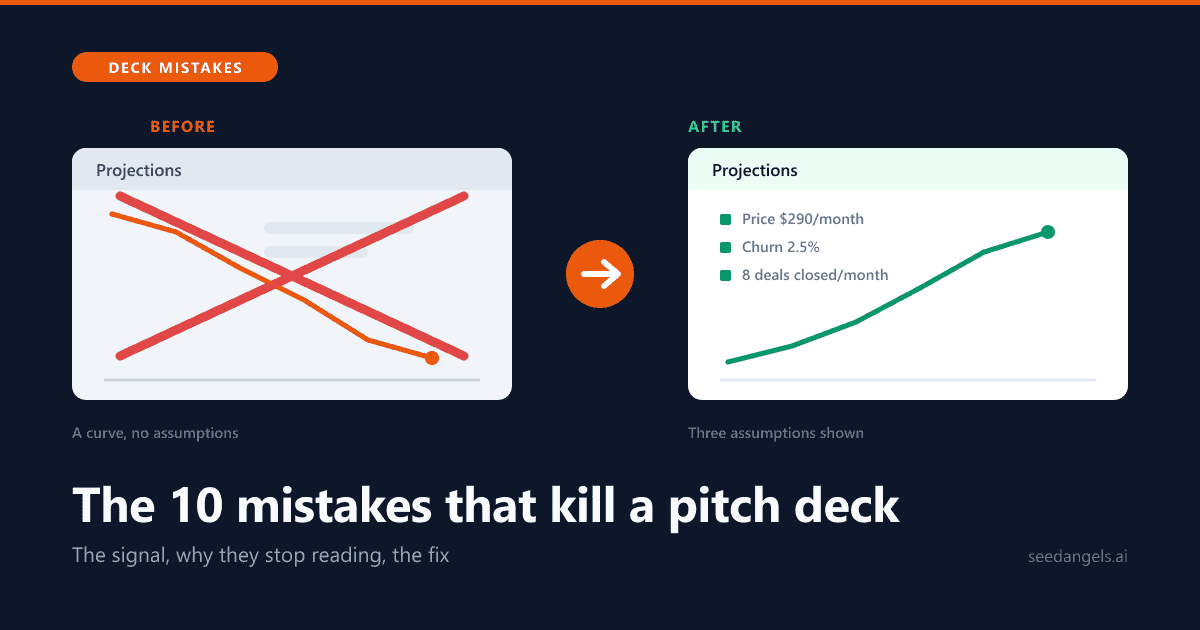
The signal. A revenue curve that takes off from year 2, and nothing on the slide explains why. Another version of the same problem: revenue multiplied by ten while sales headcount stays flat. The slide contradicts itself.
Why it stops them. The investor does not believe your year-3 number. Nobody does, including you. What they are testing is your method. A curve with no stated assumption proves nothing about your company, but it proves something about you: either you never built the calculation, or you set the result first and filled in the cells afterwards.
The fix. Show three quantified assumptions next to the curve, and build bottom-up, from the real mechanics of your business rather than a claimed percentage of a market. The SBA's own business plan guidance tells founders to clearly explain their projections and match them to the funding request, an explanation that is impossible without stating the assumptions underneath.
| Before | After |
|---|---|
| "Year 3 revenue: $4.2M" + an exponential curve | "Year 3 revenue: $4.2M, with average price $290/month, 1,200 active customers, 2.5% monthly churn, 4 reps closing 8 deals/month" |
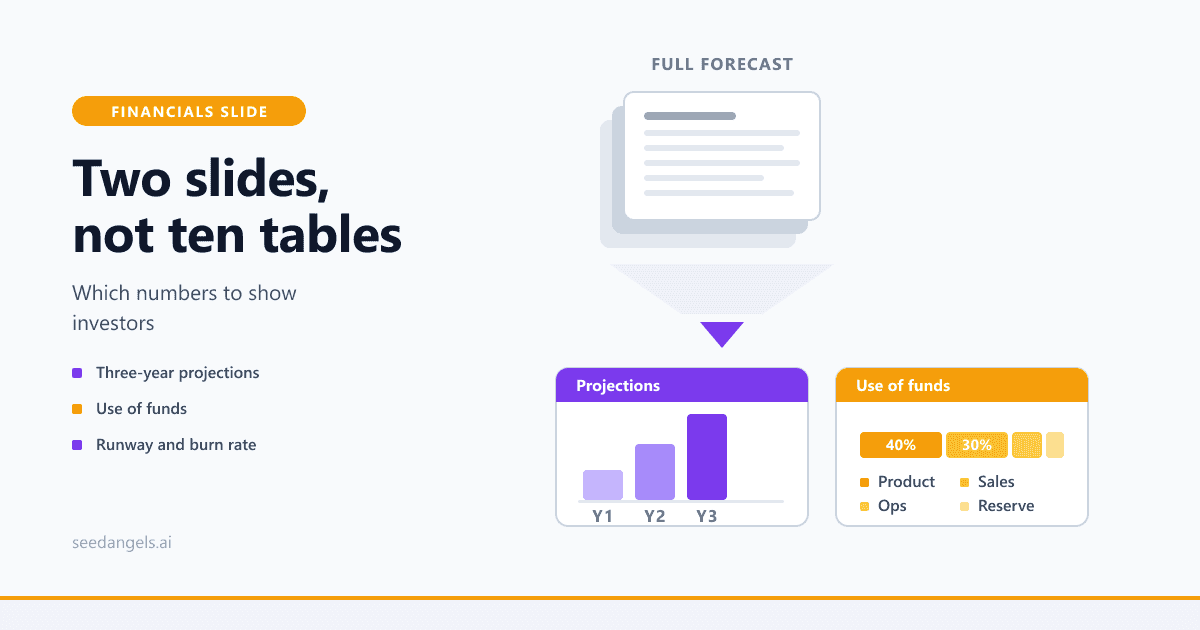
That level of detail does not expose you, it protects you: it moves the discussion from "is your number credible?" to "is your conversion rate achievable?", which is a conversation you can win. It is exactly the exercise detailed in our guide to building defensible projections, which goes line by line through what a financials slide should show.
Mistake 2: "we have no competitors"
The signal. A missing competition slide, or the sentence itself, or its disguised version: a comparison table where your column ticks every box and everyone else's ticks almost none.
Why it stops them. The claim leaves two readings, both disqualifying. Either the market does not exist, meaning nobody spends money solving this problem, and you will have to create the need before the product. Or it does exist and you have not studied it: an investor who knows your sector better than you do will not keep reading. The all-ticked table is worse still: it signals you chose your comparison criteria in order to win.
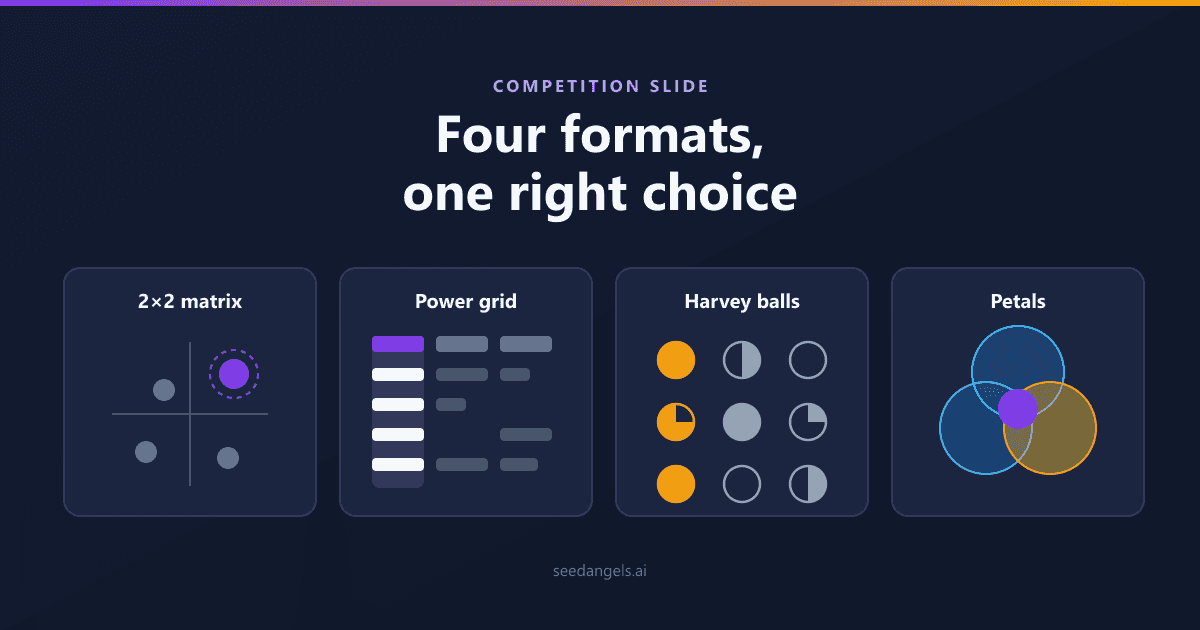
The fix. Widen the definition of a competitor to everything your customer does today instead of buying from you: a spreadsheet, an agency, an intern, or simply nothing at all. The status quo is your most serious competitor, and naming it proves you have talked to customers. What remains is deciding how to show it: the format of the competition slide changes depending on whether your market is crowded or emerging, and a badly chosen pair of axes recreates the very all-ticked table you were trying to avoid.
| Before | After |
|---|---|
| "No direct competitor in this segment" | "Today our customers run this process in Excel (70% of cases), with an outside provider (20%), or not at all (10%). Two vendors serve the top of the market, starting at $2,000/month." |
This reflex is often the symptom of an upstream problem: a market definition so broad that nobody in it really resembles you. Sizing your market badly is in fact the mistake that produces both the implausible TAM and the empty competition slide.
Mistake 3: a poorly framed problem
The signal. After three slides, the reader still does not know who is suffering and from what. The problem is stated at industry level ("urban logistics is inefficient") rather than at the level of one person in a specific situation.
Why it stops them. An abstract problem prevents the investor from running the only calculation that matters at this point: who pays, how much, and how often. With no identifiable customer there is no market to size, so nothing to evaluate. And an overly broad problem suggests you have not yet chosen your entry point.
The fix. Name a specific customer and a concrete situation, with the frequency and the current cost of the problem.
| Before | After |
|---|---|
| "Inventory management is a major challenge for retail." | "A manager running 4 stores spends 6 hours a week reconciling stock by hand, and ends each month with an average 8% inventory discrepancy." |
The second version costs you apparent ambition and earns you credibility. At this stage, that is almost always a good trade.
Mistake 4: a vague or inconsistent ask
The signal. Three versions, in increasing order of severity: no amount appears anywhere in the deck; an amount appears with no use of funds; the amount is disconnected from your stage or your milestones, such as $3M requested by a two-person team with nothing in production.
Why it stops them. Investors have check sizes. Without a stated amount, your reader cannot tell whether this is even for them, and a reader who cannot tell moves on to the next deck. An amount with no use of funds creates a different problem: it turns your ask into an arbitrary number rather than the consequence of a plan. The SBA guidance on the funding request section frames it the same way: state how much you need, what you will use it for, and the period the request covers.
The fix. Three elements, on a single slide: the amount, the runway it buys, and the milestones it unlocks.
| Before | After |
|---|---|
| "We are raising to accelerate our growth." | "$800K for 18 months of runway: 3 engineering hires, entry into a second market, target of $1.5M ARR by the end of the period." |
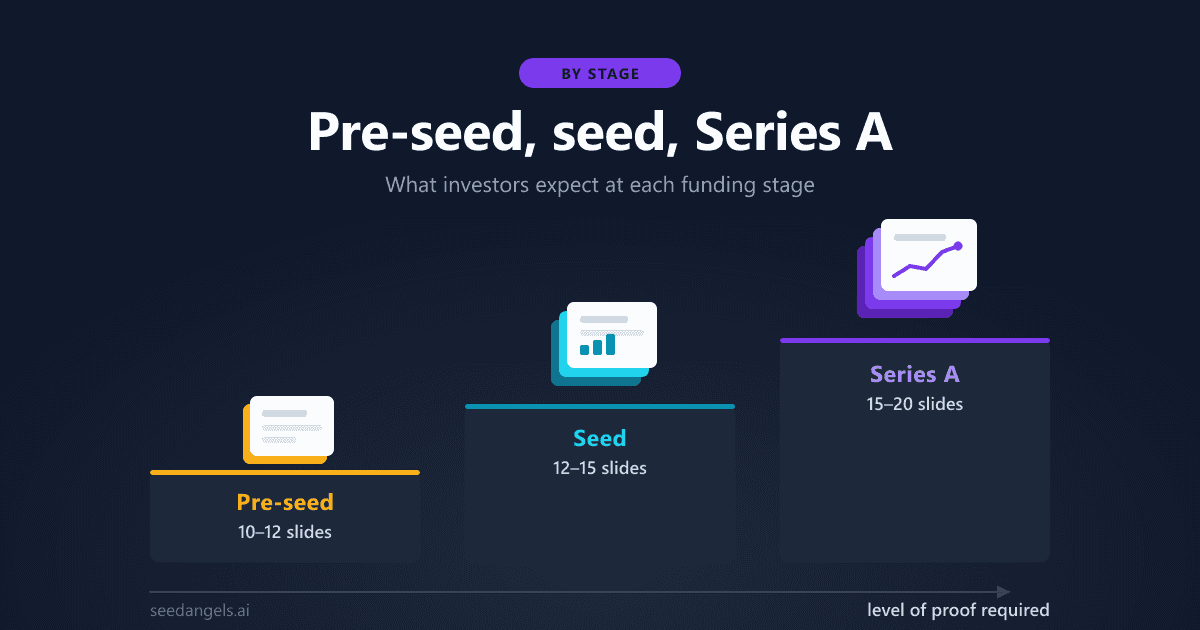
The amount itself has to match what is standard at your stage: investor expectations differ at pre-seed, seed and Series A, and our guide helps you calibrate your ask to your stage.
The 6 mistakes that weaken without killing
These do not trigger an immediate pass. They consume the attention you have and chip away at trust, and on a borderline case, that is what tips the decision.
5. Too much text per slide. Signal: your slide contains a paragraph, and you have to narrate it for it to make sense. Fix: one idea per slide, stated in an assertive headline that stands on its own ("We cut stock reconciliation time by two thirds" rather than "Our solution"). The detail goes into the meeting or the appendix. If a slide resists this rule, it holds two ideas: split it in two.
6. Technical jargon never translated into a benefit. Signal: three lines of domain vocabulary with no mention of what the customer gains. Fix: every technical term is followed by its consequence for the user. Your contact is not always from your sector; they will forward your deck to someone who is even less so.
7. A team slide with no link to the problem being solved. Signal: photos, logos of past employers, degrees, and nothing that explains why this team will solve this problem. Fix: one line per founder connecting their background to the problem ("6 years running supply chain at X, where I hit this problem every week").
8. Figures with no source or date. Signal: "a $12B market", with no source and no year. Fix: source and year under every external figure. An unverifiable number is worth no more than a missing one, and a 2019 figure in a 2026 deck signals that the market research was never refreshed.
9. Traction buried at the end of the deck. Signal: your best numbers (customers, revenue, growth) appear on slide 12, after the product and the technology. Fix: if you have traction, move it into the first third. It is the one element of your deck that cannot be argued with, and it changes how everything after it reads. Our guide details how to move your traction up in the deck and which metrics to choose for your model.
10. Typos, unstable layout, an unreadable PDF. Signal: fonts that change from slide to slide, 9-point body text, a 40 MB file that will not open on a phone. Fix: a proofread by someone outside the company, a single template, an export compressed under 10 MB, and a check on a phone before every send. Design does not win a round; it stops you losing one for a reason that has nothing to do with your business.
The invisible mistake: inconsistency between documents
This one is not visible in the deck. It is visible between the deck and everything else, and it is the hardest to repair.
The scenario is mundane. Your intro email announces a $1M raise. The attached deck says $800K, because it predates your last revision. The financial model you send three weeks later shows a year-2 revenue figure that matches neither. None of these versions is dishonest: they are three successive states of work in progress. But for the reader, they are three different answers to the same question.
The cost is disproportionate because the process is long. Institutional funding decisions come after a review of the business plan and an investment committee, over a study phase that, as Bpifrance Création puts it for venture capital, generally takes several months. Across that span, every document you send gets compared to the one before. And a contradiction cannot be fixed with an argument: it plants a doubt that contaminates the rest of the case, including the parts that were accurate.
The rule. One dated master version, from which everything else is extracted. Concretely: a single financial model is authoritative; the deck is an export of it, never a re-entry; the amount you are asking for is written in one place, once; and when you update your numbers, you update the deck the same day. Add the version date in small type on the last slide: it will stop you sending a stale document, and it signals to your reader that your files are kept in order.
Self-assessment checklist for your pitch deck
Open your deck and go through this table. Each row is a question to ask yourself while looking at your slides, not from memory. If your answer falls in the middle column, the fix is in the one opposite.
| Question to ask | Answer that should worry you | Fix |
|---|---|---|
| Do my projections show their assumptions? | A curve, no assumption figures visible | 3 quantified assumptions next to the curve, built bottom-up |
| Does my competition slide name what the customer does today? | "No competitors" or an all-ticked table | Include Excel, the agency, the provider, the status quo |
| After 3 slides, is it clear who suffers and from what? | The problem is stated at industry level | One specific customer, a concrete situation, a frequency |
| Is my ask visible, justified and calibrated? | No amount, or an amount with no use of funds | Amount + runway + milestones, consistent with the stage |
| Does each slide hold a single idea? | A paragraph to read before the slide makes sense | A self-contained assertive headline, detail in the appendix |
| Is the jargon translated into customer benefit? | Domain vocabulary with no stated consequence | Every term followed by what the customer gains |
| Is the team connected to the problem? | Logos and degrees, unrelated to the subject | One line per founder: background → problem |
| Are my external figures sourced and dated? | A market size with no source and no year | Source + year under every figure |
| Is my traction in the first third? | The best numbers arrive on slide 12 | Move traction ahead of the product |
| Is the deck readable on mobile? | 9-point text, heavy file, inconsistent fonts | Compressed export, single template, phone test |
If three rows or more worry you, start with the first four: those are the ones that produce silent elimination. You can also analyze your pitch deck for free to get this slide-by-slide read without doing it yourself.
What to do when you get no response
Before rebuilding your deck, check that it is actually the problem. Silence has four possible causes, and they are not fixed the same way. Work through them in this order:
- Targeting. Does this investor back companies at your stage, in your sector, in your geography, with checks your size? A Series A fund will not reply to a pre-seed, however good the document is. This is the most frequent cause and the easiest to fix.
- The channel. A cold send with no introduction gets very few replies, regardless of the quality of the case. An introduction from a founder in their portfolio changes the response rate entirely.
- Timing. A fund between vehicles, a recently revised investment thesis, an allocation already committed in your sector: none of this is about you, and none of it will be explained to you.
- The deck. It comes fourth, not first. It becomes the likely cause once the three above are ruled out and the silence persists across a well-targeted set of contacts.
You also have to accept the order of magnitude. The Angel Capital Association analysed more than 12,000 funding applications submitted to angel groups between 2022 and 2024, and found an average funding rate of 6.1%, dropping to 4.3% in 2023 before recovering to 7.3% in 2024. Roughly nine applications in ten are turned down in a normal year. Selectivity is not an accident of your particular file, it is structural. A run of non-answers is a normal outcome, not a verdict.
Finally, when you do get an explicit rejection, ask for the reason, in one short question, with no pushing back, no case for the defence. Some of them will answer. What matters is the reasons that recur across several rejections: an isolated piece of feedback often reflects a personal preference, three converging ones point at the real weakness.
FAQ
What are the most common pitch deck mistakes?
The costliest are financial projections with no visible assumptions, claiming you have no competitors, a poorly framed problem, and a vague funding ask. Then come the finishing mistakes: text overload, untranslated jargon, unsourced figures, and traction buried at the end of the document.
How much text should each slide have?
One idea per slide, expressed as an assertive headline the reader understands on its own. The rest fits in a few keywords or a visual. If a slide needs a paragraph to be understood, it either contains two ideas or the detail belongs in the appendix.
Should you put your valuation in the pitch deck?
It is not required, and many investors prefer to discuss it later. Always state the amount you are raising and what it funds; valuation can stay open at first contact. A valuation shown too high and left unjustified loses meetings before the conversation even starts.
Why are investors not responding to my deck?
Silence does not always mean a bad deck. Check targeting first: does this investor back companies at your stage, in your sector, in your geography? Then check the channel: a cold send with no introduction gets very few replies. The deck is only one of three possible causes.
What should you do after an investor rejection?
Always ask for the reason, in one short question without pushing back. The reasons that recur across several rejections reveal the real weakness in your case. Fix it before starting a new round of outreach, and keep a record of the feedback so you can measure what changes after the fix.
Can bad design cause a fundraise to fail?
Rarely on its own, but it costs attention. A deck that is unreadable on mobile, laid out inconsistently, or riddled with typos suggests a lack of care that the investor projects onto the rest of your execution. Design does not win a round; it avoids losing one.
How many slides should a pitch deck have?
Plan for around ten slides for a first contact, up to fifteen depending on your stage, with appendices kept separate. The count matters less than the density: twelve clear slides beat eight overloaded ones that force the reader to decode them.
Conclusion
Most of these ten mistakes do not come from a lack of work. They come from the opposite: you know your case so well that you no longer see what is missing for someone discovering it in three minutes. The problem seems obvious to you, so you state it quickly; your assumptions live in your model, so you do not display them; your traction feels modest to you, so you put it at the end.
Fixing a deck is therefore mostly a matter of making explicit what you already know. The four deal-breakers first (assumptions, competition, problem, ask), because they alone cause silent elimination. The other six next, which can be handled in a day. And consistency across your documents permanently, because that is the only one that damages trust for good.
Go back through the self-assessment checklist with your deck open beside it, and work the flagged rows in that order. If three rows or fewer worry you, your document is in better shape than most of what circulates: send it, and put your effort into targeting instead.
For an outside read before you send, the SeedAngels pitch deck analyzer works through these points slide by slide, and SeedAngels helps you build the financial model that holds up behind your projections. Try SeedAngels for free →