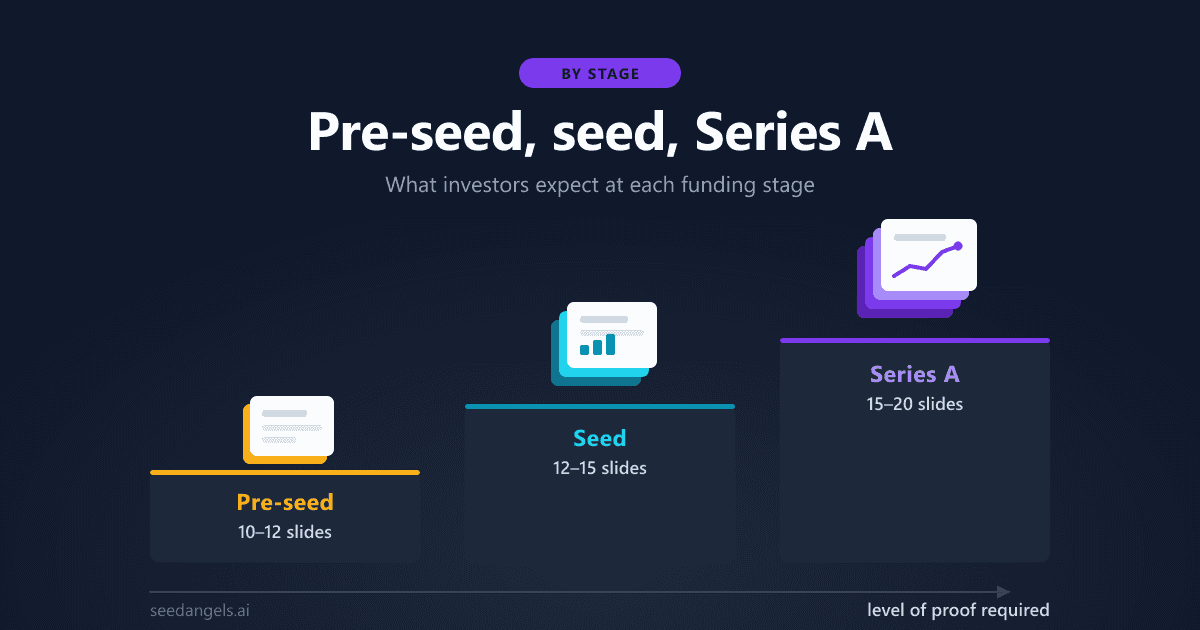
A deck is never good in the abstract
A pitch deck is not good or bad: it is calibrated, or it is not, for the funding stage you are targeting. The same document that excites an angel investor at pre-seed will raise an eyebrow at a Series A fund, and the reverse is just as true. A deck packed with five-year projections sent out for a first pre-seed round signals a founder who has not understood who they are talking to.
What changes from one stage to the next is not the structure of the document. It is the level of proof the investor demands before signing. At pre-seed, they are buying a vision and a team. At seed, they are buying a first proof of market. At Series A, they are buying a machine, and checking that it repeats.
The market makes this calibration more decisive than ever. Venture investors have become markedly more selective: fewer rounds, larger cheques, and a much lower tolerance for a deck that argues at the wrong altitude. A badly calibrated deck no longer gets a second meeting.
This guide gives you, stage by stage, the expected slide count, the required metrics, the round-size ranges observed in the market, and the level of proof your numbers need to carry.
Why the funding stage changes everything in a pitch deck
An investor does not fund an idea: they fund the reduction of a risk. At each stage, the dominant risk shifts, and the deck has to attack the one that matters right now.
At pre-seed, the risk is team and execution: is this project feasible, and by these particular people? At seed, it becomes market risk: does this product find buyers, and how fast? At Series A, it becomes scaling risk: does what worked on a hundred customers work on a thousand, with acquisition costs that hold?
From that shift comes a simple rule: the larger the cheque, the less tolerance the investor has for an undemonstrated assumption. An angel investor is allowed to bet on conviction: it is their own money, in small cheques, often through a syndicate. A venture fund manages other people's money, holds its position for years, and puts your business plan through an investment committee that studies it for months. The second one is not entitled to be convinced by a story alone.
That difference also shows up in the attention you get. Angel syndicates screen in committee, with roughly ten to fifteen minutes of pitch per project. Industry studies put the average reading time of an early-stage deck at under four minutes. Either way, the strongest proof for your stage has to appear within the first five slides, not on slide 14.
Side-by-side: pre-seed vs seed vs Series A
| Pre-seed | Seed | Series A | |
|---|---|---|---|
| Typical round size | $250k – $2.5M | $2M – $5M | $5M – $20M |
| Investor type | Friends and family, angel investors, micro-funds | Seed funds, angel syndicates, corporate ventures | Institutional venture capital firms |
| Number of slides | 10 to 12 | 12 to 15 | 15 to 20 + appendices |
| What the investor is buying | A vision, a team, a credible market | A first proof of market | A growth machine that repeats |
| Expected metrics | Traction proxies, documented market size | Early MRR/ARR, monthly growth, first paying customers | ARR and growth rate, cohort retention, CAC, LTV, payback, gross margin |
| Level of proof in the forecast | Coherent assumptions, 3 years, order of magnitude | Assumptions tied to observed real data | Model defensible line by line, anchored in cohorts |
| Indicative valuation | $8M – $15M post-money cap | $16M – $25M pre-money | $40M – $50M pre-money |
| Process duration | 2 to 4 months | 4 to 6 months | 6 to 9 months |
These ranges are orders of magnitude observed in the market, not rules. Sector shifts them substantially: a deep-tech company with a long R&D cycle usually raises more at pre-seed than a B2B SaaS, and AI-adjacent valuations have little in common with a classic B2C service. For reference, Carta reports that in 2025 median valuation caps on post-money SAFEs hovered around $10 million for rounds between $250,000 and $1 million, and $15 million for rounds between $1 million and $2.5 million.
The "indicative valuation" row is the one that suffers most from hasty comparison: yours depends on your traction, your sector and how much competition there is for your deal, far more than on your stage. Before writing a number into your deck, take the time to estimate your startup's valuation using several methods, because walking into a meeting with a defensible range beats a round number you cannot argue for.
Finally, the "what the investor is buying" row explains why market size is expected from pre-seed onwards, even though traction is not: it is the only slide that lets an investor check that your success, if it comes, will be big enough to return their fund.
The pre-seed pitch deck: selling a vision and a team
At pre-seed, you have no numbers to show, and that is normal. Nobody is asking for them. What the investor is looking for is the answer to three questions: is the problem real, is the opportunity large, and is this the right team to attack it?
The relative weight of those three questions is very uneven. At pre-seed, the team outweighs everything else. It is the only variable that will not change, when the product, the target market and the business model are all going to move within eighteen months.
The essential slides (and the ones you can skip)
A pre-seed deck fits in 10 to 12 slides. The non-negotiables:
- Problem: specific, quantified, embodied by an identified target.
- Solution: what you do, in one sentence that works without jargon.
- Market: size and dynamics, with sourced assumptions.
- Team: placed high, never second-to-last.
- Proof: your traction proxies (see below).
- Business model: how you make money, even if pricing will move.
- The ask: amount, runway length, milestones targeted.
The ones you can skip at this stage: the detailed five-year P&L, the twelve-axis competitive matrix, the quarter-by-quarter product roadmap and the named hiring plan. They consume attention without reducing any risk. The twelve-axis matrix is the textbook case: at pre-seed, a competition slide holds in three or four criteria, the ones customers actually decide on, and lengthening the list only dilutes your differentiation.
We do not break down slide content here: our guide to the 10-slide pitch deck structure covers each section in depth, and holds regardless of your stage: what changes is the ordering and the level of proof, not the list.
What to show when you have no traction yet
This is the question that blocks the most founders at pre-seed. The answer: you replace traction with substitutable proof, signals that cost someone something.
What counts as proof before your first dollar of revenue:
- Signed letters of intent from target customers, with the company name and the volume contemplated.
- Pre-orders or paid commitments, even symbolic ones: a customer who parts with $200 proves infinitely more than a customer who says "interesting".
- Quantified customer interview results: "34 interviews conducted, 27 confirm losing more than 3 hours a week on this task".
- An MVP with real usage: active users, usage frequency, return rate.
- A signed partnership with a player that gives you access to distribution.
- Team credibility: ten years in the sector, a prior exit, a patent, a rare and verifiable expertise.
What does not count, whatever you read elsewhere: follower counts, newsletter sign-ups bought through ads, verbal "expressions of interest" with no written trace, and press mentions. An experienced investor spots them in three seconds, and putting them in the position of proof hurts more than it helps: it suggests you had nothing better.
Pre-seed also plays out with very different counterparties, on a different timetable and with different instruments, than a Series A: if this process is new to you, the stages of a fundraising round, from investor targeting to due diligence and closing, will stop you from perfecting a deck for a round whose right counterparties you have not yet identified.
The seed pitch deck: proving early product-market fit
Seed is the stage where you move from promise to observation. Your product has launched, customers use it, some pay. The investor is no longer asking whether the problem exists: they are asking whether you have found early product-market fit, meaning a fit between product and market strong enough that demand starts pulling supply.
The deck grows to 12-15 slides, but above all it reorganises: proof moves up, vision moves back.
The traction slide moves centre stage
At pre-seed, traction was a bonus. At seed it is mandatory, and it typically moves to slide 3 or 4, right after problem and solution. A seed fund that finds no numbers in the first third of your deck concludes, often correctly, that there are none.
What the slide has to show: a growth curve over at least six months, the MRR or ARR reached, the number of paying customers, and a retention signal. What it must not do: present a cumulative metric that can only go up (total sign-ups since launch) to mask flat monthly growth. A fund systematically recalculates the month-over-month change, and being caught smoothing costs more than the number it was hiding. If it is the retention curve that stays flat despite several product iterations, the problem is no longer the slide: retention that never flattens is the first of the signals that force you to reopen the question of the segment before the question of the round.
The financial forecast enters the picture
Seed is where the financial forecast stops being a stylistic exercise. The fund is not trying to work out whether you will hit your numbers: it knows you will not. It is checking three things:
- Coherence between assumptions and numbers. If your plan triples revenue, where are the salespeople, the acquisition budget and the corresponding hiring lead times?
- The runway requested. The amount raised should cover 18 to 24 months, up to milestones that make the next round possible. A 9-month runway signals either an undersized ask or an unmanaged burn.
- Use of funds. The split between product, hiring and acquisition has to reflect the strategy you just laid out, not a generic pie chart.
This section is where the deck and the business plan must speak with one voice: every number displayed on the financial slide has to exist, identically, in the model you send during due diligence. Building that forecast (P&L, month-by-month cash flow, financing plan) is exactly what SeedAngels automates from your business assumptions, without letting an AI invent your revenue line. Try SeedAngels for free →
The Series A pitch deck: proving a machine that repeats
At Series A, the fund is no longer buying proof: it is buying repeatability. The question becomes: if I put one more dollar into your acquisition, how much recurring revenue comes out, and after how long?
The direct consequence for the document: a Series A deck is no longer a story illustrated with numbers, it is a numbers case illustrated with a story. Plan for 15 to 20 slides, plus a set of appendices the fund will open every time.
Unit economics and cohorts
Unit economics, the economics of a single customer, are the heart of a Series A deck. The expected indicators:
- ARR (annual recurring revenue) and growth rate, month by month over at least twelve months.
- Cohort retention: what happens to customers acquired in January, six months later? It is the only chart that separates a product that is adopted from a product that is bought once.
- CAC (customer acquisition cost), broken down by channel.
- LTV (lifetime value) and the LTV/CAC ratio.
- Payback: the number of months needed to recover the cost of acquiring a customer.
- Gross margin and burn multiple (dollars burned per dollar of net new ARR).
Funds now state these thresholds themselves: US venture firm CRV says it expects at Series A a few million in ARR, net revenue retention above 100% and an LTV:CAC ratio of roughly 3:1, against a record median pre-money valuation of $49.3 million in Q3 2025 according to Carta data. Levels vary by geography, but the analytical logic is identical everywhere.
One point many founders discover too late: the fund rebuilds its own financial model from your data. It does not simply read your projection, it redoes it with its own growth and churn assumptions. Every claim in the deck therefore has to be anchored in exportable data, not in a drawn chart.
Appendices become mandatory
At pre-seed, appendices are optional. At Series A, their absence is a negative signal. The minimum set:
- The data room: incorporation documents, an up-to-date cap table, significant customer contracts, intellectual property, any litigation.
- Cohort detail: retention, expansion and churn by acquisition month and by segment.
- The hiring plan: roles, timing, fully loaded cost, and the link to growth targets.
- Sales pipeline detail: amounts, stage-by-stage conversion rates, average sales cycle.
This deep review phase takes time: an institutional round runs through analysis, an investment committee and legal work over several months. A file whose appendices are not ready at the first meeting mechanically loses six to eight weeks.
The 4 most common calibration mistakes
All four mistakes come from the same mechanism: a deck that answers to the level of proof of a stage other than the one you are targeting.
-
The over-financialised pre-seed deck. A five-year P&L, month by month, when the product does not exist. The investor reads one thing into it: this founder spent three weeks in a spreadsheet instead of talking to customers. At this stage, three years at order-of-magnitude precision with owned assumptions is plenty.
-
The seed deck hiding an absence of traction behind design. Beautiful slides, animations, cumulative metrics and charts with no y-axis. A seed fund spots the arrangement immediately, and the effort at concealment costs more than the missing numbers ever would: it attacks your credibility, not just your traction.
-
The Series A deck still pitched at "vision" level. Still handsome market and product slides, but no cohorts, no CAC, no payback. The fund cannot build its model, so it cannot decide, and an investor who cannot decide says no.
-
An ask disconnected from stage and runway. Asking for $3M with a pre-seed deck, or $400k with Series A traction. The amount must be the arithmetic consequence of a plan: X months of runway, Y milestones to hit, Z dollars to get there. An incoherent ask also damages your cap table: use our dilution calculator to check what the amount really costs you in ownership before you write it into the deck.
How to evolve your deck from one stage to the next
Good news: you do not rewrite a deck between rounds. You re-rank it. The slides stay largely the same; what changes is their order, their depth and their status (body or appendix).
What moves up from one stage to the next:
- Traction: from slide 8 at pre-seed to slide 3-4 at seed.
- Real numbers: from an illustrative callout to a full section.
- Cohorts and unit economics: absent at pre-seed, central at Series A.
What moves down:
- Vision and storytelling: essential at pre-seed, condensed into one slide at Series A.
- Detailed product description: it moves to a demo or an appendix from seed onwards.
- Founders' personal background: it tightens to what proves operational credibility.
What moves into the appendix:
- The detailed competitive matrix.
- The product roadmap.
- The detailed forecast assumptions.
Checklist before sending a deck at the next stage:
- Does the strongest proof for my stage appear within the first five slides?
- Does every number in the deck exist, identically, in my financial forecast?
- Does my ask map to an explicit runway and named milestones?
- Have I removed everything that belongs to the previous stage (long vision, detailed product)?
- Are my appendices ready on the day of the first meeting?
For a concrete starting point, our pitch deck templates show a complete seed deck for a SaaS startup in six designs: the metrics-led Signal design suits seed and Series A, while Editorial or Atelier put more weight on the story of a pre-seed project.
FAQ
What is the difference between a pre-seed and a seed round?
Pre-seed funds validation: the team, a prototype and early market signals, usually from friends and family, angel investors and micro-funds. Seed funds acceleration of a product that has already launched, backed by seed funds, with first customers and early recurring revenue. The difference is less about the amount than about the level of proof required: a credible vision at pre-seed, actual numbers at seed.
How many slides should a seed pitch deck have?
Plan for 12 to 15 slides at seed, versus 10 to 12 at pre-seed and 15 to 20 (plus appendices) at Series A. The gap is not about "filling space": each stage adds proof: detailed traction at seed, cohorts and unit economics at Series A. Past 20 slides excluding appendices, the message dilutes.
How much can you raise at pre-seed?
Pre-seed rounds typically range from $250,000 to $2.5 million. Carta reports that in 2025, median valuation caps on post-money SAFEs sat around $10 million for rounds between $250,000 and $1 million, and $15 million for rounds between $1 million and $2.5 million. The amount should match 12 to 18 months of runway and the milestones you commit to hitting.
Can you raise money with no traction at all?
Yes, at pre-seed, provided you replace traction with substitutable proof: signed letters of intent, pre-orders, quantified customer interview results, an MVP with real usage, or strong founder credibility in the target market. What does not count: followers, unqualified sign-ups, or interest expressed only verbally.
Which metrics do you need for a Series A?
A Series A is judged on repeatability: ARR or MRR and its growth rate, cohort retention, CAC, LTV, payback period, gross margin and burn multiple. Investors build their own model from this data, so every number must hold up under due diligence.
Do you need a business plan in addition to a pitch deck?
Yes, but not at the same moment. The pitch deck opens the door; the business plan and financial forecast are requested next, during due diligence, to verify that the deck's numbers hold. A deck with no business plan behind it gets caught out as soon as detailed questions start.
How long does an investor spend on a pitch deck?
A few minutes at most. Industry studies put the average reading time of an early-stage deck at under four minutes, and a significant share of decks are never read through to the last slide. The direct consequence: the strongest proof for your stage must appear within the first five slides.
Conclusion
The right pitch deck is not the prettiest or the most complete: it is the one that answers exactly the level of proof of the stage you are targeting. A vision and a team at pre-seed. A first proof of market at seed. A machine that repeats, with the numbers to show it, at Series A. Anything above that level clutters; anything below it disqualifies.
Before your next meeting, run the exercise in that order: identify the stage you are targeting, the strongest proof you hold at that stage, and check that it is visible within the first five slides. If it is not, your problem is not your project, it is the order of your slides. In a market that funds fewer rounds each year, that calibration discipline is no longer an edge: it is the entry ticket.
SeedAngels generates your business plan, financial forecast and pitch deck from your project data, with an AI deliberately kept away from your revenue assumptions. Try SeedAngels for free →
You can also have your pitch deck analysed for free, to check slide by slide whether it is calibrated for the stage you are targeting.