What your file has to prove
A business plan in Africa is judged on one question: will the business repay its loan? The loan officer at a bank in Douala, the agent at a microfinance institution in Dakar or the assessor at a youth fund in Abidjan isn't looking for a clever idea. They want a documented owner contribution, cash flow that holds, collateral and a properly registered business.
This guide is written for anyone working with French-speaking Africa: diaspora founders, investors, NGOs and consultants who prepare files for local entrepreneurs. Most guides on the topic stop at the list of business plan sections. This one starts from what the funder checks, then shows it on a real calculation: the file for a 40-seat maquis (a casual West African eatery) in Abidjan, entirely in CFA francs, from the financing plan to the downside scenario. You'll also find a table of public schemes by country (Cameroon, Senegal, Ivory Coast, Morocco, DRC, Madagascar), checked in October 2026, and a section for the diaspora.
A word on the figures: the example's amounts are assumptions built for illustration, not market averages. The public programmes' figures come from dated sources, and these programmes change fast: always confirm the terms with the organisation before applying.
What is a bankable business plan?
A bankable business plan is a file that proves to a bank or a microfinance lender that the business will repay its loan. It rests on a realistic forecast, a month-by-month cash flow plan, a documented owner contribution and identified collateral. In French-speaking Africa, it is presented in CFA francs and sits within the OHADA legal framework.
The core content is the same everywhere: summary, founder, market, sales strategy, operations, financial forecast. If you're starting from scratch, begin with the standard structure of a business plan in 9 steps, then adapt it with what follows. Public programmes in the region often say plan d'affaires: it's the same document.
What changes in Africa is who reads it and what they check. A youth fund checks your age, your registration and the jobs created. A microfinance lender looks at your Mobile Money flows and your savings. A bank wants a registered company, readable accounts and, almost always, a guarantee.
What an African credit committee checks
Whether it sits in a bank, a microfinance institution (MFI) or a public fund, a credit committee checks four things, in this order:
- Owner contribution: how much you put in yourself, and where that money comes from.
- Repayment capacity: does the business generate enough to cover the instalments, even if sales disappoint?
- Collateral: what the lender recovers if the business stops paying (pledged equipment, a personal guarantee, a public guarantee fund).
- Formal registration: a registered business, a bank account, traceable sales.
Owner contribution
No common rule sets the owner contribution in Africa: each bank and MFI has its own threshold, usually stricter for a start-up than for an established business. Ask for it before you build your financing plan.
The amount matters, but so does the proof. Savings visible on a bank or Mobile Money statement, equipment bought with invoices, a tontine payout certified in writing: all of these count. Money "available from a relative" does not.
Repayment capacity
The loan officer compares EBITDA (what the business generates before depreciation, interest and tax) with debt service (principal and interest repaid over the year). They want a comfortable margin above 1, and they look hardest at the tightest month in your cash flow. We've covered the five ratios a lender runs on a financial forecast, with the usual thresholds: the logic is the same in Abidjan as in London, only the amounts and rates change.
One detail weighs more in Africa than in Europe: seasonality. A harvest, the start of the school year, the rainy season or a religious holiday can shift a large share of sales. A month-by-month cash flow plan that shows those troughs, and how you get through them, reassures more than an annual average.
Collateral and guarantee funds
A lack of collateral is among the most common reasons for refusal, which is precisely why governments created guarantee funds. There are three answers:
- A pledge on the financed equipment (kitchen equipment, a vehicle, stock): it puts the business's assets on the line, not your house.
- A personal guarantee, from you or a third party, which lenders very often request.
- A public guarantee fund, which covers part of the loan on the lender's behalf: SGPME in Ivory Coast (50 to 80% of the loan), FONGIP in Senegal, the FOGAJEUNE guarantee window in Cameroon, Damane Intelak in Morocco (up to 80%), FOGEC in the DRC.
Remember one point: you almost never apply to these funds directly. You submit your file to a partner bank, and the bank requests the guarantee. Your business plan has to convince the bank first.
Formal registration and the usury cap
A bank lends to a business registered with the trade and personal property credit register (RCCM), with a tax ID (NINEA in Senegal, NIU in Cameroon, a taxpayer account in Ivory Coast) and a bank account. Microfinance lenders and youth funds often accept projects that are still being formalised, but formalisation is part of what they fund and check.
In the WAEMU (UEMOA) zone, interest rates are capped by the usury rate. Since 1 June 2026, the cap has been 14% a year for banks and 24% for microfinance institutions and other financial institutions (BCEAO notice of 31 December 2025). A microfinance loan therefore often costs far more than a bank loan: put the real rate in your forecast, not the one you hope for. These caps only apply in the WAEMU: in Cameroon and the rest of CEMAC, the usury rate falls under BEAC rules; ask your bank.
The OHADA framework: company form, RCCM and SYSCOHADA
OHADA (the Organisation for the Harmonisation of Business Law in Africa) has 17 member states, including Cameroon, Ivory Coast, Senegal and the DRC. Its Uniform Acts apply directly: the same company forms, the same register, the same accounting standard.
Company form. The revised 2014 Uniform Act on commercial companies sets the minimum capital of a SARL (the OHADA private limited company) at 1,000,000 FCFA and created the simplified joint-stock company (SAS). States can relax that minimum: Senegal removed it, Law No. 2015-07 of 9 April 2015 leaving the articles of association to set the capital. Check the rule in the country where the company will be registered.
| Form | Best for | How the bank sees it |
|---|---|---|
| Sole trader (entreprenant) | Small activity, solo start | Simple, but personal and business assets are not separated |
| SARL (or single-member SARL) | Retail, restaurants, family SMEs | The most common form, and the one banks read most often |
| SAS (or single-member SASU) | Projects with investors or diaspora partners | Flexible articles; useful if partners will join the capital |
The RCCM. Registration with the trade and personal property credit register gives the business its legal existence. It's also where security interests are recorded, such as the bank's pledge on your equipment.
SYSCOHADA. The Uniform Act on accounting law of 26 January 2017, in force since 1 January 2018, imposes the revised SYSCOHADA. Its annual financial statements include a balance sheet, an income statement, a cash flow statement and notes. Very small entities can use a simplified cash-based system below revenue thresholds of 60, 40 or 30 million FCFA excluding VAT, depending on the activity.
A forecast has no mandatory format. But if your tables follow the SYSCOHADA logic (an income statement built on intermediate balances, a cash flow statement), the loan officer can compare them directly with what they will later read in your accounts. A local accountant can do this restatement in a few hours.
Working in CFA francs: XOF, XAF and the fixed peg
The CFA franc is actually two separate currencies, with the same fixed peg: €1 = 655.957 FCFA since 1999:
- XOF, the West African CFA franc (WAEMU): Benin, Burkina Faso, Ivory Coast, Guinea-Bissau, Mali, Niger, Senegal, Togo.
- XAF, the Central African CFA franc (CEMAC): Cameroon, Central African Republic, Congo, Gabon, Equatorial Guinea, Chad.
Both are worth the same, but XAF banknotes aren't accepted in Dakar. State the exact currency at the top of every table ("amounts in FCFA, XOF").
Present the whole file in CFA francs: it's the currency of the account, the invoices and the instalments. If part of your contribution comes from Europe, the conversion is exact: €5,000 gives 3,279,785 FCFA. Round to the franc and use the same rate throughout.
The peg only applies within the franc zone. The Moroccan dirham, the Congolese franc and the Malagasy ariary float: a forecast converted from euros at today's rate will be wrong in six months. For those countries, build the forecast directly in local currency.
If you build your forecast with SeedAngels, note that it currently produces amounts in euros or US dollars, not CFA francs. The financial forecasting software links the income statement, cash flow and balance sheet over three to five years, reads the funding need from your cash flow and calculates your loan's amortisation schedule. In the franc zone, multiply each euro amount by 655.957 to get the file in CFA francs. The SYSCOHADA presentation is still yours to do, with your accountant: the tool doesn't produce it.
The informal economy, Mobile Money and tontines: what counts for the lender
A large part of the economy runs outside the banks, and the loan officer knows it. They won't hold the informal sector against you. They'll hold against you whatever you can't prove.
Mobile Money is your best evidence. In 2024, 40% of adults in sub-Saharan Africa had a mobile money account, up from 27% in 2021, according to the World Bank's Global Findex 2025. According to the GSMA, Africa had 1.2 billion registered mobile money accounts at the end of 2025, more than half of the 2.3 billion worldwide, and sub-Saharan Africa handled 66% of global transaction value. If you already sell, even informally, six to twelve months of Mobile Money statements show real, regular revenue. Attach them as an appendix, with a table summarising them by month.
A tontine can fund part of your contribution. A tontine is a rotating savings group: members pay in regularly and each takes the pot in turn. The payout you receive is a legitimate resource. For it to count, get it certified in writing (name of the group, amount, payout date) and run it through an account. Don't present a future payout as money already in hand: the bank will ignore it.
Cash sales need a paper trail. A cash book kept every day, then regular deposits into the business account: that's what will let you apply for a second loan in a year's time on the basis of real figures.
Costs have their own line. Mobile Money fees, generator fuel during power cuts, bought water: these costs are often missing from templates imported from Europe. The local lender knows them well.
Worked example: a maquis in Abidjan (XOF)
Aïcha opens a 40-seat maquis in Abidjan: dishes of the day, grilled meat and fish, drinks, open lunch and dinner, 26 days a month. She sets up a SARL and applies for a bank loan backed by an SGPME guarantee. All amounts are in CFA francs (XOF) and are illustrative assumptions.
For the market, menu and operations sections, our restaurant business plan template gives the full structure, with a written example you can adapt to a maquis.
The financing plan
| Uses | FCFA | Sources | FCFA |
|---|---|---|---|
| Fit-out (kitchen, electrics, washrooms) | 4,500,000 | Personal savings | 1,800,000 |
| Kitchen equipment (freezers, burners, utensils) | 3,200,000 | Tontine payout received (certified) | 1,200,000 |
| Furniture (10 tables, 40 chairs, counter) | 1,300,000 | Owner contribution | 3,000,000 |
| Generator | 1,500,000 | Bank loan (10% a year, 4 years) | 12,000,000 |
| Deposit and rent paid in advance (6 × 250,000) | 1,500,000 | ||
| SARL setup, RCCM, permits | 500,000 | ||
| Opening stock | 500,000 | ||
| Opening cash | 2,000,000 | ||
| Total uses | 15,000,000 | Total sources | 15,000,000 |
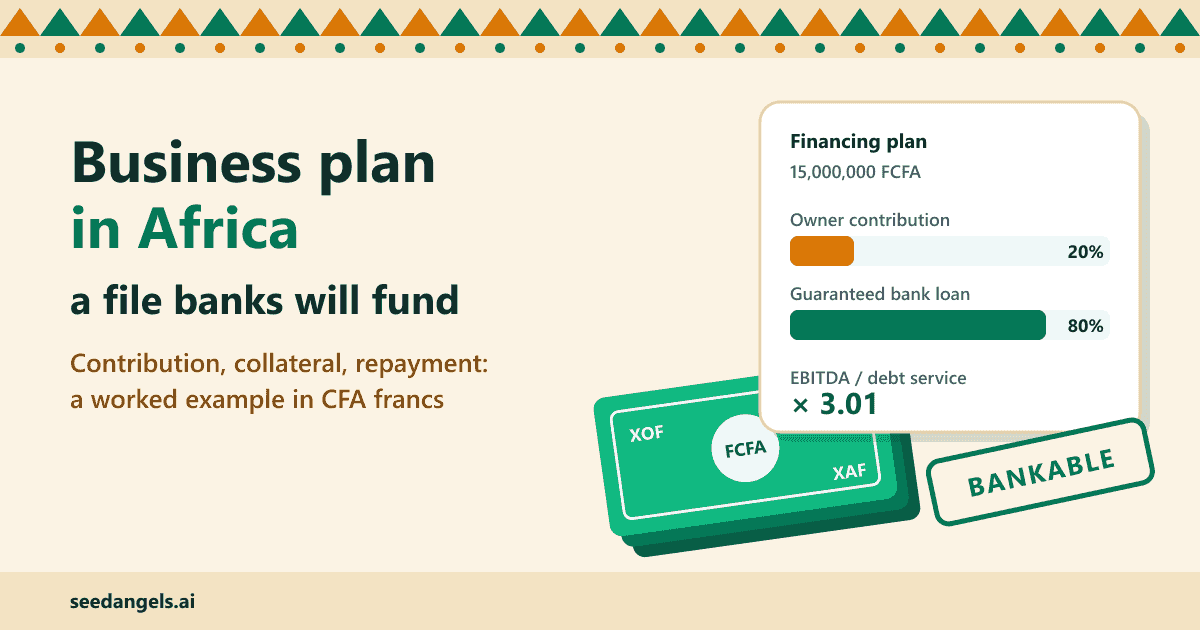
The owner contribution is 20% of the project (3,000,000 out of 15,000,000). In euros, the project is worth €22,867.35 and the loan €18,293.88, at the fixed peg. The table follows the method of a sources and uses statement built step by step: uses priced from quotes, opening cash included, and the bank loan as the last line that balances it.
The 10% rate sits below the 14% cap for banks. To keep the arithmetic readable, the loan is repaid in annual instalments with equal principal: 3,000,000 of principal a year, plus interest on the outstanding balance.
| Year | Balance at start of year | Interest (10%) | Principal repaid | Debt service |
|---|---|---|---|---|
| 1 | 12,000,000 | 1,200,000 | 3,000,000 | 4,200,000 |
| 2 | 9,000,000 | 900,000 | 3,000,000 | 3,900,000 |
| 3 | 6,000,000 | 600,000 | 3,000,000 | 3,600,000 |
| 4 | 3,000,000 | 300,000 | 3,000,000 | 3,300,000 |
| Total | 3,000,000 | 12,000,000 | 15,000,000 |
In practice, the bank will probably offer equal monthly instalments: the principle is the same, only the split between principal and interest changes. At 10% over 48 months, the monthly instalment would be 304,351 FCFA, or 3,652,212 FCFA in the first year: the equal-principal schedule used here, at 4,200,000 FCFA in year 1, is the more cautious assumption.
Year 1 operating account
Sales assumption: 70 covers a day, an average ticket of 3,500 FCFA including a drink, 312 trading days (26 days × 12 months).
| Line | FCFA |
|---|---|
| Revenue (70 × 3,500 × 312) | 76,440,000 |
| Cost of goods (food and drinks, 45% of revenue) | − 34,398,000 |
| Gross margin | 42,042,000 |
| Rent (250,000 × 12) | − 3,000,000 |
| Wages and payroll costs, 6 staff | − 15,600,000 |
| Manager's pay | − 3,600,000 |
| Electricity, water, gas | − 3,600,000 |
| Generator fuel | − 1,200,000 |
| Maintenance, marketing, Mobile Money fees, sundries | − 1,800,000 |
| Local taxes and licences | − 600,000 |
| Total fixed costs | − 29,400,000 |
| EBITDA | 12,642,000 |
The loan officer will make two remarks unprompted. First, the manager's pay sits in the costs: a forecast where the owner takes no salary hides a need that will eventually come out of the till. Second, with 76,440,000 FCFA of revenue, the maquis exceeds the highest threshold of the simplified cash-based system (60 million): it will keep full SYSCOHADA accounts, which need budgeting.
Income tax isn't shown here: it is calculated after depreciation and interest, under a regime that depends on revenue. Have a local accountant work it out and add it to the cash flow plan.
Repayment capacity and scenarios
In year 1, EBITDA of 12,642,000 FCFA covers the debt service of 4,200,000 FCFA 3.01 times. That leaves 8,442,000 FCFA for tax, equipment replacement and the unexpected. On paper, the file passes easily.
The committee won't stop there: it will cut your sales. Cost of goods follows revenue (45%); fixed costs don't move.
| Base case | Sales −15% | Sales −25% | |
|---|---|---|---|
| Revenue | 76,440,000 | 64,974,000 | 57,330,000 |
| Cost of goods (45%) | 34,398,000 | 29,238,300 | 25,798,500 |
| Gross margin | 42,042,000 | 35,735,700 | 31,531,500 |
| Fixed costs | 29,400,000 | 29,400,000 | 29,400,000 |
| EBITDA | 12,642,000 | 6,335,700 | 2,131,500 |
| Debt service (year 1) | 4,200,000 | 4,200,000 | 4,200,000 |
| EBITDA / debt service | 3.01 | 1.51 | 0.51 |
| Left after debt service | 8,442,000 | 2,135,700 | − 2,068,500 |
At −15%, the maquis still repays, with a thin margin. At −25%, or 52.5 covers a day on average instead of 70, it no longer covers its instalments. Break-even including debt sits at around 61.1 million of revenue, about 56 covers a day: 29,400,000 + 4,200,000 = 33,600,000 FCFA to cover with a 55% gross margin.
That's the real information in the file. Aïcha has three levers to show the committee before it asks:
- Extend the loan to 5 years: principal repaid falls to 2,400,000 a year and year 1 debt service to 3,600,000.
- Start with 4 staff instead of 6, and hire once footfall passes break-even.
- Prove demand: if she already sells takeaway meals, her Mobile Money statements are worth more than an assumption of 70 covers.
Funders by country (table checked in October 2026)
These schemes change fast: FOGAJEUNE replaced FONIJ in Cameroon, Intelaka is being reworked in Morocco, and Madagascar launched a new programme in July 2026. Each row gives its source and date.
| Country (currency) | Scheme | What it does | Published amounts | Source |
|---|---|---|---|---|
| Cameroon (XAF) | FOGAJEUNE (MINJEC) | Direct funding and loan guarantees for 15–35 year olds | Grants up to 1,500,000 FCFA; 8% loans from 10 to 25 million FCFA | EcoMatin, 28 February 2026 |
| Senegal (XOF) | DER/FJ | Nano-loans, sector funding, support | Varies by window and year (sources conflict) | der.sn, checked October 2026 |
| Senegal (XOF) | FONGIP | Individual or portfolio guarantees, interest subsidies | Coverage rate not published on the site | fongip.sn, checked October 2026 |
| Ivory Coast (XOF) | SGPME | Guarantees on SME bank loans, through partner banks | 50 to 80% of the loan | Forbes Afrique, 6 March 2026 |
| Ivory Coast (XOF) | Youth Employment Agency (AEJ) | Grants or loans after a feasibility review | 500 million FCFA envelope (August 2026 operation) | AIP, 11 August 2026 |
| Morocco (MAD) | Forsa | Interest-free honour loan and grant, training, incubation | Up to 100,000 MAD, including a 10,000 MAD grant; one-year deferral available | maroc.ma, 30 October 2025 |
| Morocco (MAD) | Intelaka / Damane Intelak (Tamwilcom) | Guarantees on loans to young businesses | Guarantee up to 80%; programme being reworked | Tamwilcom; EcoActu, 23 July 2026 |
| DRC (CDF) | FOGEC and the Bokeli platform | Loan guarantees; online business plan platform | No published scale | actualite.cd, 4 February 2026 |
| Madagascar (MGA) | Fandroso | Low-rate loans, Tsiry (start-up) and Tafita (existing business) strands | Up to 60 million ariary; rate not published | AllAfrica, 23 July 2026 |
Cameroon: FOGAJEUNE and partner banks (XAF)
The Young Entrepreneurs Guarantee Fund (FOGAJEUNE), run by the Ministry of Youth and Civic Education (MINJEC), replaces the former National Youth Integration Fund (FONIJ). According to the report presented to the cabinet on 26 February 2026, it mobilised 26.5 billion FCFA between 2023 and 2025, including 6.5 billion in direct funding for 4,273 projects. The rest, over 20 billion, goes through the guarantee window. MINJEC signed agreements with BGFIBank Cameroon (May 2024) and Afriland First Bank (November 2024).
The published conditions:
- be Cameroonian and aged 15 to 35;
- be registered with the National Youth Observatory (ONJ) and hold the biometric youth card;
- present a job-creating project, preferably in agriculture, digital or industry.
The direct window grants subsidies capped at 1,500,000 FCFA, zero-rate loans up to 10 million, and 8% loans from 10 to 25 million FCFA (terms published in late 2024). The guarantee window targets businesses that are already trading, including young diaspora entrepreneurs in partnership with peers based in Cameroon.
Example: a poultry farm near Douala. A young farmer borrows 15,000,000 FCFA (XAF) at 8% for a building, equipment and the first batches of broilers, over 3 years with equal principal. Year 1 debt service: 5,000,000 of principal + 1,200,000 of interest = 6,200,000 FCFA. The batches must generate at least that much EBITDA after mortality, feed and vaccines, and the cash flow plan must show how the instalments are paid between two sales.
Senegal: DER/FJ and FONGIP (XOF)
The General Delegation for Rapid Entrepreneurship of Women and Youth (DER/FJ), created by decree in November 2017, funds self-employment and business creation for women and young people: nano-loans through dedicated points, sector funding (agriculture, fishing, livestock, crafts, digital, tourism…) and support with formalisation. It operates in all 14 regions through its employment and entrepreneurship hubs.
Be careful with amounts: published ceilings have changed by year and by window, and sources contradict each other. Nano-loans cover small sums, sector funding larger projects: ask your regional hub for the current scale rather than relying on a figure found online.
FONGIP (the Priority Investment Guarantee Fund) doesn't lend: it guarantees loans made by banks and microfinance institutions, and can subsidise their rates. It also runs targeted funds, including FOGARISE for Senegalese living abroad (see the diaspora section). You submit the file to the bank, which requests the guarantee.
In Senegal, as across the WAEMU zone, your loan rate can't exceed 14% from a bank or 24% from a microfinance institution.
Ivory Coast: SGPME and the Youth Employment Agency (XOF)
SGPME, the Ivorian SME loan guarantee company, was created in April 2022, is state-owned and licensed by the BCEAO. It guarantees 50 to 80% of the loans made by its partner banks and microfinance institutions. It reports supporting 2,840 SMEs by the end of 2025 (figures published by SGPME itself in a Forbes Afrique partner feature). Here too, access goes through the bank.
The Youth Employment Agency (AEJ) funds small projects and income-generating activities. During an operation in Yopougon from 3 to 8 August 2026, it received 351 million FCFA of funding requests, against a 500 million FCFA envelope provided by the government. Files are then reviewed for technical and economic feasibility, and selected projects receive management training before a grant or a loan. A costed business plan, even a simple one, makes the difference at this stage.
The maquis example above follows the typical Ivorian route: a registered SARL, a bank loan, an SGPME guarantee requested by the bank.
Morocco, DRC, Madagascar: outside the franc zone
These three countries don't use the CFA franc: their currencies float, and the amounts below stay in local currency.
Morocco (MAD). The Forsa programme funds up to 100,000 dirhams per project, including a 10,000 dirham grant, the rest as an interest-free honour loan. Since 1 December 2025, beneficiaries can request a one-year deferral of repayments. Intelaka, launched in 2020, combines a bank loan with Tamwilcom's Damane Intelak guarantee (up to 80% of the loan). The programme is being reworked in 2026, with a Very Small Business Charter signed with the banks in force since 1 January 2026: the rates and ceilings circulating online may be out of date. Morocco isn't an OHADA member: company law and accounting follow Moroccan rules.
DRC. The Congo Entrepreneurship Guarantee Fund (FOGEC) guarantees loans to micro, small and medium businesses and artisans that lack collateral. Since 3 February 2026, its Bokeli platform helps applicants write the business plan, add the forecast, submit the file to FOGEC from a personal space and track it. If you're targeting FOGEC, that's the official channel: build your file in Bokeli. The DRC is an OHADA member.
Madagascar. On 22 July 2026, the government launched the Fandroso programme: low-rate loans of up to 60 million ariary, with a Tsiry strand for start-ups and a Tafita strand for existing businesses. It follows the Fihariana programme, whose results were described as mixed. Detailed terms had not yet been published when this article was written.
Diaspora: starting a business in Africa from Europe
You live in France or elsewhere in Europe and want to start a business back home. Your advantage: income in euros, so an easier owner contribution and, in the franc zone, no currency risk. Your difficulty: running from a distance a business that the local banker will judge on its day-to-day management.
- Choose the form. An OHADA SARL or SAS can have non-resident partners. The SAS gives more flexibility in splitting powers between you and the person on the ground.
- Register. One-stop shops handle the formalities: CEPICI in Ivory Coast, APIX in Senegal, the business creation centres (CFCE) in Cameroon, with the MyBusiness.cm platform. Some steps require being there in person: plan for a power of attorney.
- Appoint a local manager. The banker will fund the person running things day to day as much as the project. Present them in the business plan, with their experience.
- Document your contribution. A transfer from Europe into the company's account is the cleanest proof. At the fixed peg, €5,000 gives exactly 3,279,785 FCFA.
- Look for diaspora schemes. In Senegal, FONGIP runs FOGARISE, a guarantee fund for investments by Senegalese living abroad, with nearly 2 billion FCFA at its disposal in July 2025. In December 2020, FONGIP and ADEPME also set up a 450 million FCFA guarantee fund for Senegalese residents of France, Belgium, Italy and Spain, for projects of 5 to 50 million FCFA. In Cameroon, FOGAJEUNE's guarantee window is open to young diaspora entrepreneurs partnering with entrepreneurs based in the country.
- Plan your controls. Mobile Money takings on a merchant account you can check remotely, a monthly bank reconciliation, a local accountant: these will also reassure the credit committee.
Mistakes that get a file rejected
- A euro forecast handed in as it is to a bank in Abidjan or Douala. Convert everything into CFA francs, to the franc.
- A single year, with no monthly detail. The loan officer wants to see the slow months and how you pay your instalments during them.
- An undocumented owner contribution, or a future tontine payout presented as money in hand.
- Costs imported from Europe that forget the generator, Mobile Money fees, water or rent paid in advance.
- A public scheme quoted from an outdated source. FONIJ instead of FOGAJEUNE, Intelaka's 2020 terms: the reader knows the scheme currently in force.
- No downside scenario. If you don't show what happens when sales fall (at −20%, the example maquis only just covers its instalments), the committee will work it out without you, and keep the most cautious assumption.
Once your assumptions are set, SeedAngels builds the forecast, the business plan and the pitch deck from the same figures. Amounts come out in euros: in the franc zone, they convert exactly at 655.957 FCFA to €1. Try SeedAngels for free →
Conclusion
A bankable business plan in Africa doesn't stand out by its length, but by the evidence it brings. An owner contribution whose origin is visible, a repayment capacity that still holds when sales fall, collateral identified before the meeting, a registered business, and figures in CFA francs presented the way the committee will later read them in your SYSCOHADA accounts. The maquis example makes the point: a file that covers its debt three times on paper can tip over at −25% sales, and it's by saying so yourself, with your levers, that you earn the funder's trust. Before applying, check the terms of the scheme you're targeting with the organisation itself: those terms set the rules, not the guides.
FAQ
What is a bankable business plan?
A bankable business plan is a file that proves to a bank or a microfinance lender that the business will repay its loan. It rests on a realistic forecast, a month-by-month cash flow plan, a documented owner contribution and identified collateral. In French-speaking Africa, it is presented in CFA francs and follows the OHADA framework.
How much of my own money do I need for a loan in Africa?
There is no single rule: each bank or microfinance institution sets its own threshold. In our example, the owner puts in 3,000,000 FCFA out of 15,000,000, or 20%. What matters is proving where the money comes from (savings, Mobile Money statements, a documented tontine payout) and asking for the lender's threshold before you apply.
Should my forecast be in CFA francs or euros?
In CFA francs if the business is in the WAEMU or CEMAC zone: it is the currency of the bank account and the repayments. A euro forecast converts exactly at 655.957 FCFA to €1, because the peg is fixed. Outside the franc zone (Morocco, DRC, Madagascar), currencies float: build the forecast directly in local currency.
Does my business plan have to follow the SYSCOHADA format?
The annual accounts of a company in the OHADA zone follow the revised SYSCOHADA, in force since 2018. A forecast has no mandatory format, but a lender reads it faster if it mirrors the SYSCOHADA balance sheet, income statement and cash flow statement. A local accountant can do this restatement.
How do I apply for FOGAJEUNE in Cameroon?
FOGAJEUNE is open to Cameroonians aged 15 to 35 who are registered with the National Youth Observatory and hold the biometric youth card, with a job-creating project. It funds projects directly (grants, subsidised loans) or guarantees loans made by partner banks. Check the current terms with the Ministry of Youth (MINJEC) before applying.
Do banks take tontines and Mobile Money into account?
Yes, as long as they are documented. Regular Mobile Money statements prove revenue or a saving capacity; a written tontine certificate and the transfers received justify part of the owner contribution. Without a paper trail, these amounts do not count for a credit committee.
Can I start a business in Africa while living in France or Europe?
Yes: OHADA company forms (SARL, SAS) accept non-resident partners, and one-stop shops (CEPICI in Ivory Coast, APIX in Senegal, CFCE in Cameroon) handle registration. You need a manager or a proxy on the ground for in-person steps and day-to-day running. Some schemes target the diaspora, such as FONGIP's FOGARISE in Senegal.