A list of startup costs is not a funding plan: the plan is the proof that every dollar you spend before your first customer is covered by a named source of money. Most pages on the topic stop at a checklist of expenses, or at a blank template. They don't show how to turn those costs into a funding need, how much working capital to add, or how to check that the loan can still be repaid once the business is running.
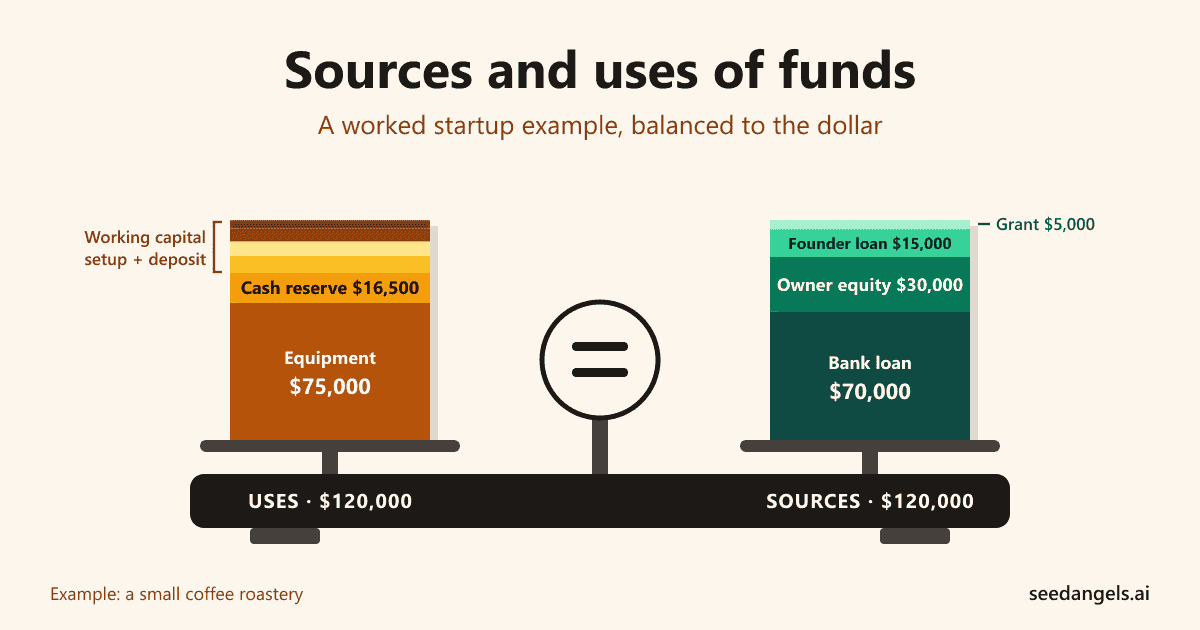
This article follows a single business from the first line to the funding request: a small coffee roastery that needs $120,000. Every use is calculated, every source is justified, the statement balances, and the plan is then tested over three years with the cash flow the business generates. All totals reconcile to the dollar, so you can rerun each calculation with your own figures.
What is a sources and uses of funds statement?
A sources and uses of funds statement is a two-column table that lists everything a new business must pay for before it can stand on its own (setup costs, equipment, deposits, inventory, working capital, cash reserve) and every source of money that covers it (owner equity, loans, grants, investors). Both columns must show the same total.
The SBA puts the stakes plainly: calculating your startup costs is what lets you estimate profits, secure loans and attract investors. The sources and uses statement is the next step: it turns those costs into a funding need and shows who covers it.
Don't confuse it with its two neighbors:
| Document | What it shows | Time frame |
|---|---|---|
| Sources and uses of funds | What the launch costs and who pays for it | Day one |
| 3-year funding plan | New needs and new resources, year by year | First three years |
| Cash flow forecast | Actual money in and out, month by month | 12 to 36 months |
Sources and uses says how much and from whom. The cash flow forecast says when. Both must tell the same story.
The case: a $120,000 coffee roastery
The business is fictional, but every number is calculated, and you can swap our assumptions for yours line by line.
Maison Grain is a small-batch coffee roastery in an 80 m² (860 sq ft) downtown space. It roasts on site, sells in its shop, and supplies cafés, restaurants and offices in town. Opening is planned three months after the funding comes through, the time needed for the build-out.
| Assumption | Value used |
|---|---|
| Year 1 revenue | $240,000 |
| Sales mix | 50% shop (paid on the spot), 50% trade customers (net 45) |
| Purchases (green coffee, packaging) | 30% of revenue, i.e. $72,000 in year 1 |
| Supplier terms | Net 30 |
| Average inventory | 40 days of purchases |
| Rent | $1,500 per month |
| Year 1 fixed costs | $42,000 operating expenses + $90,000 payroll = $11,000 per month |
| Team | The founder and one employee |
Two conventions throughout: amounts exclude sales tax or VAT, and day-based calculations use the 360-day year that banks commonly use.
Step 1: list and calculate the uses
To calculate your funding need, add up six lines, in this order:
- Setup costs: everything it costs to create the business before you buy anything.
- Equipment and build-out: the long-lived assets.
- Deposits: money held by your landlord or suppliers.
- Opening inventory: the stock you buy before your first sale.
- Working capital: the gap between what customers owe you and what you owe suppliers.
- Cash reserve: the cushion that carries you through the ramp-up and the surprises.
For Maison Grain, those six lines come to $120,000. Here is how each one is calculated.
Setup costs
Registration, legal and accounting fees, branding, website and signage: $7,000 ($2,500 of formalities and fees, $4,500 of branding and materials). None of it produces anything durable, but all of it is paid before opening day, so it has to be funded.
Equipment and build-out
| Item | Cost | Depreciation period |
|---|---|---|
| 15 kg coffee roaster | $35,000 | 7 years |
| Build-out of the space | $25,000 | 10 years |
| Counter, grinders, espresso machine | $12,000 | 5 years |
| Computer and point of sale | $3,000 | 3 years |
| Total | $75,000 |
Each figure should come from a quote, not an estimate. Depreciation periods don't matter for the day-one statement, but they come back in the three-year cash flow check.
Deposits
The lease requires a security deposit of three months' rent: 3 × $1,500 = $4,500. Use the amount written in your lease. You get it back when you leave, but it is locked up for the whole lease, so it is funded like an asset.
Opening inventory
Maison Grain needs green coffee and packaging on hand on opening day. With an average inventory of 40 days of purchases and $72,000 of purchases planned for the year:
$72,000 × 40 / 360 = $8,000
Inventory is part of working capital. We give it its own line because lenders often ask for it that way, but it must not be counted again in the working capital line.
Working capital, calculated in days
Working capital is the money tied up in your operating cycle: inventory you have paid for and not yet sold, plus invoices your customers haven't paid yet, minus invoices you haven't paid your suppliers yet. The most reliable way to size it is in days, item by item:
| Item | Annual base | Days | Amount |
|---|---|---|---|
| Inventory | $72,000 of purchases | 40 days | + $8,000 |
| Accounts receivable | $120,000 of trade sales | 45 days | + $15,000 |
| Accounts payable | $72,000 of purchases | 30 days | − $6,000 |
| Total working capital | $17,000 | ||
| of which inventory (own line) | $8,000 | ||
| of which working capital excluding inventory | $9,000 |
Shop sales are paid on the spot, so they create no receivables: only the trade half of revenue enters the calculation. That is why working capital depends as much on your sales mix as on your total, and why it should be built from a revenue forecast split by channel rather than from a single number.
Cash reserve
The last line is the cushion that pays the bills while sales ramp up and absorbs the unexpected. Maison Grain keeps one and a half months of fixed costs:
$11,000 × 1.5 = $16,500, or 13.75% of total uses.
No official rule sets this amount. A common starting point is one to three months of fixed costs; the right figure is the one that keeps your monthly cash flow forecast positive in its lowest month. The SBA advises counting at least a year of monthly expenses when you estimate your costs: that year sits in your forecast, and the reserve covers the part your early revenue can't pay yet.
Sales tax and VAT at opening. In VAT countries, the plan is built net of VAT when the business can reclaim it, but the VAT on equipment and setup costs (up to $16,400 here, at a 20% rate on $82,000) is paid to suppliers weeks or months before it comes back. Cover it with the cash reserve or a short-term VAT bridge loan. In the US, sales tax paid on equipment is generally part of its cost: include it in the uses directly.
Summary of uses:
| Use | Amount | Share |
|---|---|---|
| Setup costs | $7,000 | 5.83% |
| Equipment and build-out | $75,000 | 62.50% |
| Security deposit | $4,500 | 3.75% |
| Opening inventory | $8,000 | 6.67% |
| Working capital excl. inventory | $9,000 | 7.50% |
| Cash reserve | $16,500 | 13.75% |
| Total uses | $120,000 | 100% |
Step 2: line up the sources
Fill the sources column starting with money the business never has to repay, and finish with the bank loan, which balances the table.
Owner equity
The founder puts $30,000 of savings into the company's equity, 25% of total uses. That share, and where the money comes from, is what lenders look at first.
Interest-free founder loan
The founder also obtains a $15,000 interest-free personal loan and puts it into the company. In France and several other countries this is an honour loan from a founder network; elsewhere it can be a family loan. What matters for the statement is that the loan is personal: the company receives it as equity, and the founder repays it from her salary, so it adds nothing to the company's debt payments. Founder networks grant these loans after a committee hearing, and what a loan committee checks in your business plan includes whether this statement balances and stays within the network's cap on its loan.
A microloan could fill the same slot in the US: the SBA program goes up to $50,000, with an average of about $13,000 and a maximum term of seven years. But it is company debt, usually at 8 to 13% interest, so its payments would join the bank loan in the three-year check below.
Grants
Maison Grain receives a $5,000 local small-business grant. Don't plan on a federal one: the SBA states that it "does not provide grants for starting and expanding a business". Grants for new businesses usually come from local or state programs, economic development agencies or competitions. One rule applies everywhere: only list a grant once it has been awarded. A grant you've applied for is a hope, not a source.
Bank or SBA-backed loan
The bank loan fills the gap:
$120,000 − $30,000 − $15,000 − $5,000 = $70,000
Assumption: 7 years at 4.5%, giving a monthly payment of $973.01 and annual debt service of $11,676. The term is not random: it matches the life of the roaster (7 years), the main asset financed. A loan should never last longer than what it pays for. In the US, the SBA's 7(a) program, which goes up to $5 million and covers equipment and working capital, is the usual guaranteed route for a loan of this kind; your lender tells you whether it applies.
| Source | Amount | Share |
|---|---|---|
| Owner equity (savings) | $30,000 | 25.00% |
| Interest-free founder loan | $15,000 | 12.50% |
| Local grant | $5,000 | 4.17% |
| Bank loan (7 years) | $70,000 | 58.33% |
| Total sources | $120,000 | 100% |
The complete statement, and the balance a lender checks
Here is the table as it appears in the business plan:
| Uses | Amount | Sources | Amount |
|---|---|---|---|
| Setup costs | $7,000 | Owner equity | $30,000 |
| Equipment and build-out | $75,000 | Interest-free founder loan | $15,000 |
| Security deposit | $4,500 | Local grant | $5,000 |
| Opening inventory | $8,000 | Bank loan (7 years) | $70,000 |
| Working capital excl. inventory | $9,000 | ||
| Cash reserve | $16,500 | ||
| Total | $120,000 | Total | $120,000 |
Before anything else, a lender checks three things on this table:
- The two totals match. If uses exceed sources, part of the plan is unfunded; if the plan only balances because the loan line was inflated, the file was built backwards.
- Long-term needs are funded by long-term money. Here, the $70,000 loan is smaller than the $75,000 of equipment: it funds durable assets, and the founder's $45,000 funds everything else, from inventory to the cash reserve. Lenders prefer financing equipment to financing operations.
- The loan term matches the life of the assets. Seven years for a roaster depreciated over seven years: consistent.
Then come the ratios: the owner's share of the total need, repayment capacity, leverage. They are all computed from the lines of this table and the income statement; we cover them, with their thresholds, in our article on the ratios lenders run on your forecast. For reference, Maison Grain's year 1 EBITDA ($33,000, calculated in the next section) covers its $11,676 debt service 2.8 times.
The 3-year check, with cash flow
The day-one statement proves the launch is funded. The three-year plan proves the business holds up once loan payments start. Each year, it sets the new needs (new equipment, growth in working capital, loan principal to repay) against the new resources, first of all the cash the business generates itself.
That cash flow is net income plus depreciation: depreciation reduces profit without a single dollar leaving the account. Bpifrance, France's public investment bank, uses exactly this formula for new businesses: after-tax profit plus depreciation. So you need a simplified income statement:
| Simplified income statement | Year 1 | Year 2 | Year 3 |
|---|---|---|---|
| Revenue | $240,000 | $300,000 | $360,000 |
| Purchases (30%) | −$72,000 | −$90,000 | −$108,000 |
| Operating expenses | −$42,000 | −$45,000 | −$48,000 |
| Taxes other than income tax | −$3,000 | −$3,500 | −$4,000 |
| Payroll | −$90,000 | −$115,000 | −$130,000 |
| EBITDA | $33,000 | $46,500 | $70,000 |
| Depreciation and amortization | −$12,300 | −$12,300 | −$12,300 |
| Loan interest | −$2,972 | −$2,572 | −$2,154 |
| Pre-tax income | $17,728 | $31,628 | $55,546 |
| Income tax | −$2,659 | −$4,744 | −$9,637 |
| Net income | $15,069 | $26,884 | $45,909 |
| Cash flow (net income + D&A) | $27,369 | $39,184 | $58,209 |
To rerun the numbers:
- Depreciation: $5,000 (roaster, $35,000 over 7 years) + $2,500 (build-out, $25,000 over 10 years) + $2,400 (equipment, $12,000 over 5 years) + $1,000 (computer, $3,000 over 3 years) + $1,400 (setup costs, $7,000 over 5 years) = $12,300 a year.
- Interest: taken from the amortization schedule of the $70,000 loan at 4.5% over 84 months. Each year, interest plus principal equals the $11,676 annual debt service.
- Income tax: our example uses the French small-company rates, 15% on the first $42,500 of profit and 25% above. Replace them with your own jurisdiction's rates. Year 3: $42,500 × 15% + $13,046 × 25% = $9,637.
- Timing: to keep it simple, year 1 is the first twelve months of trading, and the loan is assumed to be drawn and repaid from opening day. In practice, ask for a principal deferral during the build-out.
The three-year plan then looks like this (no dividends are paid over the period):
| 3-year funding plan | Year 1 | Year 2 | Year 3 |
|---|---|---|---|
| Startup uses | $120,000 | – | – |
| New equipment (packaging machine) | – | – | $8,000 |
| Increase in working capital | – | $4,250 | $4,250 |
| Loan principal repaid | $8,704 | $9,104 | $9,522 |
| Total needs | $128,704 | $13,354 | $21,772 |
| Startup sources | $120,000 | – | – |
| Cash flow | $27,369 | $39,184 | $58,209 |
| Total resources | $147,369 | $39,184 | $58,209 |
| Surplus for the year | $18,665 | $25,830 | $36,437 |
| Cumulative surplus | $18,665 | $44,495 | $80,932 |
Where do the working capital increases come from? The same day-based calculation, rerun with each year's volumes. Year 2: $10,000 of inventory + $18,750 of receivables − $7,500 of payables = $21,250, which is $4,250 more than the starting $17,000. Year 3: $12,000 + $22,500 − $9,000 = $25,500, another $4,250. A growing business locks up more cash in its operating cycle: that's a funding need, not a detail.
Bpifrance reports a rule of thumb French lenders apply: in year 1, resources should exceed needs by at least 15 to 20% of that year's cash flow, and the surplus should then grow. Maison Grain's year 1 surplus is $18,665, or 68% of its cash flow, and it grows every year.
A positive annual plan does not guarantee that no month dips below zero, though. The first months combine the build-out, advanced sales tax or VAT and still-low sales. Only the monthly cash flow statement, one of the three statements in your financial forecast, shows that, and it is what confirms whether the $16,500 reserve is enough.
That chain is what SeedAngels' financial forecasting software automates: it reads your funding need from your monthly cash flows, includes working capital, builds the amortization schedule of your loans and its effect on cash, then helps you cover the need with debt, equity or both. It does not choose your assumptions for you: the quotes, your customers' payment terms and the grants you've actually been awarded remain yours, and the loan is still negotiated with the bank.
5 mistakes that unbalance a funding plan
- Leaving out working capital, or guessing it. A flat "$5,000 of working capital" tells a lender nothing. A calculation in days (inventory, receivables, payables) shows you understand your operating cycle.
- Counting inventory twice. If opening inventory has its own line, it comes out of the working capital calculation. In our example, the mistake would have inflated the need by $8,000.
- Counting a source before it arrives. A grant applied for but not awarded, or an installment that lands months after opening, does not pay opening-day bills. Put each source in the month it actually arrives in your cash flow forecast.
- Forgetting tax on equipment. Whether it is VAT you will reclaim later or sales tax you will never get back, it is cash out on day one.
- Funding long-term needs with short-term money, or balancing to the dollar with no margin. An overdraft or a credit card does not fund a roaster, and a plan with no cash reserve has no room for the first surprise.
How to present the funding request in your business plan
The sources and uses statement is a table; the funding request is the text that makes it readable in two minutes. It goes at the end of the financial section of your business plan, right after the tables. The SBA's own guidance for the funding request section asks for the amount, debt or equity, the terms, the time period covered and what the money is for. In practice, that means five things, in this order.
The amount, in one sentence
Start with the sentence the reader must remember if they read nothing else:
"Maison Grain is requesting a $70,000 bank loan over 7 years to fund the equipment and build-out of its roastery, against a total need of $120,000 of which 41.7% is already covered by owner equity, a founder loan and a grant."
The 41.7% is the $50,000 that doesn't come from the bank ($30,000 + $15,000 + $5,000), divided by the $120,000 total.
Use of funds, line by line
Show where every dollar goes, grouped into items a non-specialist can follow:
| Use of funds | Amount | Share |
|---|---|---|
| Roaster, shop equipment, computer | $50,000 | 41.67% |
| Build-out | $25,000 | 20.83% |
| Setup costs | $7,000 | 5.83% |
| Security deposit | $4,500 | 3.75% |
| Opening inventory | $8,000 | 6.67% |
| Working capital excl. inventory | $9,000 | 7.50% |
| Cash reserve | $16,500 | 13.75% |
| Total | $120,000 | 100% |
Each equipment line points to a quote in the appendix.
The funding mix: who pays for what
Say which source funds which use. At Maison Grain, the split is clean:
- the bank loan ($70,000) and the grant ($5,000) fund the $75,000 of equipment and build-out;
- the founder's money (savings and founder loan: $45,000) funds everything else: setup costs, deposit, inventory, working capital and the reserve ($7,000 + $4,500 + $8,000 + $9,000 + $16,500 = $45,000).
This shows the lender that its money buys assets that keep their value, and that the operating risk sits with the founder.
The milestones the money pays for
Funding buys a trajectory, not just equipment. Give three or four dated, checkable milestones:
- Month 3: shop open, roaster running.
- Month 12: about fifteen active trade accounts, roughly $10,000 of trade sales a month.
- Year 1: $240,000 of revenue, above a break-even point of about $215,000 ($150,272 of fixed costs including depreciation and interest, divided by the 70% gross margin).
- Year 3: $360,000 of revenue and a packaging machine paid for from cash flow.
Bank or investor: two readings of the same table
The same request is not written the same way for every reader.
| What they look at | A bank | An investor |
|---|---|---|
| The real question | Will I be repaid, even if things go worse? | What will the company I fund be worth? |
| The key figure | Cash flow against debt service | Growth, and how long the round lasts |
| Use of funds | Durable assets that back the loan | What speeds up growth: hiring, marketing, product |
| Funding mix | A solid owner contribution, a loan backed by assets | The share of equity sold and the valuation |
| Milestones | Break-even and steady cash | The steps that justify the next round |
A roastery like Maison Grain is a natural fit for a bank. A business that aims for fast growth and is ready to sell equity presents its request differently: use of funds is tied to growth milestones and to how many months the money keeps the company running, as we explain in our fundraising guide.
Conclusion
A solid funding plan isn't recognized by its total but by its traceability: every use comes from a quote or a calculation in days, every source is in hand or awarded, and the bank loan is only the last line, the one that balances. The Maison Grain example shows the full chain: six uses, four sources, a balance at $120,000, then cash flow that covers loan payments with a surplus that grows every year.
Rebuild that path with your own numbers, in the same order, and check three things before you send it: working capital is calculated, not guessed; every source and every tax payment sits in the right month of your cash flow forecast; and your funding request fits in one sentence. To build the forecast that feeds this table, use SeedAngels. Try SeedAngels for free →
FAQ
What is a sources and uses of funds statement?
It is a two-column table that lists everything a business must pay for before it can stand on its own (setup costs, equipment, deposits, opening inventory, working capital, cash reserve) and every source of money that covers it (owner equity, loans, grants, investors). The two totals must be equal. Lenders and investors read it to see exactly what their money pays for.
How do I calculate my startup costs?
Add six lines: setup costs, equipment and build-out, deposits, opening inventory, working capital and a cash reserve. Take each equipment figure from a quote, calculate working capital in days (receivables minus payables, with inventory counted separately) and size the reserve from your monthly fixed costs. In our coffee roastery example, those six lines add up to $120,000.
Should working capital be included in startup costs?
Yes. As soon as customers pay you later than you pay your suppliers, cash gets tied up in the business. Calculate it in days: 45 days of credit on $120,000 of trade sales ties up $15,000. Forgetting working capital is the first of the common mistakes listed by Bpifrance, France's public investment bank, and it leaves a plan short of cash in its first months.
Do sources and uses have to balance?
Yes. Total sources must equal total uses. If uses are higher, part of the plan is unfunded; if you only balance it by inflating the loan line, the lender will notice. Balance it with real sources, then check that long-term needs such as equipment are funded by long-term money, not by an overdraft or a credit card.
How much cash reserve should a startup plan for?
There is no official rule. A common starting point is one to three months of fixed costs. In our example, $16,500 covers 1.5 months of fixed costs and is 13.75% of total uses. The right figure is the one that keeps your monthly cash flow forecast above zero in its lowest month, including any sales tax or VAT you have to advance.
What is the difference between sources and uses and a cash flow forecast?
Sources and uses shows how much money the launch needs and who provides it, as a snapshot on day one. The cash flow forecast shows when money actually comes in and goes out, month by month. A plan can balance on paper and still run out of cash in month five, which is why lenders read both documents together.
How should I present the use of funds to a bank versus an investor?
A bank wants durable assets it can rely on, a solid owner contribution and cash flow that covers the loan payments. An investor wants to see which growth milestones the money reaches and how long it lasts before the next round. The table can be the same; the sentence that introduces it and the milestones you highlight change.