You have real numbers, and that is exactly the trap
A buyer starts with an advantage no founder will ever have: three years of real, audited, already-collected numbers. And that is precisely what sinks most acquisition files. Because those numbers are not yours. They describe a business run by someone else, who paid themselves whatever they liked, who may have leased the building to their own company, and who has stopped investing in equipment for three years while preparing an exit.
Carry those figures straight into your forecast and you hand the lender a document that describes neither the past (the seller is leaving) nor the future (your cost base will differ). An analyst spots it in ten minutes.
The method sits elsewhere: an acquisition forecast is not built, it is normalized. This article starts from the seller's accounts and follows one worked example end to end: the six adjustments to apply to the income statement, the three-year rebuild, and the one calculation that actually decides the outcome: can the business you are buying service the debt used to buy it?
Why an acquisition plan is nothing like a startup plan
The two exercises share a name and almost nothing else. Lenders know it, which is why an acquisition file is read against a different set of questions.
| Startup | Acquisition | |
|---|---|---|
| Source of the numbers | Assumptions to justify | Real accounts to normalize |
| Evidence expected | Market research, quotes | Three years of accounts + documented adjustments |
| Dominant funding line | Capex + working capital at launch | Purchase price |
| Main risk | The business never takes off | Revenue drops once the seller leaves |
| Horizon requested | 3 years | 3 years, aligned with the loan term |
| The lender's question | "Does this market exist?" | "Does the business service its own debt?" |
That last line is the only one that truly matters. With a startup, the lender bets on a market; with an acquisition, it buys an accounting certainty, or it declines. If you start from a business plan template designed for a launch, expect to rebuild the funding plan entirely: the purchase price simply is not in it.
The financing route matters too. In the United States, SBA 7(a) loans explicitly list "changes of ownership (complete or partial)" among approved uses, with a maximum loan amount of $5 million, and most 7(a) term loans "are repaid with monthly payments of principal and interest from the cash flow of the business." That last clause is the whole subject of this article.
Asset purchase or stock purchase: what the structure changes in your numbers
Settle this before you line up a single figure. It determines what lands on your balance sheet, what runs through the income statement, and what you inherit along the way, including what you did not want to inherit.
Asset purchase: you start from a clean balance sheet
You buy the operating assets: customer list, trade name, lease, equipment, contracts in progress. You do not buy receivables, cash or debts. The seller's legal entity survives, emptied of its business.
The direct forecast consequence: you start with no cash and no receivables, so the entire working capital requirement has to be funded from month one. That is the classic asset-deal mistake: budgeting the price but forgetting you will pay suppliers well before you collect from your first customers.
On the upside, the purchase price is generally allocated across asset classes and goodwill, and amortizable intangibles produce a real tax shield your forecast should reflect.
Stock purchase: you inherit the liabilities
You buy the shares. The company carries on unchanged, with its cash, receivables and inventory, and its debts, pending litigation, and latent tax and employment exposure.
The price is usually lower than for an equivalent asset deal, precisely because you are taking on the liabilities. In exchange, due diligence becomes mandatory and representations, warranties and an indemnity escrow are not negotiable: they protect you from an assessment covering a period before you arrived.
Forecast-wise the advantage is clear: working capital is already funded and the cash stays in. Your funding need narrows to price, fees and a safety reserve.
Buying through a holding company
As soon as the price exceeds your available equity, this becomes the dominant structure. You incorporate a holding company, which borrows and buys the target's shares. The holding has no operations of its own: it repays the debt with dividends distributed up from the target, and most jurisdictions tax those intra-group distributions lightly.
Here is the point buyers handle worst in their forecast: after corporate income tax, the target must generate distributable profit above the holding's annual debt service. A comfortable EBITDA is not enough if tax and replacement capex absorb the margin. Your forecast therefore needs two levels: the target's income statement, and the holding's dividend-and-repayment schedule.
| Asset purchase | Stock purchase | |
|---|---|---|
| Goes on the balance sheet | Allocated assets + goodwill | Investment in subsidiary |
| Cash and receivables | Not acquired | Acquired |
| Debts and tax exposure | Not assumed | Fully assumed |
| Commercial lease | Assigned (landlord consent needed) | Unchanged (entity stays the tenant) |
| Employment contracts | Re-hired or transferred | Unchanged |
| Working capital to fund | In full | Residual |
Normalizing the seller's accounts: the 6 adjustments lenders expect
Adjusted EBITDA is operating profit corrected for the owner's personal choices. You get there by restating their compensation to a market rate, removing family payroll, correcting off-market rent and stripping out non-recurring items, keeping only what the business genuinely earns regardless of who runs it. It is the only number a price or a repayment schedule can be built on.
For owner-operated companies, buyers often work with seller's discretionary earnings, which Wall Street Prep defines as pre-tax income adjusted for owner's compensation, interest, depreciation and amortization, discretionary expenses and non-recurring items, noting that "the owner's salary component is oftentimes the owner's desired level of compensation, rather than the market rate." That single sentence is the whole reason this section exists.
Here are the six adjustments, in the order to apply them, with their effect on the example below.
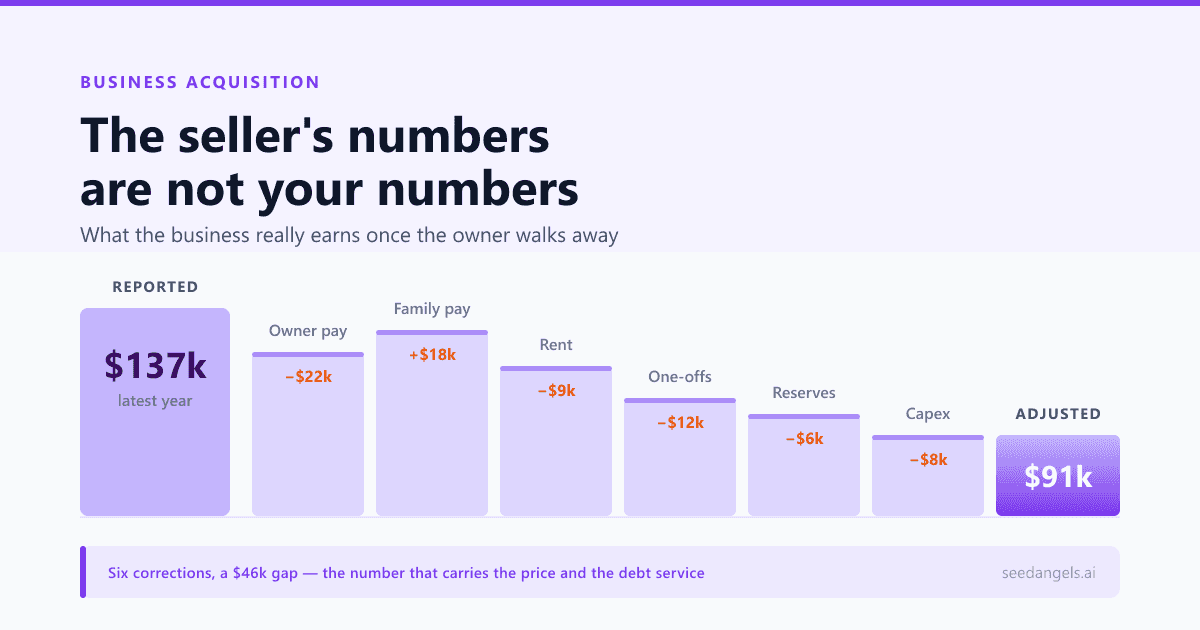
- Restate the owner's compensation. Replace what they paid themselves with the real cost of whoever replaces them: you, or a hired manager. An owner near retirement often underpays themselves; an owner dressing up the accounts for sale sometimes overpays. Either way, the reported figure is not yours. Impact on the example: −$22,000.
- Remove non-working family payroll. A spouse on the payroll part-time but absent, a child under contract with no real role: those costs disappear at closing and must be added back. Impact: +$18,000.
- Correct off-market rent. When the seller owns the premises through a separate entity, the rent is almost always set for tax reasons, never at market. Restate it to fair rental value, and check what happens to the lease at closing. Impact: −$9,000.
- Strip out non-recurring items. Gain on a vehicle sale, an insurance settlement, a one-off legal provision: positive or negative, they will not repeat. They leave the calculation. Impact: −$12,000.
- Fix the reserves. Cushion reserves booked to smooth a strong year get added back. Missing reserves on doubtful receivables or a pending employment claim have to be created. Impact: −$6,000.
- Add back deferred capex. An owner winding down stops buying equipment. If the asset base is five years behind, the catch-up is a certain year-one cost that appears nowhere in the seller's accounts, and it is the most frequently skipped adjustment of the six. Impact: normalized depreciation charge of −$8,000/year.
Weight the three years 3/2/1. Never work off the most recent year alone: it is the one most often dressed up for sale. Apply a coefficient of 3 to the latest year, 2 to the prior one and 1 to the oldest, then divide the total by 6. You get a weighted average that gives recent performance its due without ignoring the trend.
Adjusted EBITDA is also the base for the price: market multiples apply to it, never to reported profit. If yours diverges materially from the seller's, the price negotiation has to reopen: a good moment to revisit the valuation methods and check that the multiple being asked sits inside your sector's range.
Worked example: from the seller's accounts to a financeable forecast
A fictional example, built on realistic orders of magnitude. A B2B services company, 8 employees, $920,000 in revenue, asking price $450,000 for 100% of the shares. The owner is 62.
The accounts as reported by the seller (3 years)
| Y-2 | Y-1 | Y | |
|---|---|---|---|
| Revenue | $875,000 | $895,000 | $920,000 |
| Operating expenses | $268,000 | $271,000 | $279,000 |
| Payroll (excluding owner) | $392,000 | $401,000 | $408,000 |
| Owner's compensation (fully loaded) | $96,000 | $96,000 | $96,000 |
| Reported EBITDA | $119,000 | $127,000 | $137,000 |
Over three years the curve rises. With the 3/2/1 weighting, weighted average EBITDA comes out at $130,000, not $137,000. That is the first gap, before a single adjustment.
The normalized income statement
| Adjustment | Effect | Running EBITDA |
|---|---|---|
| Weighted average EBITDA (3/2/1) | n/a | $130,000 |
| 1. Owner's compensation at market ($96k → $118k) | −$22,000 | $108,000 |
| 2. Non-working spouse payroll removed | +$18,000 | $126,000 |
| 3. Rent restated to fair value ($36k → $45k) | −$9,000 | $117,000 |
| 4. Non-recurring gain on vehicle sale removed | −$12,000 | $105,000 |
| 5. Missing doubtful-receivable reserve | −$6,000 | $99,000 |
| 6. Normalized equipment replacement charge | −$8,000 | $91,000 |
The gap is $46,000, or 34% of the EBITDA reported in the final year. At a 3.5x multiple that is $160,000 of value, more than a third of the asking price. It is exactly the calculation the credit analyst runs, and it is your main negotiating lever.
Note the mechanics: the adjustments do not all move the same way. The spouse's payroll lifts the result, while the compensation restatement, the rent and the reserves push it down further. A file where every adjustment improves the result is a file that was not done properly.
The buyer's forecast, years 1 to 3
Start from the $91,000 of adjusted EBITDA, then apply your own assumptions. Here: an 8% revenue loss in year one tied to the owner's departure (two long-standing accounts he personally handled), with gradual recovery afterwards.
| Year 1 | Year 2 | Year 3 | |
|---|---|---|---|
| Revenue | $846,000 | $890,000 | $935,000 |
| Adjusted EBITDA | $74,000 | $88,000 | $99,000 |
| Depreciation and amortization | $14,000 | $16,000 | $16,000 |
| Operating income | $60,000 | $72,000 | $83,000 |
| Interest expense | $11,000 | $9,500 | $8,000 |
| Income tax | $12,250 | $15,625 | $18,750 |
| Net income | $36,750 | $46,875 | $56,250 |
| Operating cash flow | $50,750 | $62,875 | $72,250 |
Year one is deliberately degraded. An acquisition forecast that returns to the seller's level from day one is not credible: it ignores the one risk the lender is trying to measure. The line-by-line build is the same as for any complete financial forecast: what changes is the input data, which here is historical rather than hypothetical.
Can the target service its own acquisition debt?
This is the single question. Everything above exists only to answer it with defensible numbers.
The acquisition funding plan
| Uses | Amount | Sources | Amount |
|---|---|---|---|
| Share purchase price | $450,000 | Buyer's equity | $135,000 |
| Legal and due diligence fees | $18,000 | Bank loan, 7 years | $380,000 |
| Catch-up capex | $25,000 | Subordinated / seller note | $30,000 |
| Cash reserve | $40,000 | ||
| Total | $533,000 | Total | $545,000 |
Equity here covers 25% of the total need, inside the usual range. The $12,000 surplus is deliberate slack: a funding plan balanced to the dollar is a funding plan that breaks on the first surprise.
Note the catch-up capex line: it flows directly from adjustment 6. A funding plan that omits it mechanically produces an unfunded gap in year one.
Computing repayment capacity and DSCR
Two calculations, two thresholds.
Repayment capacity = Net debt ÷ Operating cash flow ≤ 4
This ratio expresses how many years of operating cash flow it would theoretically take to clear the debt. Above 4, lenders read the business as over-leveraged.
Applied to the example: net debt of $410,000 against year-one operating cash flow of $50,750 gives 8.1. Taken alone, this file fails that test, which is normal in an acquisition, where the debt is backed by a purchased asset rather than by a growing operation. So the lender looks primarily at the second calculation.
DSCR = Available cash flow ÷ Annual debt service
Corporate Finance Institute states that "most commercial banks and equipment finance firms want to see a minimum of 1.25x but strongly prefer something closer to 2x or more," and that many small and middle-market lenders set covenants at not less than 1.25x.
With a $380,000 loan over 7 years at 7.5%, annual debt service comes to roughly $63,000. The $30,000 seller note over 5 years adds $6,000, for total debt service of $69,000.
| Year 1 | Year 2 | Year 3 | |
|---|---|---|---|
| Operating cash flow | $50,750 | $62,875 | $72,250 |
| Debt service | $69,000 | $69,000 | $69,000 |
| DSCR | 0.74x | 0.91x | 1.05x |
Verdict: not financeable as it stands. The business does not cover its own debt before year three, and even then without any margin. For context, SBA 7(a) files are assessed against a global coverage floor of 1.15x, raised to 1.25x for first-time acquisitions under the rules taking effect in October 2026, with projections no longer accepted to clear that hurdle.
Three levers can fix this file, and one is an illusion:
- Extend the term. Ten years brings bank debt service to roughly $47,000, total service to $53,000, and DSCR to 0.96x in year one and 1.37x in year three. Still short in year one, but the profile becomes arguable with an interest-only period.
- Negotiate the price. This is the main lever, and you have already built it: the $46,000 gap in adjusted EBITDA is a factual basis for revision. At $380,000 with the same equity, debt falls to $340,000 and year-one DSCR rises to 0.89x, reaching 1.26x by year three.
- Negotiate a 12-month interest-only period, standard in acquisition lending: you pay interest only through the year when commercial attrition risk peaks.
- Inflate the forecast to clear the ratio. This is the most common and most counterproductive reflex: the analyst compares your assumptions to the historical accounts sitting in front of them, and a year one above the seller's final year during an ownership change reads as a red flag, not an argument.
These are the same filters applied to any commercial loan request; if you want to anticipate them one by one, we broke down the 5 ratios your lender runs on a forecast, with thresholds and the lines that produce them.
To test your own price, term and equity assumptions before the meeting, the Business Plan Analyzer flags the most common inconsistencies between funding plan, income statement and cash flow.
The 5 mistakes that get an acquisition file declined
- Carrying the seller's revenue across unchanged. The owner's departure always has a commercial cost. A flat or growing year one without a precise explanation (multi-year contracts signed, customers not tied to the owner) discredits the entire forecast.
- Forgetting acquisition working capital. In an asset deal you start with no receivables and no cash: working capital has to be funded in full, from month one. It is the most mechanical decline reason there is.
- Underestimating owner dependency. In services and trades, part of the customer base is attached to the person, not the brand. Quantify that share explicitly and plan a three-to-six-month transition period with the seller: lenders read it as a genuine risk reduction.
- Skipping catch-up capex. Adjustment 6 is not an accounting nicety: it is a real cash outflow in year one, exactly when your margin is thinnest.
- Building a forecast with no safety margin. A DSCR of 1.01x is not a file that clears: it is a file that collapses the day one customer leaves. Run a downside scenario at −15% revenue and show that debt service still holds. Many buyers outsource this exercise rather than build it, which is legitimate, but what a financial forecast actually costs is worth comparing against a tool you drive yourself, assumption by assumption.
Conclusion
Three moves, in this order, and the file stands up: normalize the seller's accounts to isolate what the business earns without them, rebuild the forecast around the real cost of ownership and the year-one commercial drop, verify that operating cash flow covers debt service with at least a 15% cushion.
If that third calculation fails, the answer is never to retouch the forecast. It sits in the price, in the loan term or in an interest-only period: three variables your normalization work is precisely what lets you negotiate. A buyer who walks into a lender meeting with documented adjusted EBITDA and a computed DSCR is no longer defending a project: they are presenting a proof.
SeedAngels builds your acquisition business plan, your three-year forecast and your monthly cash flow plan from your own data, with assumptions you keep under your control, the prerequisite for defending them in front of an analyst. Try SeedAngels for free →
FAQ
How do you write a business plan for acquiring a company?
Start from the seller's last three years of accounts, normalize the result to strip out the departing owner's compensation, off-market rent and one-off items, then rebuild a three-year forecast that includes the cost of the acquisition debt. The document must show that operations generate enough cash to service that debt, guarantees included.
What numbers should an acquisition forecast be built on?
On the seller's actual accounts, not on assumptions. The last three fiscal years give you the base, weighted 3 for the most recent, 2 for the prior year and 1 for the oldest. Those figures become your forecast once normalized, then adjusted for the customer attrition risk tied to the owner's departure.
What is the difference between an asset purchase and a stock purchase?
An asset purchase covers only the operating assets: you start from a clean balance sheet, without the seller's liabilities or cash. A stock purchase transfers the entire company, including its debts, its litigation and its latent tax exposure, which makes representations and warranties non-negotiable. The two structures produce very different forecasts.
What is adjusted EBITDA and why does it decide the deal?
Adjusted EBITDA is operating profit corrected for the owner's personal choices: compensation restated to a market rate, family payroll, off-market rent and non-recurring items. It measures what the business actually earns independently of who owns it. Both the price and the repayment capacity are computed on that number, never on reported profit.
What debt service coverage do lenders require on an acquisition?
Most commercial lenders set a minimum debt service coverage ratio around 1.25x, and the SBA applies a 1.15x global floor on 7(a) loans, rising to 1.25x for first-time acquisitions under the 2026 rules. Anything sitting at 1.0x is not a financeable file: it fails the moment one customer leaves.
Should you use a holding company to buy a business?
It is the dominant structure as soon as the price exceeds the cash you can put in. The holding company carries the acquisition debt and repays it with dividends distributed up from the target, most jurisdictions taxing those intra-group distributions lightly. In exchange, the target must generate enough distributable profit every year, which your forecast has to demonstrate.
How many years should an acquisition forecast cover?
Three years is the expected standard, with year one broken down month by month. If the acquisition loan runs longer than seven years, add a simplified projection through to maturity to show that debt service holds across the whole term.