Ask ChatGPT for the occupancy rate of holiday cottages in your area and you will get an answer in two seconds, with a precise percentage and often a source. The trouble is that nothing in the answer tells you whether that figure actually exists. A language model produces plausible numbers, not verified ones. And that is exactly the number your banker or investor will ask you to justify.
AI is still a real accelerator for market research. It frames the questions, finds and summarises 80-page reports, analyses hundreds of customer reviews and drafts a clean summary. Bpifrance Création, the business-creation information service of France's public investment bank Bpifrance, ran a webinar on market research in the age of AI in April 2026 and summed up the division of labour in one line (our translation): "You collect. The AI analyses. You decide."
This guide gives you the 6-step method, a copy-ready prompt for each step and a reusable verification sheet. To keep it concrete, we apply it to one running example: a six-sleeper holiday cottage in inland Brittany, France. It is an example of how to apply the prompts, not a report of results: the prompts are templates for you to run on your own project, and to check what they return.
Can you use ChatGPT for market research?
Yes for desk research, customer review analysis and synthesis: AI saves days on those. No for supplying reliable figures or replacing your customers: it generates plausible values and can cite sources that do not exist. Every figure it gives you must therefore be traced back to its primary source before it goes into your business plan.
The slides from Bpifrance Création's webinar (in French) draw the same line. Restated, it fits in one table:
| What AI does well | What it will not do |
|---|---|
| Analyse the data you bring it | Know your local market |
| Summarise long documents | Replace interviews with your customers |
| Cross-check several sources and spot contradictions | Give you reliable figures |
| Speed up every step of the research | Validate your idea for you |
The same deck puts it another way: AI has compressed the time analysis takes; it has not removed the need for method.
Academic research points the same way. Three researchers, Ayelet Israeli of Harvard Business School and James Brand and Donald Ngwe of Microsoft, compared willingness-to-pay estimates produced by language models with those from studies of real consumers. In the April 2026 version of their Harvard Business School working paper, the AI estimates were "sometimes comparable" but "often inaccurate and in some cases wrong-signed". Their conclusion: a supplement to human studies, not a substitute. The key point is this one: without human benchmark data, there was no way to tell which estimates were wrong. That is what steps 4 and 5 are for.
The 6-step method
Market research with AI follows six steps. You can delegate most of four of them; two stay with you:
- Frame the questions your research must answer (AI + you).
- Search for public sources and summarise them (AI).
- Analyse your competitors' customer reviews (AI).
- Verify every figure against its primary source (you).
- Interview real prospective customers: interviews and survey (you; AI prepares and summarises).
- Synthesise, then have your conclusions challenged (AI, then you decide).
This method covers how to use AI, not the full content of the research. For what the market section must contain and how it ties into the rest of the plan, see our guide to market research for your business plan: it sets the brief that AI will help you fill.
One rule that applies to every research prompt. Always end them with the same instruction. It is what makes step 4 possible, because it forces the AI to separate what it has read from what it assumes:
For every figure, give the exact source (organisation, title, year, URL)
and say whether it is published data or your own estimate.
If you do not know the source, write "source unknown"
rather than suggesting one.
This instruction does not stop the AI from inventing things. It makes the inventions easy to spot.
Step 1: frame the questions before asking for answers
Goal: get the list of research questions before getting a single answer.
"Do market research for a holiday cottage" produces three pages of generalities about rural tourism. AI fills whatever space you leave it. Asking for the questions first gives you a skeleton you can control, and tells you from the start which answers will come from documents, from observation or from your future customers.
Context: I am preparing the market research for [project: a six-sleeper
holiday cottage] located in [place: inland Brittany, France]. Target
guests: [e.g. families, groups of friends, hikers]. Target price:
[price per night or per week]. Project stage: [idea / property
identified / raising finance].

List the 10 questions my market research must answer so that I can
build my financial forecast. For each question, say where the answer
will come from: published data, observation (listings, prices,
reviews), or prospective customers.
Present the result as a table.

[Add the source rule above here.]
For the example cottage, expect questions about tourist demand in the area, seasonality, the competing supply (number of comparable cottages, listed prices), what guests expect and what occupancy rate is achievable. That questions-by-source table becomes the work plan for everything that follows. Review it: delete questions that change no decision, and add the ones the AI could not have guessed (a local constraint, a planned partnership).
Takeaway: an AI asked for answers invents easy questions; an AI asked for questions shows you what you need to prove.
Step 2: AI-assisted desk research
Goal: quickly find the reports, observatories and public statistics that answer the questions from step 1.
Desk research is where AI saves the most time: finding the right publications, summarising an 80-page PDF, comparing two sources that disagree. Two very different uses coexist, and they do not carry the same risk.
With web search (Deep Research, Perplexity…)
Tools that browse the web and cite their pages (Perplexity, deep-research modes such as Deep Research in ChatGPT and Gemini or Research in Claude) are easier to trace than a chat with no web access. But a cited link is not a verified fact: the page may exist without containing the figure, or contain it for another year or another area.
Find recent public sources on tourism demand in [area: Brittany, and
if possible the inland Morbihan department]: overnight stays,
occupancy rates for holiday rentals and cottages, month-by-month
seasonality, guest profiles. Prioritise public bodies and regional
or local tourism observatories. For each source, give the exact
title, the organisation, the year of the data and the URL.

[Add the source rule here.]
Treat the output as a reading list, not as results. Every figure in it goes through step 4.
On your own documents (NotebookLM or a chat with files)
The other use flips the logic: you collect the documents, and the AI works only on that corpus. The risk of invention drops sharply, though it does not disappear. This is the sequence Bpifrance Création recommends: collect, organise, analyse with AI, decide.
Answer only from the documents provided.
For each piece of information, cite the document and the page.
If the information is not in the documents, write
"not in the documents" and do not fill the gap from your own knowledge.

Question: [e.g. how are overnight stays distributed by month in the
area, and which year does that data cover?]
Where to find documents to feed the AI. The U.S. Small Business Administration notes that existing sources "can save you a lot of time and energy" and lists free federal data, including the Census Bureau. In the UK, the Office for National Statistics plays the same role. For the Brittany cottage, the sources are French: the national statistics office (INSEE) and the regional tourism observatory. Upload those files to the tool, then query them.
Takeaway: AI that searches the web gives you leads; AI that reads your documents gives you answers, as long as you forbid it from leaving them.
Step 3: mine your competitors' customer reviews
Goal: learn what guests criticise and praise about your direct competitors.
This is probably the best use of AI in a small business's market research: analysing customer comments at scale (often called review mining). A person reading dozens of reviews remembers the most striking ones; AI groups them into themes and counts them in seconds.
The raw material: 30 to 50 public reviews of your three closest competitors (Google, rental platforms), copied by hand. Do not use scraping tools: they generally breach the platforms' terms of use. Bpifrance Création's deck gives an example built on 40 Google Maps reviews; here is a version adapted to the cottage:
Here are [number] public guest reviews of three competing cottages
within [distance] of my project. Each review starts with the name
of the cottage.

1. Identify the 5 most frequent complaints.
2. Identify the 5 most frequent points of praise.
3. Suggest 3 ways a new cottage could stand out.

For each theme, give the number of reviews that mention it and quote
one exact excerpt, in quotation marks, with the cottage's name.
Do not invent any quote: if a theme has no clear quote, write
"no exact quote".

[Paste the reviews here]
This step has its own quick check:
- Check three quotes at random against the source text: AI readily paraphrases, and a paraphrase in quotation marks is an invented quote.
- Recount one theme by hand. If the AI says "14 reviews mention the beds" and you find 6, all its counts are suspect.
The themes feed straight into your positioning. To turn them into a structured comparison (price, amenities, capacity, each competitor's strengths and weaknesses), the next move is to build the competitive analysis grid that lenders expect: reviews tell you what guests feel, the grid tells you where you stand.
Takeaway: AI counts and groups better than you do; make sure it does not quote better than the guests did.
Step 4: trace every figure back to its primary source
Goal: keep only figures you have read yourself in their original source.
This step is what separates defensible market research from a well-written text. It cannot be delegated: if you ask the AI to check its own figures, it will produce a check as plausible as the figures themselves.
Why AI makes up numbers
A language model does not look anything up in a database when it answers you: it generates the most likely continuation of the text. An occupancy rate of "58%" or a "2024 regional observatory study" are likely continuations, whether or not they exist. The U.S. National Institute of Standards and Technology calls this confabulation in its Generative AI Profile (AI 600-1): "the production of confidently stated but erroneous or false content", known colloquially as hallucinations.
The trap is in the word "confidently". A made-up figure does not look different from a real one: same precision, same tone, often the same kind of reference.
Documented errors, not anecdotes
Three public cases are enough to show the risk is neither theoretical nor limited to beginners.
- References that do not exist. In 2023, two researchers had ChatGPT write short literature reviews and checked every reference it cited. According to their study in Scientific Reports (Walters & Wilder), 55% of the references produced by GPT-3.5 and 18% of those produced by GPT-4 were fabricated. Those models have since been replaced: the figure illustrates the mechanism, not the error rate of today's tools. But the mechanism has not gone away.
- A Big Four firm caught out. In October 2025, Deloitte agreed to refund part of the AU$440,000 it charged the Australian government for a report containing non-existent references and quotes, first flagged by a University of Sydney academic. Deloitte confirmed that some footnotes and references were incorrect, and the corrected report now discloses the use of a generative AI tool, according to The Guardian. If a report from a firm that size can let ghost sources through, yours can too.
- A public agency's warning. Bpifrance Création's 2026 webinar deck explicitly puts supplying reliable figures and knowing your local market in the column of things AI will not do. This is not an anti-AI position: the same deck presents AI as a way to speed up every step of the method.
These cases point to the errors to look for first in your own research:
| Type of error | How to recognise it |
|---|---|
| Source does not exist | The title or URL leads nowhere, or to a different publication |
| Real source, figure missing | The page exists and covers the topic, but the figure is not in it |
| Right figure, wrong year | The figure exists, but in an older edition |
| Right figure, wrong scope | Region instead of county, hotels instead of rentals, country instead of area |
| Average with no origin | "On average", "around", "according to industry experts" with no reference |
| Competitor that does not exist | The name leads to no active listing or web page |
| Out-of-date price | The quoted rate no longer matches what is listed today |
The 5-check routine
To check a figure ChatGPT gave you, run these five checks, in this order:
- Open the cited source yourself.
- Find the exact figure on the page.
- Check the date of the data.
- Check the scope: area, population, type of offer.
- Recalculate any derived figure yourself.
The fourth check is the one people skip most often. For the cottage, a region-wide occupancy rate covering "all accommodation" says almost nothing about a six-sleeper cottage inland: the coast, hotels and campsites pull the average. The fifth check covers growth rates, market shares and totals: a language model does not calculate, it writes a plausible result. Calculations get redone in a spreadsheet.
The verification sheet to copy
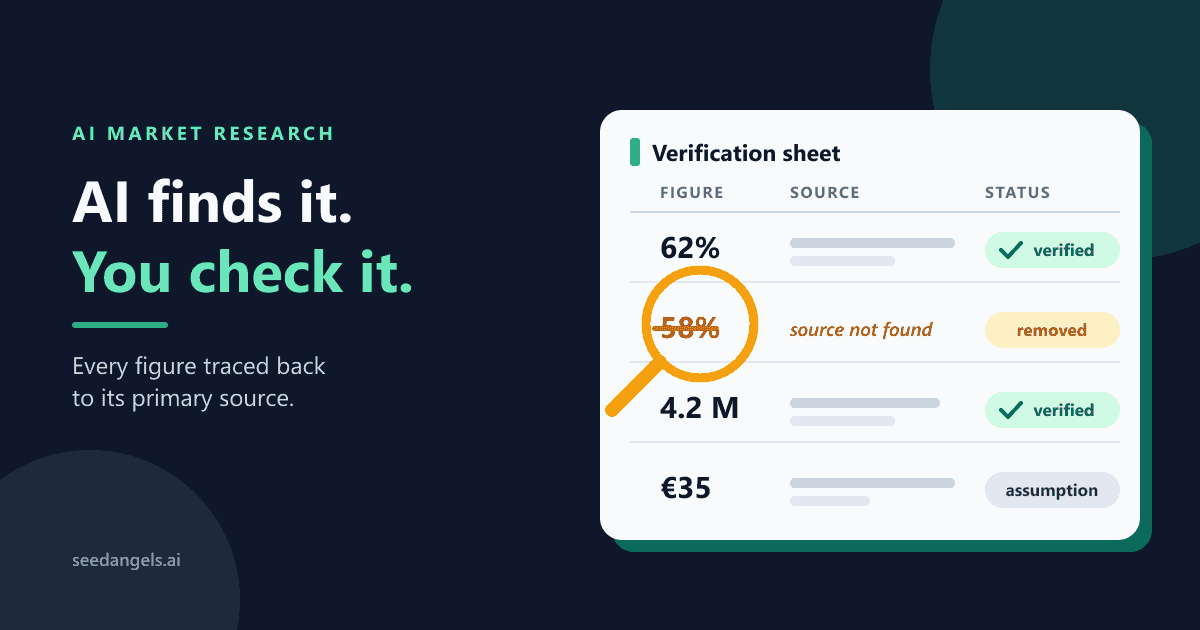
Log every figure in your research in a sheet like this one, one row per claim. It takes a little time per figure, and it becomes the best appendix in your plan: the day your banker asks "where does this number come from?", the answer is already written down.
| Claim | Figure | Source given by the AI | Source opened? (yes/no) | Figure found? (exact / different / missing) | Date of the data | Scope (area, population, year) | Final status (verified / corrected / removed / assumption to test) |
|---|---|---|---|---|---|---|---|
How to use it, on the cottage: if the AI states an annual occupancy rate of X% for cottages in the area and cites an observatory, the row only moves to "verified" once you have opened the publication, read X% in the text, noted the year and confirmed it covers cottages or holiday rentals in that area. If the figure covers the whole of Brittany, the status becomes "corrected" (with the right scope) or "assumption to test".
What fails the check becomes an assumption
A figure you cannot find is not necessarily wrong. It is simply unproven. It does not vanish from your research: it changes status. Either you test it in the field at step 5 (an accepted price, a length of stay), or you write it into your forecast as an explicit assumption, stating where the order of magnitude comes from.
For sizing the market itself, the logic is the same but the method has its own rules: to size your market with TAM, SAM and SOM, start from counted data (number of customers, average spend) rather than a percentage of a big total, which shrinks the room left for figures nobody can check.
Takeaway: a figure with no primary source is not market data. It is an assumption, and it must be presented as one.
Step 5: the fieldwork AI will not do for you
Goal: test the remaining assumptions with real prospective customers.
AI cannot talk to your customers. The Harvard Business School working paper cited above shows why: the models' estimates were sometimes close to reality, but there was no way to tell which ones without human benchmark data, and they did not reliably capture differences between customer segments. Bpifrance Création's deck says it plainly: fieldwork remains essential to check demand. Its four-week market research plan includes 5 to 8 interviews with prospective customers.
That number is a floor for a first read. To know how many conversations are enough before you decide, and which commitment signal to look for beyond stated intentions, use the protocol for validating a business idea: it sets a numeric threshold at each stage.
Around the fieldwork, on the other hand, AI is very useful:
- Drafting the interview guide from the unverified assumptions of step 4: each assumption becomes an open question.
- Reviewing your questionnaire to catch leading or double-barrelled questions. It does not replace a sound design: for the survey questions to ask, order and wording matter as much as the number of respondents.
- Summarising your interview notes, with a safeguard: every need is tied to the interview it came from.
Here are my notes from [number] interviews with prospective guests,
anonymised and numbered (I1, I2…).

Summarise:
1. The needs expressed, ranked by frequency.
2. The objections and barriers to booking.
3. The prices or budgets mentioned.

For each point, list the numbers of the interviews that mention it.
Do not add any need that is not in the notes.
Flag any points where the interviews contradict each other.

[Paste the notes here]
One thing to avoid: having the AI "play" customers (synthetic personas you put your interview questions to) and treating their answers as demand data. That is precisely the situation the Harvard study warns against: convincing answers, with nothing to tell you which are wrong.
Takeaway: AI prepares and summarises the fieldwork; the answers come from real customers.
Step 6: the synthesis, then the prompt that argues back
Goal: write a summary in which every claim carries its status, then put it up for criticism.
Synthesis is the second step where AI excels, on one condition: it must work only on what you have verified.
Using only the verification sheet and the fieldwork notes below,
write the summary of my market research: demand, customers,
competition, 3 opportunities, 3 risks.
After each claim, add its status in square brackets:
[verified: source] or [assumption].
Do not add any information from outside the documents provided.

[Paste the verification sheet and the interview summary]
Then comes the most useful prompt in this guide, and the one people forget. Language models tend to agree with whoever they are talking to: present a project enthusiastically and they will find reasons to back it. So you have to ask explicitly for the opposite.
Here are the conclusions of my market research. Play devil's advocate.
1. List the possible biases in how I collected and interpreted the data.
2. Suggest alternative explanations for the trends I see.
3. Identify the 3 assumptions that, if wrong, would sink the project,
   and say how I could test each one.

[Paste the summary]
The three critical assumptions it surfaces are the ones to test first, or to state clearly in your plan.
The verified summary then feeds the market section of the business plan and the assumptions in your forecast. The market research guide linked above shows how to turn the findings into forecast assumptions: average price, volume, ramp-up. For the example cottage, our holiday cottage business plan template shows where each part of the summary belongs, from the guest profile to the occupancy rate used in the projections.
Takeaway: an AI that approves your project teaches you nothing; ask it what would make it fail.
Which AI tool for which step?
There is no single AI for market research, only categories of tools suited to each step. The brands named are examples; their plans and prices change too fast for any ranking to stay accurate for more than a few months.
| Tool category | Examples | Steps | Main limitation |
|---|---|---|---|
| General chat assistant | ChatGPT, Claude, Mistral (Le Chat), Gemini | 1, 3, 5 (prep), 6 | Makes up figures when it has no documents |
| Web research with citations | Perplexity, Deep Research modes | 2 | A cited page does not always contain the figure |
| Assistant restricted to your documents | NotebookLM, chat with attached files | 2, 3, 6 | Only knows what you gave it |
| Spreadsheet | Excel, Google Sheets, LibreOffice | 4 (recalculations), forecast | None: calculations are not delegated to AI |
Free tiers are enough to get started. This table is about market research; if you are looking for a tool that writes the whole business plan, our comparison of AI business plan generators shows that the main difference between them is how they handle your numbers.
If your research has to end up in a business plan, SeedAngels brings steps 2 and 6 into one tool: it writes the market section (market size, competitors, personas) from web research, and its Sources page lists every page used, section by section, so you can trace each claim back to its source in step 4. It does neither the fieldwork nor your assumptions: your revenue is yours to set.
What not to paste into a chatbot
Market research handles very different kinds of data, and not all of it belongs in a consumer chatbot. In its Q&A on the use of generative AI systems, France's data protection authority, the CNIL, considers that a consumer service can be suitable for non-confidential uses, with safeguards, and advises never sharing confidential information such as personal data. It also recommends keeping a critical eye on outputs and never reproducing them as they are. Whatever tool you use, check its data settings before you paste anything into it.
Applied to market research:
- Public customer reviews: yes, they are already published.
- Interview notes: only once anonymised (no names, contact details or detail that could identify the person).
- Customer database, named quotes, a future partner's data: no.
Conclusion
AI handles four of the six steps of market research well: framing, searching, analysing reviews, synthesising. The other two, checking every figure against its source and talking to real customers, stay with you, and they are what make the research defensible. Any figure you have not read yourself in its primary source is an assumption: write it as one, test it, and your plan will hold up to questions.
Once your research is checked, SeedAngels writes your business plan and forecast from your own revenue assumptions. Try SeedAngels for free →
Before you start your interviews, our startup idea validator helps you pin down the problem, the target customer and the questions to test.
FAQ
Can you do market research with ChatGPT alone?
No. ChatGPT can frame the research, find and summarise public sources, analyse customer reviews and draft the summary. It cannot guarantee its figures or talk to your customers. Market research you can defend in front of a lender combines that desk work, checking every figure against its primary source, and a handful of interviews with real prospective customers.
Is ChatGPT reliable for market research?
For structure and synthesis, yes; for numbers, not without checking. A language model produces plausible values, not verified ones, and can cite studies that do not exist. It is more useful in well-documented consumer markets than in niche or B2B markets, where public data is scarce. Treat every figure as an assumption until you have found it in its source.
Which prompts should you use for market research?
Start with a framing prompt that lists the questions your research must answer before asking for any answers. Then add prompts for desk research, review analysis and synthesis. End each one with the same instruction: give the exact source of every figure and say whether it is published data or an estimate. Finish with a prompt that argues against you and names the assumptions that could sink the project.
Which AI tool should you use for market research?
Pick by step rather than one tool for everything. A general chat assistant (ChatGPT, Claude, Mistral) is enough for framing and drafting. A web research tool that cites its sources (Perplexity, Deep Research modes) helps with desk research. An assistant restricted to your own documents, such as NotebookLM, reduces the risk of invention. Calculations stay in a spreadsheet.
Can AI replace customer interviews or a survey?
No. Researchers from Harvard Business School and Microsoft compared language-model answers with real surveys: they were sometimes close, but often inaccurate, and there was no way to tell which ones without human data. AI can draft your interview guide, review your questionnaire and summarise your notes. The answers themselves have to come from real prospective customers.
Can you paste customer data into ChatGPT?
Not into a consumer service. France's data protection authority, the CNIL, advises never sharing personal data or confidential information there, and keeping these tools for non-confidential uses. For market research, public reviews are fine. Interview notes should be anonymised before you paste them. A customer database should not be pasted at all.