The page that decides whether the rest gets read
Your banker or angel investor reads the first page of your business plan, and that page decides whether they read the second. That first page is the executive summary. Every guide tells you it should fit on one page and be written last. Very few show you what one looks like once it is written.
Attention is short. DocSend, which tracks how documents sent to investors are read, reports that in 2025 investors spent less than 3 minutes on a pitch deck, and that in 2020 decks that went on to raise held their readers for over four minutes, against a minute and a half for the others. Those figures are about decks, not summaries, but the order of magnitude holds for any first read: a few minutes, not half an hour.
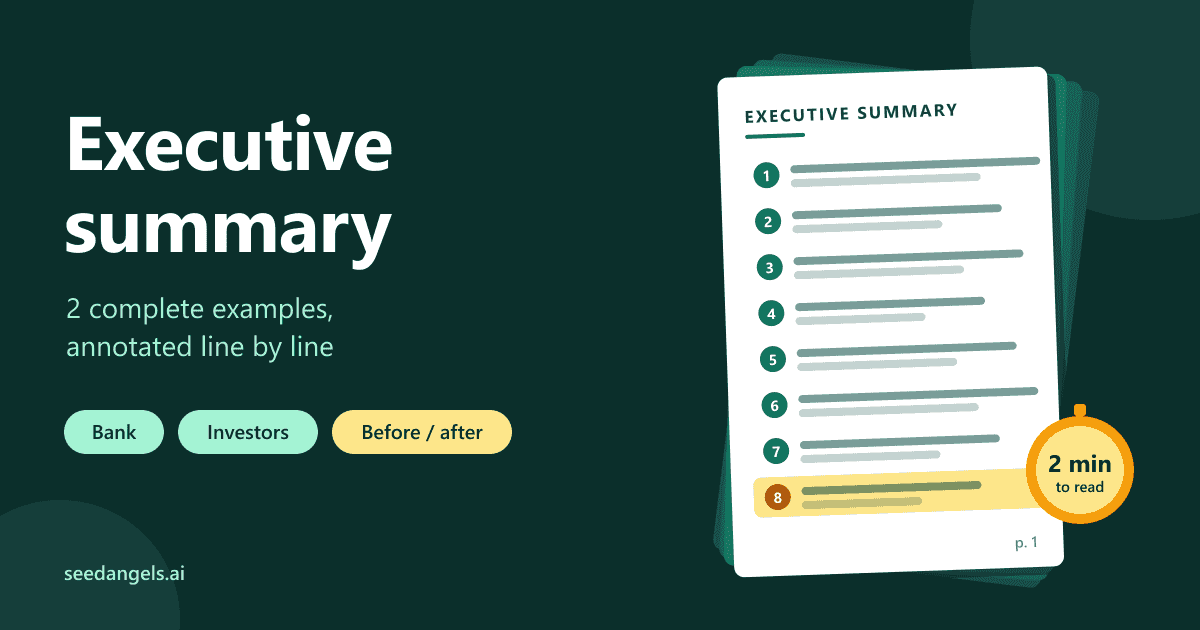
This article gives you what is missing elsewhere: two complete executive summaries, one for a bank and one for investors, annotated sentence by sentence; a before-and-after rewrite of a weak summary; and a paragraph-by-paragraph template to write your own.
What is a business plan executive summary?
A business plan executive summary is the one- to two-page overview placed at the front of the plan. It presents the business, its market, its key figures, the team and the funding requested, so that a busy reader can decide within minutes whether to keep reading.
It is the first section of a business plan, and the only one every reader will see. The U.S. Small Business Administration puts its purpose in one line: “Briefly tell your reader what your company is and why it will be successful.” It adds that when you are asking for financing, the summary should include financial information and high-level growth plans.
A summary is not an introduction. An introduction announces what the document will say; a summary already states the conclusions: what you are aiming for, what you are asking for, why it will work. The amount you ask for is not a round number: it comes out of the sources and uses statement, where the loan closes the gap, and the summary repeats it to the euro or dollar. It also has to stand on its own, because it is often sent alone as a first contact.
How long? One page, two at most
One page, roughly 400 to 600 words, for a bank or a loan committee. One to two pages, 600 to 900 words, for investors. Never more than two pages: the U.S. Chamber of Commerce gives the same range of one to two pages.
You will often see another rule: “5 to 10% of the length of the plan.” It does not hold up. For a 30-page plan, 10% is three pages, which is no longer a summary. The page limit always wins over the percentage.
| Reader | Format | Length | What they do next |
|---|---|---|---|
| Bank lender | First page of the application | 1 page | Goes straight to the funding plan and the forecast |
| Loan committee | Page read before the meeting | 1 page | Prepares questions for your presentation |
| Angel investor, fund | Document sent alone, as a first contact | 1 to 2 pages | Asks for the deck and a meeting, or stops there |
If you run over, cut in this order: adjectives, the history of the project, feature descriptions, then any figure that does not help your reader decide.
The paragraph-by-paragraph template
An effective executive summary fits into eight short paragraphs. Each one answers a question the reader is asking, in the order they ask it. The word budgets below target a page of about 500 words.
- The opening sentence (1 sentence, ~30 words). Who you are, what you do, for whom, where. Sequoia asks founders to define their company “in a single declarative sentence”: if you cannot, your reader will not either. Template: “[Name] is a [type of business] that [what it does] for [customer] in [place].”
- The problem or need (40 to 60 words). What is missing today, observed and quantified if possible. “Today, [customer] has to [current situation], which costs them [time, money, quality].”
- The solution and what sets it apart (50 to 70 words). What you offer and why a customer will pick you over the alternative they already use.
- The market and customers (50 to 70 words). For a local business, the area and its customers; for a startup, the number of potential customers and the addressable revenue, calculated rather than copied from a report.
- The proof (40 to 60 words). What already exists: paying customers, pre-orders, letters of intent, a signed lease, customer interviews.
- The business model and key figures (60 to 80 words plus a small table). How you make money, then revenue, gross margin, operating profit (EBITDA) and net income over three years.
- The team (40 to 60 words). What qualifies each founder for this specific project, not their full résumé.
- The request and use of funds (50 to 70 words). The amount, its form (loan, equity), how it will be spent, what it will achieve, and the next step you expect from the reader.
Four rules apply to every paragraph:
- Write it last. The figures it summarizes are only settled at the end of the financial forecast.
- Every figure matches the forecast, to the euro or dollar. Readers compare.
- No jargon and no unproven adjectives. “Innovative,” “unique” and “fast-growing market” say nothing that can be checked.
- The order follows the reader, as the next section shows.
To see how these blocks connect to the rest of a complete document, browse our free business plan templates: each sector is covered from market research to the financial forecast, and the summary is simply those sections condensed.
Bank or investor: what changes
The substance is the same, but the order, the figures you highlight and the tone change, because the two readers are not asking the same question.
| Bank | Investor | |
|---|---|---|
| Reader's question | Will I be repaid? | What could this be worth in 5 to 7 years? |
| What comes first | The request, your contribution, the project | The problem, the market, traction |
| Figures to highlight | Owner contribution, operating profit against loan payments, lowest cash month | Growth, recurring revenue, churn, acquisition cost, runway |
| Risk to address | The weak point of the forecast, collateral | Competition, ability to execute |
| Tone | Factual, conservative | Ambitious, but every ambition backed up |
| Form of the request | Loan of X over N years | Raise of X to reach a given milestone in 18 months |
For a bank, your own commitment shows up in the second paragraph. There is no written rule, but in France Les clés de la banque, the French Banking Federation's education site, says lenders generally expect an owner contribution of at least 30% of the total budget for a standard business. The summary does not need to prove every ratio, but it must announce figures that will pass the ratios lenders run on your forecast, starting with repayment capacity.
For an investor, the summary is an access tool: its job is to get you a meeting. It is read before your pitch deck and should tell the same story, in the same order, with the same figures. Valuation does not belong in it: that conversation starts once interest is established.
For a loan committee (a microlender, a community lender, a public loan scheme), follow the bank logic and add the local impact: jobs created, the neighborhood or region served. The committee then reads the rest of your file section by section, and what a loan committee expects from the founder and the funding plan is worth preparing before the hearing.
Example 1: a restaurant applying for a bank loan
This example uses the figures of Partie Pizza, a pizza-by-the-slice shop in Lille, France, whose full business plan you can download free with our restaurant business plan template. Years 1 to 3 correspond to the 2026 to 2028 financial years of the example. Two elements are not in it and are illustrative assumptions: the partners' backgrounds and the detailed allocation of the funds.
The full summary
Partie Pizza, executive summary
[1] Partie Pizza is a pizza-by-the-slice shop, set up as a limited company (SARL), opening in central Lille to serve a quick lunch to the office workers and students of the neighborhood.
[2] We are requesting a €40,000 bank loan, repaid from the first year. It complements €20,000 of share capital from the two partners, or 33% of a €60,000 funding plan.
[3] Central Lille is dense with offices and higher-education buildings, but its quick-lunch options force a choice between a sandwich shop and a sit-down restaurant. Partie Pizza sells pizza by the slice at €4.50 to €6, or as a lunch deal at €8 to €10, with four pizza recipes, desserts and drinks.
[4] Our revenue is built from covers per service, average ticket and opening days. Pizza by the slice earns a gross margin of about 82%: profitability depends on volume, which the location has to deliver.
[5] Key figures from the forecast:
Year 1 Year 2 Year 3 Revenue €88,650 €116,955 €147,575 Gross margin ~82% ~82% ~82% Net income €778 €18,249 €36,686 [6] The first year is deliberately tight: rent (€17,400 a year) and salaries (€28,560 a year) weigh from day one, while revenue ramps up. EBITDA is nonetheless positive from year 1 (€5,134), and the starting cash covers the gap between cash flow from operations (€4,149) and the first loan repayments (€8,581). From year 2, cash flow (€21,620) covers the principal repaid (€13,197) 1.6 times, and year-end cash never falls below €16,000.
[7] The two partners share the management: one spent eight years in quick-service restaurants, three of them as a store manager (hiring, purchasing, scheduling, opening a second location); the other runs the kitchen.
[8] The funding plan covers €24,500 of capital expenditure (fit-out, baking equipment) and the first months' cash; the marketing budget (€9,600 a year) is carried by operations. We would like to walk you through the detailed funding plan and the month-by-month first-year forecast at a meeting.
Why it works
- [1] The opening sentence answers four questions: what (pizza by the slice), which legal form (SARL), where (central Lille), for whom (office workers and students at lunch). The banker knows what this is before line two.
- [2] The request comes second, with its amount and the owners' contribution. That is the lender's question: answering it at once saves them looking for it. A 33% contribution clears the 30% benchmark, and stating it as a percentage spares them the arithmetic.
- [3] The need is described through the customer's alternative, not through a national “restaurant market” that means nothing for a neighborhood shop. Prices are in the text: average ticket is the first assumption the lender will test.
- [4] The revenue states its method (covers × ticket × days). As a sanity check, €88,650 over roughly 300 opening days is a little under €300 of sales a day, about fifty customers at €6: a volume the reader can hold up against the location.
- [6] The weak point is named before the lender finds it. Net income of €778 in year 1 jumps out of the table. The summary explains it (€46,000 of rent and salaries from opening day), shows operations are already positive and says how year 1 is funded: cash flow from operations (€4,149) does not cover the €8,581 repaid, and the starting cash (€16,324 at year end) absorbs the difference. From year 2, cash flow covers the principal repaid 1.6 times: that ratio, more than net income, is what the lender recalculates.
- [7] The team fits in two lines, focused on what matters for this project: running a store, not a full career history.
- [8] The ending asks for something specific: a meeting, with the documents the lender will want to see. A summary that ends without a next step leaves the reader to decide alone what happens next.
What the example leaves out matters too: no national market size, no adjectives about how good the pizza is, no valuation.
Example 2: a SaaS startup raising a seed round
This example is fictional: Tissago does not exist. It sits in the same sector as our SaaS startup business plan template, software for home-care providers, and reuses its two subscription plans. The traction figures are invented for the illustration but consistent with one another; the count of personal-services providers comes from France's labor ministry statistics office (Dares).
The full summary
Tissago, executive summary, seed round
[1] Tissago is online scheduling and coordination software for home-care agencies, replacing spreadsheets and phone calls with one schedule shared by the agency, its caregivers and the families.
[2] A home-care agency reshuffles dozens of visits every week because of absences and schedule changes. In the 40 agencies we interviewed before writing a line of code, that reshuffling still happens in spreadsheets and over the phone, at the expense of time spent hiring caregivers and following up with clients.
[3] Tissago rebuilds the schedule when someone is absent, notifies the caregiver and the family, and produces the timesheets used for billing. Two plans: Essential at €50 a month (scheduling and booking) and Advanced at €120 a month (messaging, invoicing, documents).
[4] France had 20,720 personal-services providers in 2021 (home care, but also housekeeping, childcare and tutoring), not counting sole traders. At our average revenue per customer (€78 a month), they represent at most €19 million in annual revenue; home-care agencies, our core target, are the first step.
[5] After 14 months on the market, 120 organizations pay a subscription, for monthly recurring revenue (MRR) of €9,360. Monthly churn is 1.8%, gross margin 80%, and the cost of acquiring a customer (€650, sales salaries included) is paid back in 10 months of margin.
[6] 40% of our customers chose the Advanced plan, which brings average revenue to €78 a month. Each new customer adds to the revenue of every following month: our growth depends on acquisition pace and retention, which we track month by month.
[7] Our CEO ran a home-care agency for nine years: she has lived the problem we solve and knows the networks that buy. Our CTO was lead developer of an online HR software product used by several hundred companies. The project has been funded so far by €60,000 from the founders, including their personal honour loans.
[8] We are raising €600,000 for 18 months of runway: 50% for sales and marketing (€300k), 35% for product (€210k), 15% for operations and a safety margin (€90k). Our 18-month goal: 400 paying organizations and MRR of about €31,000, an annualized run rate close to €375k, the basis for a Series A. We would be glad to share our deck and our month-by-month MRR model.
Why it works
- [1] and [2] The problem comes before the figures, in the order an investor reads. It is described through a scene everyone in the sector recognizes, and backed by interviews actually conducted, not by opinion.
- [4] The market is a count, not a report. 20,720 providers, a Dares figure reported by France's Banque des Territoires, times annual revenue per customer (€78 × 12 = €936), gives about €19.4 million. It is a ceiling, and the summary says so: the reader knows what it covers and can redo the calculation; nobody can redo a “€950 million global market.”
- [5] Traction speaks the language of SaaS investors: MRR, churn, gross margin, payback on acquisition cost (€650 ÷ (€78 × 80%) ≈ 10 months). These are the metrics an investor recalculates; the thresholds they expect are covered in our guide to the SaaS business plan.
- [8] The request says what the money buys. The milestone (400 customers) fits the budget: going from 120 to 400 customers in 18 months with 1.8% monthly churn takes about 360 new customers, roughly €235,000 at €650 each, inside the €300,000 sales envelope. An investor runs this check while reading; better that it adds up.
- No valuation, no collateral. Valuation is negotiated once interest is established, and an equity investor takes no collateral. Unlike the bank example, the founders' contribution is a single sentence: it shows commitment, it does not drive the decision.
- The last sentence offers the next step: the deck and the MRR model, the two documents an interested investor will ask for anyway.
Both examples follow the same eight blocks. What changes is the order (the request comes second for the bank, last for the investor) and the kind of figures that lead.
Before and after: rewriting a summary that doesn't convince
Take a fictional beauty salon (name, location and figures invented for the example) applying for a loan. Here is the version lenders receive far too often, then its rewrite.
The weak version
The purpose of this business plan is to present Éclat, an innovative beauty salon located in Angers. The beauty market is booming and consumers care more and more about well-being. Our salon will offer a full range of premium treatments in a unique setting, with a passionate and experienced team.
We have no direct competitors, because our concept is different from anything that exists. Thanks to our social media marketing strategy, we expect revenue of €250,000 from year two.
To carry out this project, we are looking for bank financing. You will find all the details of our project in the following pages.
The diagnosis
| Passage | Problem | Fix |
|---|---|---|
| “The purpose of this business plan is to present…” | An introduction sentence: it announces instead of telling | Open with what the salon is, where, for whom |
| “innovative,” “unique,” “premium,” “passionate” | None of these can be checked | Replace them with facts: treatments, prices, experience |
| “The beauty market is booming” | A national market says nothing about a neighborhood salon | Describe the area, the customers, the competitors |
| “We have no direct competitors” | Not credible, and it casts doubt on everything else | Name competitors by type and say what sets you apart |
| “€250,000 from year two” | A figure with no basis, no year 1, no profit | Build revenue (rooms × occupancy × price) and give three years |
| “we are looking for bank financing” | No amount, no contribution, no term | Amount, term, contribution as a %, use of funds |
| “You will find… in the following pages” | Points to the rest instead of asking for a next step | End with the next step you are asking for |
The rewrite
Éclat is a three-room beauty salon, set up as a limited company, opening in the Saint-Serge district of Angers, offering facials, waxing and bridal packages from €35 to €90.
We are requesting a €58,000 loan over 7 years. It complements a €27,000 owner contribution, or 32% of an €85,000 budget: fit-out (€38,000), treatment room equipment (€22,000), opening stock (€6,000) and starting cash (€19,000).
Four salons are within a ten-minute walk; none opens after 7 p.m., while our target customers work during the day. Éclat will stay open until 9 p.m. three evenings a week and take bookings online.
Our revenue is calculated on three rooms, eight hours a day and 280 opening days, at an average price of €52 per one-hour treatment. At 40% occupancy in year 1 it reaches about €140,000; at 55% in year 2, about €192,000.
The founder, a qualified beautician, managed a franchise salon for six years. We would like to present our financial forecast and the commercial lease at a meeting.
The rewrite is twice as long and still fits on a page, but every sentence carries information the lender can check or challenge. Its year-2 revenue is even lower than the weak version's, and that is what makes it credible: the reader can redo the calculation (3 rooms × 8 hours × 40% × 280 days × €52 ≈ €139,800).
Write yours in 6 steps
- Finish the plan and the forecast first. The summary can only be written once the figures are settled: three-year revenue, the funding need, how the money will be spent.
- Pull out the 6 to 8 figures that matter to your reader. For a bank: owner contribution, loan amount and term, revenue, EBITDA, net income. For an investor: recurring revenue, growth, churn, acquisition cost, amount raised, runway.
- Write the opening sentence. Test: a stranger who reads it once should be able to repeat it without error.
- Fill in the eight blocks without holding back, then cut down to one page. Remove adjectives first, then history, then feature details.
- Check every figure against the forecast and the deck. A one-euro gap between the summary and the funding table is enough to make the reader doubt the whole document. If you build your plan with SeedAngels, the business plan's summary page takes share capital, the loan and the three-year P&L straight from your forecast, the project summary is written from the data you validated, and an alert tells you when your data has changed since it was last drafted. The tool does not decide the order or the emphasis for you depending on whether you are writing to a bank or an investor: review and adjust the request and the way you present your weak point.
- Have someone read it in two minutes who does not know the project, then ask them what you do, how much you are asking for and why it will work. If they hesitate on any of the three, rewrite that paragraph. For a structured review, the business plan analyzer scores your document on 29 criteria, starting with the executive summary, and for each partial or missing criterion points to the section to edit.
The mistakes that lose the reader
- Writing it first. It then promises figures the forecast does not confirm.
- Writing it like an introduction. “This document presents…”: the reader wants conclusions, not a table of contents.
- Claiming “no competitors.” Your customer already solves the problem one way or another: that is your competitor.
- Figures that differ from the forecast. Readers compare, and a single inconsistency makes them doubt every other number.
- Leaving out the amount requested. A summary without a figure for the request leaves the reader wondering why they are reading.
- Superlatives. “Revolutionary,” “leading,” “unique” cannot be checked and make the sentences around them look suspect.
- Three pages. Past two, the reader is no longer reading a summary: they skip to the funding plan.
Conclusion
A good executive summary is not a well-written text, it is a well-ordered one. It fits on one page, is written last, and puts its reader's question first: repayment for the lender, upside for the investor. Every figure in it can be checked, and the weak point is named before anyone finds it.
Go back to your summary with the eight-block grid, then reread it as your recipient: after two minutes, do they know what you do, what you are asking for and why they should say yes? If one answer is missing, it is that paragraph you need to rewrite, not the rest of the plan.
To produce the business plan, the forecast and their summary page from the same figures, try SeedAngels. Try SeedAngels for free →
FAQ
What is an executive summary in a business plan?
It is the one- to two-page overview placed at the front of a business plan. It presents the business, its market, the key figures of the financial forecast, the team and the funding requested. It has to stand on its own, because it is often sent without the rest of the plan, and its job is to make the reader want to open the next page.
How long should an executive summary be?
One page for a bank or a loan committee, roughly 400 to 600 words. One to two pages at most for investors. Beyond that it is no longer a summary: the U.S. Chamber of Commerce recommends one to two pages, and the “5 to 10% of the plan” rule produces summaries that are too long for a 30-page plan.
Should you write the executive summary first or last?
Last. It summarizes figures and choices that are only settled at the end: revenue, the funding need, how the money will be used. Written first, it promises things the financial forecast does not confirm, and the reader notices as soon as they compare the two.
How does an executive summary for a bank differ from one for investors?
A lender wants to know whether they will be repaid, so the request, your own contribution, operating profit against loan payments and any collateral come early. An investor wants to know the upside, so the problem, the market, traction and what the round will achieve come first. The substance is the same; the order and the figures you highlight change.
What should an executive summary include?
Eight elements: one sentence on who you are and what you do, the problem, the solution and what sets it apart, the market and customers, the proof you already have, the business model with three-year key figures, the team, and the amount requested with how it will be used. Every figure must match the financial forecast.
Can you send the executive summary on its own?
Yes, that is its most common use in fundraising: it is the first contact that gets you a meeting, before the pitch deck and the full business plan. It therefore has to make sense without the rest of the file, with no “see section 4” references, and it should end with the next step you are asking for.
Is an executive summary the same as an introduction?
No. An introduction announces what the document will cover; an executive summary gives its conclusions: the figures, the request, the reasons to believe. A sentence like “The purpose of this business plan is to present…” is the sign you have written an introduction, not a summary.