A committee does not fund a document, it funds a person
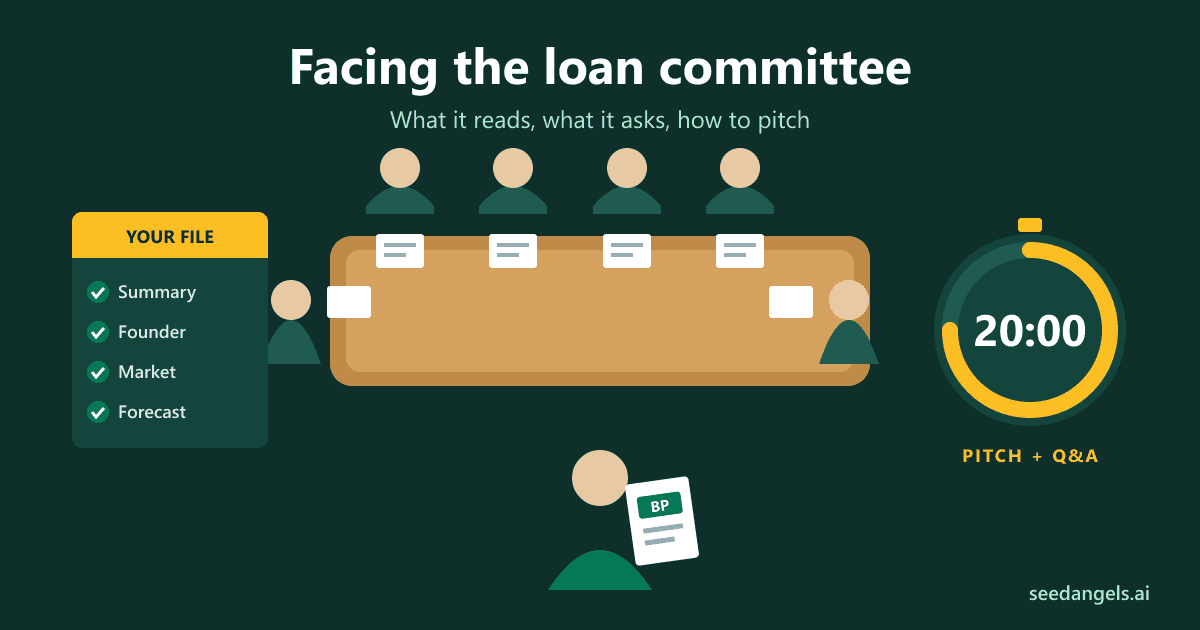
A loan committee reads your business plan in one evening and listens to you for twenty to forty minutes, questions included: everything hinges on what its members are looking for, and most files never give it to them. Around the table sit four to ten people: business owners, a banker, an accountant, sometimes a lawyer. They received your file a week ago. Whether it is a microlender, a community fund, an accelerator's investment panel or a regional development agency, the format is often similar: a written file read beforehand, a short pitch, questions, then a deliberation without you.
This guide uses one of the most structured examples in Europe as its worked case: France's honour loans (prêts d'honneur), interest-free personal loans granted by volunteer committees to over 20,000 projects in 2025 in the Initiative France network alone. Their networks publish their amounts, their hearing format and their selection criteria, which makes them an unusually clear window into how any funding committee reads a business plan. You will find what the committee looks for in each section, how a small personal loan unlocks a much larger bank loan, the three French networks compared, the real format of a hearing, the questions that come up, a timed pitch outline and a document checklist.
A caveat: each local platform sets its own amounts and hearing format. The figures below were taken from the networks' official sites on October 19, 2026. Treat them as orders of magnitude, and ask your own committee for its rules.
The worked case: France's honour loans
A French honour loan is an interest-free, unsecured personal loan granted to a founder or business buyer, not to the company, by a network such as Initiative France or Réseau Entreprendre after a committee hearing. The founder invests it in the business, which strengthens its equity and makes it easier to obtain a bank loan.
A personal loan, invested in the business
Initiative France puts it plainly on its honour loan page: it is "a loan to the person (that is, you, not a loan to the company)". The money lands in your personal account, and you then invest it in your company. Réseau Entreprendre Côte d'Azur's 2025 candidate guide spells out the mechanics: the founder lends the funds to the company as a shareholder loan within a month of receiving them.
Two consequences for your file. You repay from your personal income, so the committee looks at your household budget, not only the company's. And the committee judges you as much as the project, because you are the borrower.
That is also what sets it apart from a last-minute family loan, which a bank reads as risk simply moved elsewhere: interest-free, unsecured, repayable over several years and granted after a committee review, an honour loan is designed to strengthen equity and open the door to a bank loan.
The same logic applies well beyond France: any lender that backs the founder personally, or asks for a personal guarantee, is underwriting you first.
The leverage effect on bank lending
The point of an honour loan is not its size, which is often modest, but what it triggers. Both networks publish their leverage:
- Initiative France states on its honour loan page: "for every euro of Initiative honour loan granted, banks lend 9.50 euros on average". In 2025, according to its annual results, the network made 20,299 projects possible, with €179 million of Initiative honour loans and €2.4 billion of associated bank loans.
- Réseau Entreprendre: 13 euros of funding raised on average for every euro of honour loan, according to its 2025 activity report; the Côte d'Azur guide gives a range of 8 to 13 euros.
The two figures do not measure quite the same thing: Initiative France counts bank loans only, Réseau Entreprendre all the funds raised.
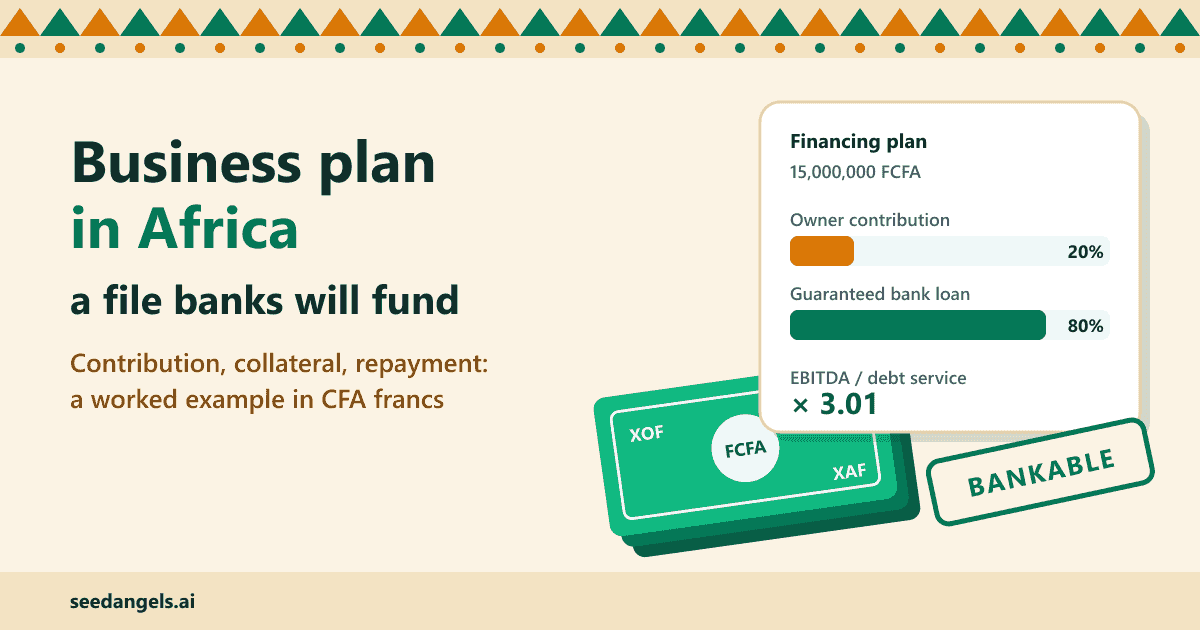
The mechanism is simple: a bank sizes its loan against your equity, and the honour loan increases that equity. Here is an illustration on an 80,000-euro project, not a rule:
| Sources | Without honour loan | With honour loan |
|---|---|---|
| Personal savings | €10,000 | €10,000 |
| Honour loan (invested) | €0 | €10,000 |
| Total equity | €10,000 | €20,000 |
| Bank loan needed | €70,000 | €60,000 |
| Equity share of total need | 12.5% | 25% |
At 12.5% equity, most French banks will hesitate (they usually expect 20 to 30% for a start-up); at 25%, the file sits within normal practice. Requirements vary by country and loan program: how a lender turns your down payment and repayment capacity into ratios has its own guide. What matters here is that the committee already reasons with those ratios in mind, because a banker usually sits on it.
A bank loan is often required
Many platforms only grant an honour loan alongside a bank loan. Initiative Calvados's fact sheet states that its loans "must be paired with a complementary bank loan, at a minimum of 1 for 2, and capped at 20% of the project's financing". France Active says its interest-free personal loan is "generally conditional on a bank loan being granted".
The lesson travels: your funding plan must already include the bank loan you are seeking, with its amount and term, and you should have met at least one banker before the hearing. A file that presents the committee's loan as the only outside money shows you have not understood the scheme.
Initiative France, Réseau Entreprendre, France Active compared
The three French networks do not fund the same projects in the same way. Initiative France targets very small businesses in every sector, with modest amounts and a short hearing. Réseau Entreprendre selects job-creating projects, with larger amounts and a longer selection. France Active focuses on people who struggle to access credit and adds a bank guarantee.
| Criterion | Initiative France | Réseau Entreprendre | France Active |
|---|---|---|---|
| Honour loan amount | €3,000 to €50,000, average €10,000; each platform sets its range | €15,000 to €50,000 (Création or Reprise programme, called "Start" in some branches), average €29,000; up to €90,000 on some programmes, depending on the branch | Interest-free personal loan; amount not published on the national site, set by the regional association |
| Terms | 0%, no guarantee | 0%, no interest, no guarantee | 0%, no interest |
| Who it targets | Founders and buyers of small businesses, all sectors (local exclusions) | Projects with job potential: at least 5 jobs within 3 years on the Start programme | All profiles, with priority for jobseekers, people on minimum benefits and priority urban areas |
| Link with the bank | Bank loan often required (Calvados: at least €2 of bank loan per €1 of honour loan) | Average leverage: €13 of funding raised per €1 of honour loan | Loan generally conditional on a bank loan; France Active can also guarantee that bank loan up to 80% |
| Process | Meetings with a case officer, file preparation, approval committee | 2 to 5 months of upstream support (Côte d'Azur), validation interviews, summary note, commitment committee | Regional intake, assessment, committee of partners and experts |
| Who decides | Approval committee of volunteers: business owners, bankers, accountants, lawyers | Commitment committee of about ten business owners, unanimous decision (Côte d'Azur) | Decision committee of experts and partners |
| After approval | Follow-up and mentoring | Monthly mentoring by a business owner for 24 to 36 months, peer club | Support provided alongside the financing |
Sources: official sites of Initiative France, Réseau Entreprendre (2025 activity report, Start programme sheet and Côte d'Azur candidate guide) and France Active, plus Bpifrance Création's honour loan page for Réseau Entreprendre's average amount. Checked October 19, 2026.
This local variation explains the contradictory amounts you find online. Initiative France quotes €3,000 to €50,000 nationally, yet Initiative Calvados lends €2,000 to €30,000, repayable over 2 to 5 years. Réseau Entreprendre's Création and Reprise programmes run from €15,000 to €50,000 nationally, but from €15,000 to €35,000 for a start-up in the Côte d'Azur branch. Whatever committee you face, get its own grid before sizing your request.
Combining two networks
The two main networks are not mutually exclusive. According to Bpifrance Création, their honour loans can be combined. Bpifrance's own Création-Reprise honour loan, from €1,000 to €80,000 over 1 to 7 years, can be added to an honour loan granted by either network, provided you are a shareholder of the company. The rule of conduct holds for any funder: disclose every application to every committee and show it in your funding plan. A committee that discovers another pending request during the hearing loses trust, and trust is exactly what it votes on.
Which network fits which project
- Shop, trade, local service or small acquisition (the average Initiative project's funding plan was €133,000 in 2025): start with your local Initiative platform.
- An employer project aiming for at least 5 jobs within 3 years: Réseau Entreprendre, knowing that selection takes several months.
- A profile banks see as risky, or a need to limit the personal guarantee: France Active, whose guarantee can cover up to 80% of the bank loan.
What the committee reads in your business plan, section by section
Committee members receive your file about eight days before the hearing: that is the practice at Initiative Calvados and at Initiative Gard. At Réseau Entreprendre, they also receive a summary note written by the member who followed your application. They are volunteers reading in the evening, often several files at once, so the first page and the funding plan weigh more than everything else. Here is what they look for in each section, and what makes them frown. For the overall structure of the document, see the full business plan method; what follows covers how a funding committee reads it.
The summary
What they look for: on one page, the project, the amount requested, its use and the full funding structure (personal savings, committee loan, bank loan). Bpifrance Création's pitch outline insists that the amount requested and its use must "imperatively" be stated.
What makes them frown: a summary that tells the project's story without a single number, or forgets to say how much you are asking for. The committee reads this page before any other: an executive summary written for a funder states the request and your own contribution in its opening lines.
The founder
This is the most-read section of a personal-loan file, and the one founders neglect most. Réseau Entreprendre makes it its first value: "what matters is the person". The validation interviews before its committee cover four points: whether the candidate can be mentored, their entrepreneurial potential, financial consistency and job creation. Two of the four are about the person.
What they look for: your experience in the trade (or what replaces it: training, an internship, an experienced partner), why this project and why now, your personal situation, and how you will live during the first months.
What makes them frown: a pasted CV with no link to the project, or a founder who has never worked in the sector and does not say so.
The local market and competition
Committee members know your area, often better than you do: they live and run businesses there. They know which bakery closed and which street is emptying.
What they look for: evidence from the field rather than national statistics. Bpifrance Création cites letters of intent, an order book or survey results when you do not have customers yet. A well-argued market section, with its sources, is what makes your revenue credible.
What makes them frown: "there is no competition", or a market described at national level for a neighbourhood shop.
Your offer, pricing and sales strategy
What they look for: how you will find your first customers, concretely, and a price compared with local competitors. If your sector has a template, start from our sector business plan templates so no heading is missing.
What makes them frown: a sales strategy reduced to "social media and word of mouth", with no budget or timeline.
The forecast
What they look for: revenue consistent with the sector average (Bpifrance Création notes that evaluators check this), a realistic founder salary, and a break-even point expressed as sales per month. The method to build a defensible revenue forecast, from your capacity and your prices, spares you the killer question: "where does this number come from?".
What makes them frown: break-even in month three, a founder who takes no salary for three years, or forgotten payroll taxes.
The funding plan
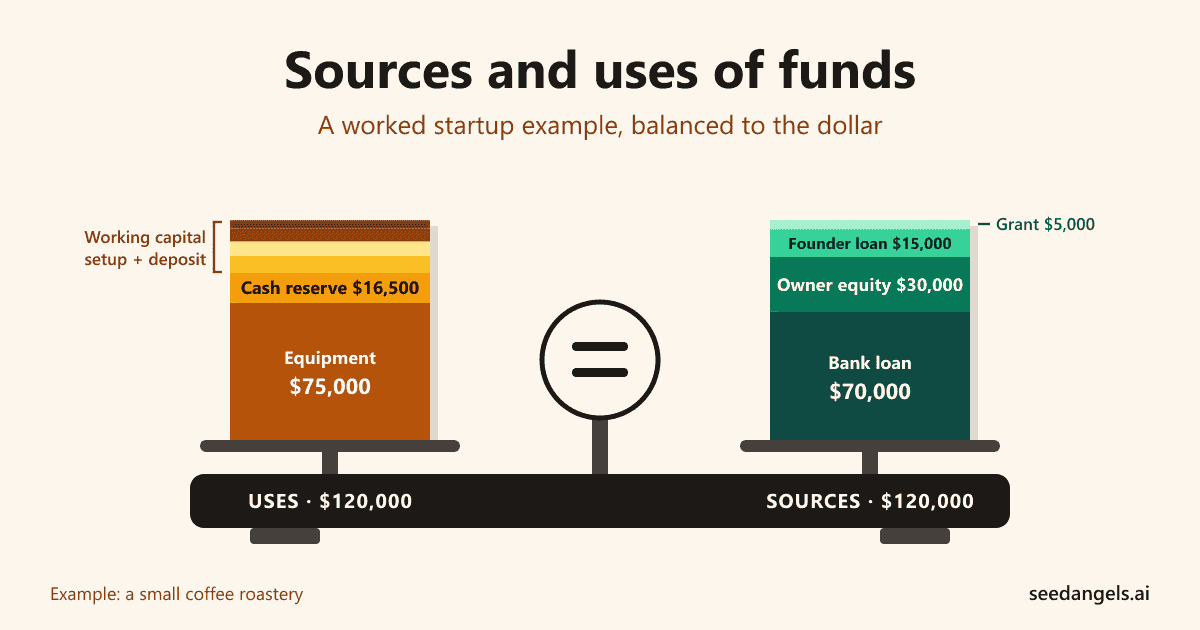
This is the table every other section feeds into. It sets what you need (capital expenditure, working capital, opening cash) against where the money comes from (savings, committee loan, bank loan, any grants).
What they look for:
- a balanced plan that already includes the bank loan you are seeking;
- a committee loan within the platform's rules: Initiative Calvados caps it at 20% of the project's financing; at Réseau Entreprendre Côte d'Azur, it "cannot exceed the amount contributed by the founding partners, including share capital and shareholder loans";
- a precise use for every euro, line by line.
What makes them frown: no working capital line, zero opening cash, or a committee loan funding half of the project on its own. Working capital is not a guess: it is calculated in days of inventory, customer credit and supplier credit, as in this sources and uses example worked line by line.
Building this table by hand is where errors pile up, because it depends on everything else. In SeedAngels, your funding need is calculated from your cash flows, and you add your bank loan with its rate and term to get the amortization schedule; the generated business plan then includes the funding plan. The tool does not know your committee's rules and does not decide how much to ask for: checking local caps is your job, and a personal loan like an honour loan goes into your equity. Details are on the financial forecasting page.
Your personal budget
Because the loan is personal, you repay it from your own income. At Réseau Entreprendre Côte d'Azur, the total term is 59 months including a 12-month grace period, with a monthly debit from the founder's personal account.
Add half a page on your personal budget to the file: your income during the launch (unemployment benefits, a partner's salary, savings), your fixed costs and the loan repayment. A committee that sees you cannot pay yourself for 18 months will rightly ask how you will repay.
How the committee hearing works
The format varies between networks and platforms, but the sequence is always the same:
- The file goes to members about eight days before the hearing.
- You present your project, alone or with your partner: about 10 minutes at Initiative Gard, 20 uninterrupted minutes at Réseau Entreprendre Côte d'Azur.
- Members ask their questions: about 10 minutes at Initiative Gard, 20 minutes at Réseau Entreprendre Côte d'Azur.
- You leave the room and the committee deliberates.
- You receive the decision: within 24 hours, always with reasons, at Initiative Calvados.
Initiative Haute-Loire describes its own committee this way: "the hearing generally lasts about 20 minutes". The decision remains valid for six months. Bpifrance Création, for its part, classes the honour loan committee as a "long pitch" of 15 to 20 minutes. Ask your case officer for the exact format: preparing 20 minutes for a committee that gives you 10 is a common mistake, and the easiest to avoid.
Who sits on the committee
At Initiative Gard, the committee gathers 4 to 10 volunteers, working or retired: business owners, accountants, bankers, lawyers, insurers. It reviews 3 to 5 projects per evening session. The presentation is oral and needs no slides; photos, brochures or other communication materials are welcome, and you may bring your accountant or support organisation.
At Réseau Entreprendre Côte d'Azur, the commitment committee has about ten members, is chaired by one of them and lasts two hours. The member who reviewed your application attends without a vote.
Two very different tests
At Initiative, the case officer has worked on the file with you beforehand; the hearing is short and validates that work. At Réseau Entreprendre, the committee comes after 2 to 5 months of upstream support: several two-hour validation interviews, each one-on-one with a business owner, by a team of 4 to 6 members. The commitment committee then decides unanimously. A single vote against is enough.
You often get one shot. Initiative Gard says so explicitly: "any refusal is final", and the same project can only be presented once. Do not go before the committee with an unfinished file to "test the waters": ask your case officer to move the date instead.
The questions the committee will ask, by theme
No network publishes an official list of questions. These follow from the criteria the networks display (the founder, financial consistency, jobs, the bank arrangement) and from Bpifrance Création's advice. They apply to almost any lending committee. Prepare a short answer to each.
About you
- Why this project, and why now?
- What have you already done in this trade?
- How will you live during the first 12 months?
- What do the people close to you think of the project?
What they are checking: that you will hold on when sales are slower than planned.
About the market and customers
- Who has already said yes, in writing?
- Why would customers come to you rather than the competitor next door?
- Why this location?
What they are checking: that your revenue rests on facts, not on a market-share percentage.
About the numbers
- How many sales a month cover your costs?
- Where does year-one revenue come from?
- How much will you pay yourself, and from when?
- Have you planned for customers paying late?
What they are checking: that you know your numbers by heart. Break-even in monthly sales is the question you must never miss.
About the funding
- Where does the bank stand? Do you have an agreement in principle?
- What happens if it lends less than planned?
- Have you applied to other networks or grants?
What they are checking: that their loan will actually trigger the rest of the funding.
About the risks
- What is your worst case?
- What is your plan B if revenue comes in at half the forecast?
- What do you not know yet?
What they are checking: your clarity. A founder who sees no risk worries a committee more than one who names three.
Bpifrance Création recommends preparing a document of frequent questions with brief answers. If a question throws you, stay calm and acknowledge the point to improve: a committee values a clear-eyed founder over one who improvises.
Your pitch, minute by minute
Bpifrance Création's outline has twelve steps. For a ten-minute hearing, group them into six blocks:
| Block | 10-minute slot | 20-minute slot | What you say |
|---|---|---|---|
| 1. You | 1 min | 2 min | Your background and what makes you credible for this project |
| 2. The problem and your offer | 1 min 30 | 3 min | The customer need, your answer, a demo or sample if possible |
| 3. The market and the evidence | 2 min | 4 min | Your area, the competition, early customer commitments |
| 4. The model and sales strategy | 1 min 30 | 3 min | Price, margin, how you will win your first customers |
| 5. The numbers and funding | 2 min 30 | 5 min | Revenue, break-even, funding plan including the bank loan |
| 6. Your request | 1 min 30 | 3 min | The amount, its use, what it unlocks (the bank loan), what you expect from the network |
Three points on delivery. Rehearse out loud with a timer: a first run almost always overshoots. Bring a one-page summary of key figures to leave with members. And always end with your precise request, as Bpifrance Création recommends: the committee must know exactly what you expect from it.
The document checklist
The exact list depends on the committee; these are the documents most often requested for a French honour loan file, and most of them apply to any lending committee:
- the full business plan, with a one-page summary;
- a three-year forecast: income statement, monthly cash flow for year one, funding plan;
- your CV and an ID document;
- proof of address;
- your personal budget and proof of your savings;
- quotes for capital expenditure;
- the company's articles of association or draft, and its registration certificate if already incorporated;
- the commercial lease or a lease agreement in principle;
- the bank's position: an agreement in principle, or at least the name of your contact;
- letters of intent or purchase orders from your first customers;
- for an acquisition: the seller's last three years of accounts and the draft sale agreement.
Your bank will ask for a similar file with its own documents. Build both at the same time, since the committee will ask how the bank loan is progressing.
If the committee says no, or "yes, but"
An approval can come with conditions: subject to the bank loan, a reduced amount, or a request for more information. Read it as a work list, not a failure.
At Initiative Calvados, every decision comes with its reasons; if yours does not, ask for them. Treat a refusal as a free audit by business owners: the reason almost always points to one specific weakness, whether experience, market, funding structure or personal budget. On some platforms, a refusal is final for the same project; you can then take a revised project to another network, explaining what has changed.
Conclusion
A loan committee does not fund a business plan; it funds a person who has mastered the project and its numbers. Your document must let members judge you quickly: a first page that says how much and why, an honest founder section, a local market backed by evidence, a funding plan that already includes the bank, and a personal budget showing you will repay. The hearing itself is a timed test, prepared with short answers to questions you can anticipate.
Three things to do before your hearing date: ask for the exact format, meet your banker, and rehearse your pitch out loud until it fits the time you are given.
SeedAngels builds your forecast and funding plan from your own assumptions, then writes the business plan that goes with them. Try SeedAngels for free →
FAQ
What should a business plan for a loan committee include?
A standard business plan, written for volunteer business owners who read it in one evening: a one-page summary stating the amount requested and its use, your background, the local market, your sales strategy, a three-year forecast and a funding plan that already includes the bank loan you are seeking. For a personal loan such as a French honour loan, add your personal budget.
How long does a loan committee presentation last?
It depends on the committee, so ask. In France, Initiative Haute-Loire allows about 20 minutes in total; Initiative Gard about 30 minutes, split into 10 minutes of presentation, 10 of questions and 10 of deliberation without you. Réseau Entreprendre Côte d'Azur gives 20 minutes of uninterrupted presentation followed by 20 minutes of questions.
What is a French honour loan (prêt d'honneur)?
An interest-free, unsecured personal loan granted to a founder or business buyer, not to the company, by a network such as Initiative France or Réseau Entreprendre after a committee hearing. The founder invests it in the business, which strengthens equity and helps secure a bank loan: Initiative France states that banks lend 9.50 euros on average for every euro of its honour loans.
How much can you borrow with an Initiative France honour loan?
Between 3,000 and 50,000 euros, with an average of 10,000 euros according to the network (figures checked in October 2026). Each local platform sets its own range: Initiative Calvados, for instance, lends 2,000 to 30,000 euros, repayable over 2 to 5 years. Check your local platform's grid before you size your request.
Do you need a bank loan alongside an honour loan?
Usually, yes. Initiative Calvados requires a bank loan at least twice the size of the honour loan, and France Active says its interest-free personal loan generally depends on a bank loan being granted. Build your funding plan around the bank loan you are seeking, and meet your banker before the committee.
What questions does a loan committee ask?
Expect five themes: you (why this project, your experience, how you will live in year one), the market (who has already said yes, why customers will choose you), the numbers (how many sales a month cover your costs, where year-one revenue comes from), the funding (where the bank stands) and the risks (your worst case and plan B).
What should you do if the committee says no?
Ask for the reason: at Initiative Calvados, every decision comes with one. Some platforms, such as Initiative Gard, treat a refusal as final for the same project, which is why you should only go before the committee with a complete file. Fix the weak point, then approach another network if the project still stands.