The criterion everyone is missing
You are not short of methods to validate your business idea: you are short of a stopping criterion. Articles talk about market research, surveys, MVPs and customer interviews, without ever answering the only question that matters once you have been sitting on an idea for three months: at what point am I allowed to launch?
The answer fits in one sentence. An idea is not validated when you believe in it, nor when the people around you are encouraging: it is validated when a measurable threshold has been crossed. As long as no threshold is set, you can keep having coffees for a year without ever knowing where you stand.
This article sets out that protocol: four successive stages, each with a single question, a duration, a cost and a numeric passing criterion. And because a restaurant is not validated the way an app is, each stage adapts to four families of projects. By the end, you will know which stage you have cleared, which one is next, and on exactly what condition you should walk away.
The scale of the question is not marginal. France alone recorded 1,170,000 new business registrations in 2025, an all-time record, up 4.9 %. A considerable share of those projects launched without ever clearing stage 3.
What "validating" a business idea actually means
Validating a business idea means obtaining proof, before committing significant resources, that three conditions hold: a problem genuinely exists among identifiable people, it hurts enough that they will pay for a solution, and you can reach them at a cost your margin absorbs. Nothing more.
That definition rules out a great deal. Validation is not market research: market research sizes and quantifies a market whose existence has already been accepted. Nor is it a business plan: the business plan quantifies and formalises an already-validated project in order to convince a third party. The three follow in that order, and confusing them is expensive, a thirty-page business plan about a problem nobody has is a 200-hour writing exercise.
The practical distinction is simple: validation happens outside, with people, before you open a spreadsheet. Everything done sitting in front of a screen comes afterwards.
What validation does not prove
Clearing the protocol guarantees neither profitability nor survival. It reduces a risk; it does not remove it.
The figures make that plain. French national statistics show that 69 % of businesses created in the first half of 2018 were still active five years later, excluding micro-entrepreneurs, in non-agricultural market sectors. In other words, close to three in ten had disappeared, and some of them were certainly well-prepared projects. The gap by legal form is telling: 71 % for incorporated companies against 63 % for sole proprietorships, with retail last at 64 %.
What validation buys you is therefore not insurance. It is a sense of the risk you are taking, and above all the chance to say no before spending your savings.
Why most ideas are never really validated
The problem is not lack of effort. It is that the signals people naturally collect are precisely the ones that prove nothing. Four biases show up every time.
- The supportive circle. Your friends and family are not answering about your idea, they are answering about your relationship. Nobody says "that's bad" to someone they love. This is exactly the principle behind The Mom Test by Rob Fitzpatrick: ask questions even your mother could not lie about, about her past and her actions, never about your idea.
- The online survey. It measures stated intent. "Would you pay €30 a month?" and "did you pay €30 for this last month?" are unrelated questions. The first is a free projection, the second is a fact.
- Confusing interest with purchase intent. "That's interesting" is a polite acknowledgement, not a buying signal. Interest costs the person expressing it nothing.
- Confirmation seeking. Rephrase the question often enough and you will eventually get the yes you were after. The test: if you cannot describe precisely the answer that would make you quit, you are not running a validation, you are running a campaign.
Failure data confirms the problem starts upstream. In its analysis of 431 venture-backed startups that shut down since 2023, CB Insights identifies running out of capital as a factor in 70 % of the 385 companies whose failure reasons could be identified, while stressing that this is almost always the final cause of death, not the root problem. The real reasons sit just behind: product-market fit never found in 43 % of cases, bad timing in 29 %, unsustainable unit economics in 19 %. And two-thirds of the product-market fit failures were early-stage companies that never found a market at all.
The number you will see everywhere else
Most articles on this subject still quote "35 % of startups fail because there is no market need", attributed to CB Insights. That figure comes from an earlier edition of the report and no longer appears in the current version, updated on 5 March 2026 on a base of 431 companies. The up-to-date data is the set quoted above. If a source serves you the 35 %, it has not reopened the report in several years.
The four-stage protocol
How to validate a business idea, concretely:
- Confirm the problem exists without suggesting it.
- Measure whether the pain justifies paying.
- Obtain a commitment that costs something.
- Check that the unit economics hold.
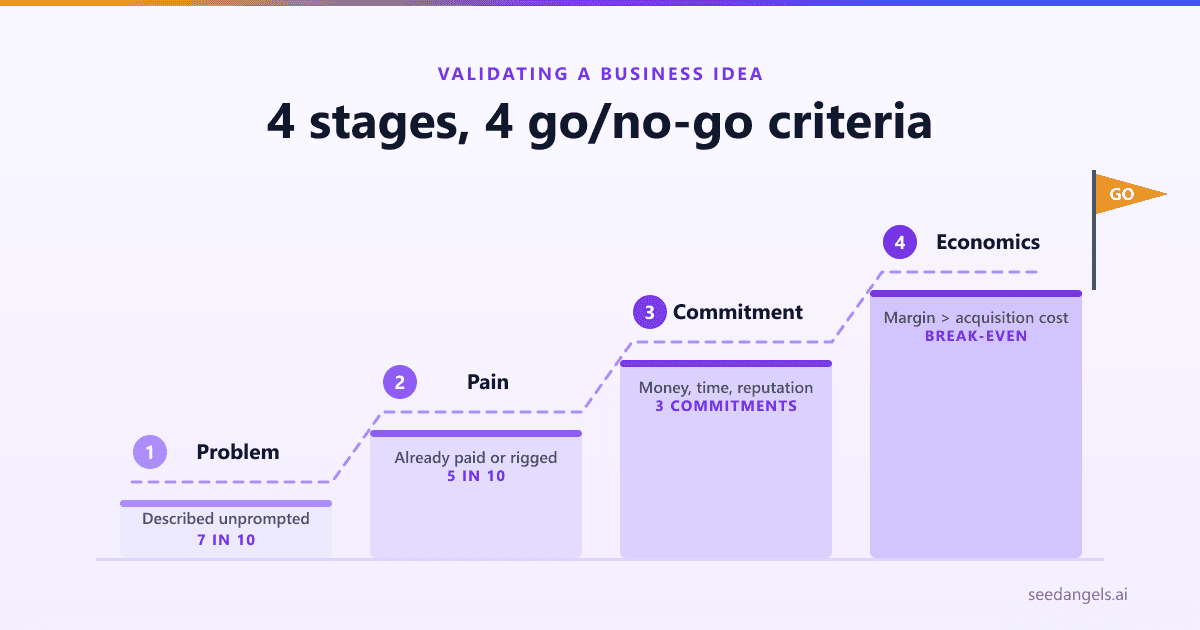
Each stage settles one question and is cleared at a precise threshold. You do not skip a stage: a commitment obtained on an unconfirmed problem is an accident, not a proof. These four stages make up the second of the six steps that lead from idea to business plan, the longest of the journey, because it runs at your contacts' pace rather than your own.
| Stage | Question to settle | Duration | Cost | Passing criterion |
|---|---|---|---|---|
| 1. Problem | Does the problem exist? | 1-2 weeks | €0 | 7 in 10 describe it unprompted |
| 2. Pain | Is it painful enough? | 2-3 weeks | €0-50 | 5 in 10 already paid or built a workaround |
| 3. Commitment | Will they pay? | 3-4 weeks | €50-500 | 3 costly commitments obtained |
| 4. Economics | Does the model hold? | 1-2 weeks | €0 | Unit margin > acquisition cost |
Stage 1: does the problem exist?
Around ten conversations are enough to settle this first stage. Beyond that, answers repeat and stop carrying new information: if the first ten affected people describe the same problem, the eleventh will not change anything, and if none of them mention it, the hundredth will not either. What matters is not the volume, it is the recruitment.
What you actually do. You talk to ten people who match your target, not your friends, and you never name your solution. You ask only about their current situation: how do they handle it today, how long does it take, what happened the last time, what did it cost them. The rule is absolute: as long as the words "I was thinking of building an app that…" have not left your mouth, the interview is valid.
The go criterion. Seven people in ten describe the problem unprompted, without you introducing it, and use their own words to do so.
The no-go signal. You have to explain the problem before it is recognised. A sentence like "ah yes, put like that, I suppose…" is a disguised no: the person is validating your reasoning, not their own experience.
The classic mistake. Recruiting from your immediate network because it is faster. You will get ten confirmations and zero information.
Stage 2: is it painful enough to pay for?
This is the stage almost everyone skips, and the one that explains most failed launches. A real problem is not necessarily a problem worth paying for. Thousands of people find folding laundry tedious; the market for at-home laundry folding remains tiny.
What you actually do. You go back to the same people and look for traces of past behaviour: have they already tried something, paid for something, rigged up a workaround? A homemade spreadsheet, a subscription taken out then dropped, a supplier trialled, every workaround is evidence of pain, because it cost time or money before you showed up.
Frequency is the second criterion. A weekly problem sells; an annual problem sells badly, because the customer forgets the pain between occurrences and never goes looking for a solution.
To sort what you hear, one table is enough.
| Strong signal (behaviour, past, quantified) | False signal (stated, future, polite) |
|---|---|
| "I tried three tools, none of them work" | "Great idea, someone should build that" |
| "It costs me €400 a month" | "I'd happily pay for that" |
| "I built my own spreadsheet for it" | "That's exactly what I'd need" |
| "We've had a contractor on this since 2023" | "Send me your brochure" |
| "Last time, it took me two days" | "Keep me posted" |
The reading rule is simple: anything in the past tense and quantified is a signal; anything in the conditional is noise.
The go criterion. Five people in ten have already paid for a solution, built a workaround, or spent identifiable time on the problem.
The no-go signal. The problem is acknowledged but nobody has ever done anything about it. That is an annoyance, not a pain.
Stage 3: are they ready to commit?
This is the only stage that proves anything. Everything before it measures statements about the past; here, you ask for a decision in the present.
The principle: the commitment has to cost the person giving it something. A free "yes" is worth nothing, however warm. Three currencies are admissible:
- Money, a deposit, a pre-order, a signed quote, even a token amount. This is by far the strongest proof.
- Time, a slot blocked in a calendar, a test session with a fixed date, data handed over. Time is scarce and easily refused, so giving it is informative.
- Reputation, a named introduction to a peer, a written recommendation. Nobody puts their name on the line for an idea they do not believe in.
What you actually do. You formulate a precise offer, with a price, and you put it to them. Not a questionnaire: a proposal. The discomfort you feel at that moment is part of the test, it is exactly the discomfort you will feel on every sale.
The go criterion. Three costly commitments obtained, independent of one another, from people with no emotional reason to help you.
The no-go signal. A zero conversion rate among people who, at stage 2, described genuine pain. That means your offer does not answer the problem you identified: the pivot belongs to the offer, not the market.
The classic mistake. Accepting a promise in place of a commitment, "come back to me when it's ready" is not a customer, it is a polite refusal with a courtesy clause.
This is also the stage where the threshold varies most by type of project: three signed quotes have no direct equivalent for a neighbourhood shop. The next section breaks the criterion down by family.
Stage 4: does the economics hold?
The stage validation methods almost always forget, and yet the most discriminating: you can have a real problem, real customers willing to pay, and a business that loses money on every sale. That is precisely the unsustainable unit economics identified in 19 % of the failures CB Insights analysed.
Three questions are enough, in this order.
What does it cost to acquire a customer? Customer acquisition cost (CAC) is everything spent to win a customer, divided by the number of customers won. At the validation stage you already have a rough measure of it: the time and money it took to land the three commitments from stage 3.
What margin does one sale generate? The selling price minus every cost directly tied to that sale. If the unit margin is below the CAC, each new customer makes you poorer, growth compounds the problem instead of solving it.
How many sales cover fixed costs? That is the break-even point, the volume beyond which you stop losing money: annual fixed costs divided by unit margin. One division, and the resulting number tells you more about the project than anything else. If your break-even requires selling 400 units a month when stage 3 produced three in a month, the gap is not an execution detail.
This is where the reasoning shifts from conviction to numbers, and where the sales volumes required become an assumption you have to defend: our guide to building a revenue forecast covers the three available methods and shows why they rarely produce the same result.
For the fixed-cost structure that feeds the break-even calculation, building a full financial forecast takes over.
The go criterion. The unit margin exceeds the acquisition cost, and the break-even point is reachable with the resources you actually have.
The no-go signal. The model only works at a volume that nothing in the three preceding stages makes credible.
Adapting the protocol to your type of project
A single protocol applied to every project means nothing. Three paying customers before launch is a reasonable threshold for a consultant; it is an absurd requirement for a restaurant, where pre-selling does not exist. What changes from one family to the next is the nature of the commitment proof at stage 3, and which stage carries the risk.
| Type of project | Expected proof of commitment | Riskiest stage | What changes |
|---|---|---|---|
| B2B service / freelance | Signed quote or deposit | Stage 1 | Fastest and cheapest validation |
| E-commerce product | Pre-orders or qualified waiting list | Stage 4 | Acquisition cost outweighs desire |
| Retail / physical location | Footfall counts, catchment area | Stage 4 | Location is the test; pre-selling impossible |
| App / SaaS | Recurring active users, not sign-ups | Stage 3 | The trap: mistaking sign-up for usage |
B2B services and freelancing. This is the simplest family to validate: the cycle is short, the buyer is identifiable, and a signed quote is unambiguous proof. Three signed quotes, or one deposit paid, clears stage 3. The risk shifts to stage 1: B2B problems are usually described in corporate language, and it is easy to confuse the problem of the department talking to you with the problem of the company paying you.
E-commerce products. Pre-orders remain the best proof, but the real question lies elsewhere: once the product, logistics and returns are deducted, does your unit margin absorb an advertising acquisition cost that will not go down? Stage 4 is the arbiter here, and it can be tested early, a few dozen euros of advertising pointed at a pre-order page gives a usable measure of CAC.
Retail or a physical location. You cannot pre-sell a restaurant. The proof moves to the field: pedestrian footfall counts at the target site, at several times of the week; the nature and density of existing businesses; direct observation of competitors at peak hours. Location is the object of the test, not a secondary parameter, and stage 4 is decisive, because the fixed costs of a lease make the break-even point particularly rigid.
Apps and SaaS. The trap is singular and systematic: mistaking sign-ups for usage. A waiting list of 500 email addresses proves nothing; ten users who come back every week without being chased prove everything. The commitment proof has to be repeated usage, or payment from the first version, and for a software project, our guide to the SaaS business plan shows how thoroughly retention metrics shape the rest of the file.
How long it really takes, and what it really costs
"Validating an idea costs nothing" is false. Validation costs little money and a lot of weeks, and the second is what founders systematically underestimate.
Time. Allow 7 to 11 weeks for a complete protocol run alongside a job. The heaviest item is not conducting interviews but recruiting the people to interview: getting ten conversations with genuine prospects, outside your personal network, easily takes two weeks. Stages 1 and 2 take up half the calendar, stage 3 a third, stage 4 a few days.
Money. From a few dozen to a few hundred euros, never several thousand. Stages 1 and 2 are free: they are conversations. Stage 3 is the only one that requires spending, a landing page, €50 to €200 of targeted advertising to test a message, possibly a sample or a mock-up. Stage 4 is a spreadsheet.
Three factors move the bill: how hard your target is to reach (a procurement director costs more to reach than a consumer), whether there is a physical product to sample, and whether regulatory constraints impose prior checks. A B2B service can be validated for the price of a few coffees; a food product subject to health standards cannot.
If you go beyond those orders of magnitude, it is no longer validation: you have started building.
When signals contradict each other: the decision tree
This is the most common situation, and the most paralysing: 200 enthusiastic survey responses, zero pre-orders. Or excellent stage 2 interviews, and nobody signing at stage 3. What should you believe?
The rule is hierarchical and admits no exception:
Behaviour always beats stated intent, and money always beats behaviour.
A survey loses to an interview. An interview loses to a rigged-up workaround. A workaround loses to a deposit paid. When two signals contradict each other, you do not look for an average: you keep the one that cost its author the most, and you ignore the other.
Applied to the results of the four stages, that rule produces three outcomes, and only three.
Go, move to the next stage. The stage criterion has been cleared on behavioural signals. Do not go back to collect more confirmation: past the threshold, every additional interview is wasted time.
Pivot, go back to stage 2, not to the beginning. The problem was confirmed at stage 1, but commitment does not come at stage 3. The diagnosis is then mechanical: the problem is good, the offer is bad. You change neither market nor target, you reformulate the solution, the format or the price, and you retest stages 2 and 3 only. A well-run pivot costs two to three weeks, not six months. That pivot stays cheap because no product has been built yet; once you have launched, the call rests on usage data and six measurable signals arbitrate between pivoting and persevering.
Stop, abandon this idea. Stage 1 was never cleared: nobody describes the problem unprompted, and you had to explain it before it was acknowledged. No amount of work on the offer compensates for the absence of a problem. This is the conclusion nobody dares write down, so let us be explicit: stopping at this point costs you one to two weeks and nothing, against two years and your savings if you carry on. A properly identified no-go is a result, not a failure, and the next idea will start with a protocol you already know how to run. Before launching into it, check that it does not belong to the ten families of ideas that fail for the same reason every time: the protocol will catch them, but two hours of upfront research saves you running it for nothing.
The ambiguous case, positive but weak signals at every stage, is settled the same way: apply the hierarchy and see what is left. If all that remains is stated intent, you have nothing.
After validation: from idea to file
A validated idea finances nothing until it is quantified. Your three commitments from stage 3 prove a market exists; they do not say whether it is large enough to carry a company. That is the purpose of market sizing, and it follows a different logic from validation: our guide to calculating your TAM, SAM and SOM shows how to get from the total market to what you can realistically capture in three years, using free public data. For the market research methodology itself, the SBA's guide to market research and competitive analysis lists the demographic and industry sources that support those numbers.
The real payoff of validation shows up at the next step. The evidence accumulated across the four stages, interview verbatims, observed workarounds, commitments obtained, the price actually accepted, is exactly the material that makes a forecast defensible. A banker or an investor never disputes an addition: they dispute assumptions. Being able to answer "three customers accepted that price before the product existed" beats any projection. That is the moment writing the business plan becomes an exercise in documentation rather than imagination: you are no longer building assumptions, you are recording them.
Conclusion
A validated idea is not a loved idea: it is an idea someone committed to, in money, time or reputation. Everything else, the encouragement, the favourable surveys, the "great idea" replies, is noise, and mistaking noise for signal is the most common way to lose two years.
Take your project and ask it one question: which stage have I cleared, and with what proof? If the strongest answer you can give is an encouraging conversation, you are at stage 1, however far ahead you are in your own head. The next stage is waiting, it costs a few weeks, and it will tell you whether to continue, reformulate your offer, or move on to something else.
To rough out the first two stages before heading into the field, the startup idea validator from SeedAngels frames the problem, the target and the questions to ask in a few minutes, you go into interviews with a stated hypothesis rather than an intuition. Try SeedAngels for free →
FAQ
How long does it take to validate a business idea?
Allow 7 to 11 weeks for a complete protocol run alongside a job, spread across the four stages. B2B service projects move faster because a signed quote is enough to prove commitment. A physical retail business or a regulated product takes longer, since the proof rests on field measurements and administrative constraints.
How many people do you need to interview?
Around ten conversations are enough at the first stage to know whether the problem exists: beyond that, answers repeat. What matters is not volume but recruitment quality, people genuinely affected, not your friends and family. Twenty well-targeted interviews beat a thousand survey responses.
Is an online survey enough to validate an idea?
No. A survey measures what people say, not what they do. It is useful for framing a segment or a price range, never for concluding. Until someone has committed money, time or reputation, your idea is not validated, whatever the share of positive answers.
Can you validate an idea with no money?
Almost. The first two stages cost only time: conversations are free. The third usually requires a small outlay, a landing page, a few euros of targeted advertising, or a sample. Budget from a few dozen to a few hundred euros depending on the type of project, never several thousand.
Should you protect your idea before talking about it?
In the vast majority of cases, no: an idea on its own cannot be legally protected, and the real risk is not theft but talking to nobody. If your project rests on a technical innovation or a brand name, a patent or trademark filing runs in parallel, without delaying validation.
What if my idea already exists?
That is a good sign: competitors prove a market pays. A complete absence of competition often means an absence of market. The real test becomes differentiation, what you do that incumbents do not, for a specific segment they serve badly.