Introduction
Someone asked you for a business feasibility study, and you are not entirely sure how it differs from the market research you have already done. It is the single most common question on the subject, and the available articles make it worse: some fold market research inside the feasibility study, others claim the exact opposite. You come away more confused than when you started.
This article gives you two things. First, a definition that takes a position and backs it with an institutional source rather than an opinion. Second, a four-dimension feasibility grid, scored, with one deal-breaker criterion per dimension and a worked case filled in front of you. By the end you will know whether your project is doable by you, and what could kill it on its own.
What is a feasibility study?
A feasibility study checks that a business project is achievable by its founder, with their means, within their regulatory framework. It examines four dimensions: legal, technical, commercial and financial. Its deliverable is not a presentation document but a decision: go, no-go, or reconfigure the project.
Hold on to that wording, because the whole distinction is inside it: feasibility means capacity to execute, not market attractiveness. Market research asks "are there customers?". A feasibility study asks "can I serve them?". Two identical projects in the same market can reach opposite feasibility verdicts, simply because one founder holds the required license and the other does not.
That is also what separates it from the business plan. The business plan explains how you will proceed and with what: it already assumes the answer to "can I?" is yes. Writing a business plan before checking feasibility is like planning an itinerary in detail without checking whether you have a passport.
Is it mandatory?
No. No statute requires a feasibility study to start a business. There is no legal format and no standard document to file anywhere.
In practice, the nuance matters enormously: it becomes unavoidable the moment a third party commits money. A bank, a lender or a grant program will ask for its components, funding plan, licensing conditions, founder credentials, often without ever using the word "feasibility". You will produce it either way. So produce it early, structured, and for yourself first.
Feasibility study, market research, business plan: who does what
This is where sources contradict each other most, so it is worth taking a clear position and justifying it.
| Market research | Feasibility study | Business plan | |
|---|---|---|---|
| Question asked | Is there a market? | Can I do it? | How, and with what? |
| What it looks at | The outside world | You and your means | The complete project |
| Deliverable | Demand analysis | Scored feasibility grid | Costed funding file |
| When | First | Second | Last |
The logical order is therefore: market → feasibility → business plan. First you confirm demand exists, then that you are able to meet it, and finally you formalize the whole thing. That sequence sits inside a wider path: our guide to going from idea to business plan in six steps places feasibility fourth, after framing and field validation, and gives an indicative duration for each.
Two confusions circulate, and they deserve naming. The first files market research inside the feasibility study: these are two distinct exercises with different methods. The SBA treats market research and competitive analysis as a standalone step aimed at demand and competitors, it answers whether an opportunity exists, not whether you can seize it. Its deliverable is not an opinion but a set of numbered assumptions, and our guide to market research for a business plan shows how each one feeds the forecast.
The second confusion pulls the financial work out of feasibility and reserves it for the business plan. That one is worth resisting on the evidence. The SBA's own guidance on calculating your startup costs is explicit that "investors and lenders compare expected costs to projected revenue and determine the potential for your business to profit", the costing exercise is a viability test, run before the plan is written, not a chapter buried inside it. That is the split we use here.
The four dimensions of feasibility
A feasibility study runs as four successive examinations:
- Legal feasibility: do you have the right to operate?
- Technical feasibility: can you produce what you sell?
- Commercial feasibility: can you reach your customers?
- Financial feasibility: can you fund the launch and hold on?
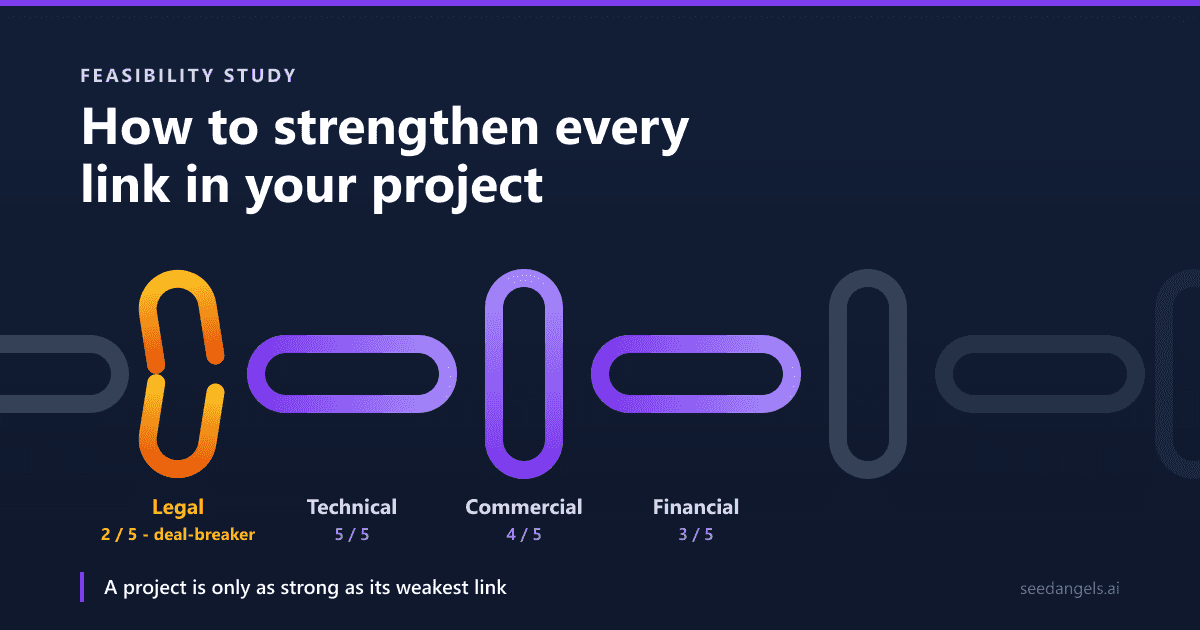
Here is the methodological point almost nobody states, and it changes everything: these four dimensions are not additive. They do not offset each other. You never average them.
One example makes the rule immediate. Picture a beauty salon project with excellent local demand, a perfectly placed unit, a comfortable down payment and a break-even point reachable in year one. Three dimensions out of four in the green. But the founder does not hold the cosmetology license required to practice, and cannot obtain it within two years. The project does not start. Commercial strength buys nothing back: this is an access condition, not an adjustable variable.
This is the weakest link rule. A chain is not worth the average of its links, it is worth its weakest link. Each dimension below therefore comes with a deal-breaker criterion: a threshold below which the project stops or gets reconfigured, whatever the other scores say.
Legal and regulatory feasibility
This is the most binary dimension, and the one most often discovered too late. It is not negotiable: either you meet the access conditions or you do not.
Checkpoints:
- Is the activity regulated? Far more activities are than founders expect, and requirements stack across federal, state and local levels.
- Is a license, diploma or professional qualification required? Trades, personal care, health services, food handling, construction and real estate typically require one.
- Do you need a federal permit or an operating authorization? The SBA lists thirteen activity categories requiring federal licenses and permits, including alcoholic beverages, aviation, firearms, commercial fisheries, broadcasting, mining and nuclear energy, noting that "requirements and fees depend on your business activity and the issuing agency".
- Are the premises compatible? Zoning, permitted use under the lease, occupancy classification, accessibility, ventilation and extraction for food service.
- Are you still bound by a non-compete clause? A former employment contract can bar you from your own project for months.
Do not settle this on a forum. Start with the SBA's guidance on federal and state licenses and permits, then check the requirements at every level that applies to you, federal where the activity is listed, then state and municipal, because the binding constraint is usually the local one, and it is the one nobody thinks to look up.
Deal-breaker: an access condition you do not meet and cannot clear within 12 months.
Technical and operational feasibility
The question is simple: can you produce what you sell, or can you source it reliably and repeatedly?
Checkpoints:
- Skills you hold versus skills to acquire. List what the project genuinely requires, then mark honestly what you cannot do today.
- Supplier availability and reliability. A single possible supplier for a critical input is a structural fragility, not an execution detail.
- Equipment and premises. Does what you need exist within your budget, and is it available within your timeline?
- Time to launch. How many months between signing and the first dollar collected? That delay is paid for in cash.
- Key person dependency. Most often that person is you. What happens if you are unavailable for six weeks?
This dimension is settled with quotes and concrete conversations, not estimates. Three supplier quotes beat three hours of online research: they give you real prices, real lead times, and sometimes the discovery that what you wanted to buy does not exist in your budget range.
Deal-breaker: the project depends on a skill you lack and can neither hire nor subcontract within your budget.
Commercial feasibility
Watch the trap here: the question is not whether the market exists, that is market research. The question is whether you can reach it. A huge market you have no access to is worth zero.
Checkpoints:
- Is the acquisition channel identified and tested? Knowing "there is demand" says nothing about the path customers will take to reach you.
- Is the acquisition cost sustainable? Compare the cost of winning a customer to the margin that customer generates: if the first exceeds the second, the model fails at any volume.
- Is the sales cycle compatible with your cash position? Selling on a six-month cycle when you hold three months of cash is a feasibility problem, not a sales problem.
- Do you have real access to referrers or to the catchment area? Location, professional network, listing with a key account.
On sizing the share you can realistically capture, the method is to start from market size and work down to what your commercial means allow: that is exactly what calculating your TAM, SAM and SOM does, and the SOM is the only figure that matters at this stage, the one you can serve with your year-one team and budget.
Deal-breaker: no route to customers at a sustainable cost.
Financial feasibility
This is the dimension most often wrongly deferred to the business plan. Five financial tables structure the examination, and each answers a different question:
- The initial funding plan: is the startup requirement fully covered by available resources?
- The projected income statement: is the activity profitable once every cost is paid?
- The break-even point: what revenue must you hit to lose nothing, and is it reachable given your production capacity?
- The monthly cash flow projection: is there a single month where the balance goes below zero?
- The three-year funding plan: does the balance hold over time, once repayments start?
The essential methodological point is that the exercise is iterative. You do not passively accept what the tables say: you adjust the project based on what they reveal. An unreachable break-even point does not automatically stop the project, it leads you to revisit pricing, cost structure, the size of the premises or the investment pace, then recalculate. That back-and-forth is what turns numbers into a decision tool.
These five tables are named here, not built: the calculation method is covered in our guide to building your financial forecast, which walks through assumption by assumption how to turn an intention into defensible numbers.
One clarification on covering the funding requirement, if a bank loan is in the picture. A lender does not simply check that total resources equal total needs: it runs five specific ratios on your forecast, starting with a down payment usually expected at around 30 percent of the total requirement, sometimes less for a limited-risk project. A funding plan that balances on paper with 5 percent equity is not financeable, and that is feasibility information, better known before you build the file than after.
Deal-breaker: a funding requirement with no route to coverage, or a break-even point out of reach given your production capacity.
The feasibility grid, filled in on a real case
Describing dimensions is useless if nobody tells you how to conclude. Here is the grid, and how to fill it in.
Each dimension gets a score from 1 to 5, a comment justifying that score, and a binary answer to "deal-breaker?". The score helps you rank your workstreams; it is the deal-breaker column that decides.
Decision rule:
- A single "yes" in the deal-breaker column → the project stops or gets reconfigured around that constraint. No average, no offsetting.
- No deal-breaker, but a score of 2 or below → the project continues, provided that point is treated as the absolute priority before launch.
- No deal-breaker, all scores at 3 or above → green light, move to the business plan.
The case: a hair salon in a small town
Take a plausible project. Someone who has worked two years as an employee in a hair salon wants to open their own in a town of 6,000 residents where a salon has just closed. They hold the entry-level cosmetology certificate but not the senior license their state requires to operate independently, and they are short of the experience hours that would let them qualify for it by seniority. Personal contribution of $25,000, total requirement estimated around $90,000 (fit-out, equipment, working capital), orders of magnitude, to be confirmed by quotes.
| Dimension | Score | Comment | Deal-breaker? |
|---|---|---|---|
| Legal | 2/5 | Cosmetology is a licensed activity: operating independently requires the senior license (or a recognized equivalency). The entry-level certificate alone is not enough, and the experience-based route is not yet open. Premises: accessibility upgrades to be costed. | Yes, as things stand |
| Technical | 4/5 | Two years in the trade plus training, solid command of core services. Multiple approved suppliers. Time to launch estimated at 4 months. | No |
| Commercial | 4/5 | Competing salon has closed, existing clientele partly transferable, high-footfall location. Small catchment area: no growth headroom beyond the town. | No |
| Financial | 3/5 | $25,000 contribution on $90,000, i.e. 28 percent: within lender norms. Break-even to be confirmed precisely by the forecast. Cash tight across months 2 to 5. | No |
Reading the grid. The project is strong everywhere except on one dimension, and it happens to be the dimension that does not offset. An arithmetic average would return 3.25/5 and a comfortable green light. The weakest link rule returns the opposite: as things stand, this project cannot start.
The judgment call. So the question is not "how do we compensate", but "does the constraint clear within an acceptable timeframe?". Here the answer is encouraging: another year of salaried work would take them past the experience threshold most states set for licensure by seniority. Three routes exist: stay employed until that threshold is met, sit the senior license exam, or partner with a qualified professional who holds technical responsibility. The first costs only time and clears the constraint on a known date; the third changes the structure of the project and how value is shared. That decision, not a score, is the real deliverable of a feasibility study.
Note what the grid produced: it did not say the idea was bad. It said that as things stand, this founder cannot execute it, and it identified the only workstream that matters. That is exactly what you want from it.
Feasibility: how much your context changes
Feasibility does not deserve the same level of scrutiny everywhere, because survival rates vary enormously.
Eurostat's business demography data give the scale of it: the EU five-year survival rate for enterprises born in 2014 and still active in 2019 was 45 percent, fewer than half. The spread between countries is wider still: 62 percent in Belgium and Sweden, against 29 percent in Lithuania. These figures cover the 2014 cohort measured through 2019: read them as orders of magnitude, not as current data.
Two lessons follow. The first is that a survival rate is not a verdict on your project, a 45 percent baseline says nothing about a specific founder with a specific set of means. The second is that the gap between a 62 percent country and a 29 percent one is driven largely by conditions no founder controls: access to credit, payment terms, administrative load. Those belong in your feasibility assessment precisely because you cannot change them.
The methodological consequence is straightforward. Where survival is structurally weaker, retail, hospitality and food service, and capital-hungry activities generally, the financial and commercial dimensions have to be assessed more strictly: a wider safety margin on break-even, a thicker cash buffer at launch, an acquisition channel that has been tested rather than assumed. A 3/5 that is acceptable in manufacturing becomes a warning sign in a restaurant, where a small sizing error is paid for within months.
Should you do it yourself or outsource it?
A feasibility study outsourced to a specialist firm typically runs between $5,000 and $8,000, depending on project complexity, that is the order of magnitude observed on the market. For the vast majority of startup projects, that spend is disproportionate.
The reason is simple: three quarters of the work consists of collecting public, free information. Licensing conditions for regulated activities are online. Sector statistics are open data. Supplier quotes are free, and you have to request them yourself anyway. A firm mainly bills you for compilation time and presentation, not for privileged access to information.
Doing it yourself, budget one to three weeks of actual work, spread across one to two months: the time it takes for quotes to come back and for agencies and support networks to answer.
Outsourcing genuinely pays off in four cases:
- Heavy capital investment: past several hundred thousand dollars, the cost of the study becomes marginal against the risk.
- Complex regulatory profile: environmental permitting, healthcare, multi-license activities.
- Explicit requirement from a funder: some programs mandate a third-party study, which settles the question.
- Industrial projects: technical sizing, siting, production process.
Between the two extremes there is a middle route founders often overlook: chambers of commerce and small business support networks offer free or low-cost guidance. Use them before considering a paid engagement.
From feasibility to business plan
Once the grid is complete with no deal-breaker, the project changes phase: it moves from assessment to formalization. And the work already done is not wasted, it feeds directly into the next document.
The handover happens line by line. The regulatory constraints you identified become elements of the legal section and cost items (training, bringing premises up to code, licensing). The technical needs you listed become the investment program and equipment plan. The acquisition channels you validated become the commercial strategy. And the five financial tables built for feasibility become, once refined, the numbers section of the file. Our complete guide to writing your business plan picks up all of these building blocks across nine steps.
Put differently, a serious feasibility study represents between a third and half of the business plan work. That is the best reason not to rush it: you are not adding a step, you are getting most of the next one done.
If your grid is green, the simplest path is to start from an existing structure rather than a blank page: our free business plan templates cover eight sectors and already include the regulatory and financial sections you have just documented. And to go straight to the costed file, SeedAngels builds the forecast and the business plan from your assumptions, Try SeedAngels for free →
Conclusion
A feasibility study does not tell you whether your idea is good. It tells you whether it is achievable by you, with your means, within your framework. A project can be excellent on paper and undoable in your specific situation, and it is infinitely better to find that out before signing a lease than six months after.
Hold on to the rule that structures the whole exercise: the four dimensions do not offset each other. Never try to make up for a legal weakness with commercial strength, or a funding gap with technical mastery. Find your weakest link, look at it squarely, and ask the only question that matters: can this constraint clear within an acceptable timeframe? If yes, you have your roadmap. If no, you have just saved yourself years and a great deal of money, which is, also, an excellent outcome.
FAQ
What is the difference between a feasibility study and market research?
Market research looks outward: is there demand, are there customers, who are the competitors? A feasibility study looks at you: do you have the legal right, the skills, the technical means and the financial resources to serve that demand? You run market research first, then the feasibility study.
Is a feasibility study mandatory?
No law requires one to start a business. In practice it becomes unavoidable the moment a third party puts money in: banks, lenders and grant programs almost always ask for its components, even without using the word. It is also your best protection against a badly sized investment.
How much does a feasibility study cost?
Outsourced to a consulting firm, it typically runs between $5,000 and $8,000 depending on complexity. Done yourself, it costs only time: most of what you need, licensing rules, sector data, supplier quotes, is public and free. Outsourcing only pays off on heavy or highly regulated projects.
Who carries out a feasibility study?
The founder, in the vast majority of cases. An accountant adds real value on the financial section, a lawyer on complex regulatory constraints. Support networks such as chambers of commerce and small business development centers offer free or low-cost help well before a private firm becomes necessary.
When should you run a feasibility study?
After confirming that a need exists, and before writing the business plan. Too early, you are assessing a project that is still vague; too late, you discover a regulatory or financial blocker after committing money. It is the hinge step between the idea and the funding file.
What should you do if one dimension is a deal-breaker?
Do not try to offset it with the others: feasibility dimensions do not add up. Either the constraint clears within an acceptable timeframe, earning a license, finding a partner, changing premises, or the project has to be reconfigured around it. A lasting regulatory blocker stops the project.