The line many founders leave at zero
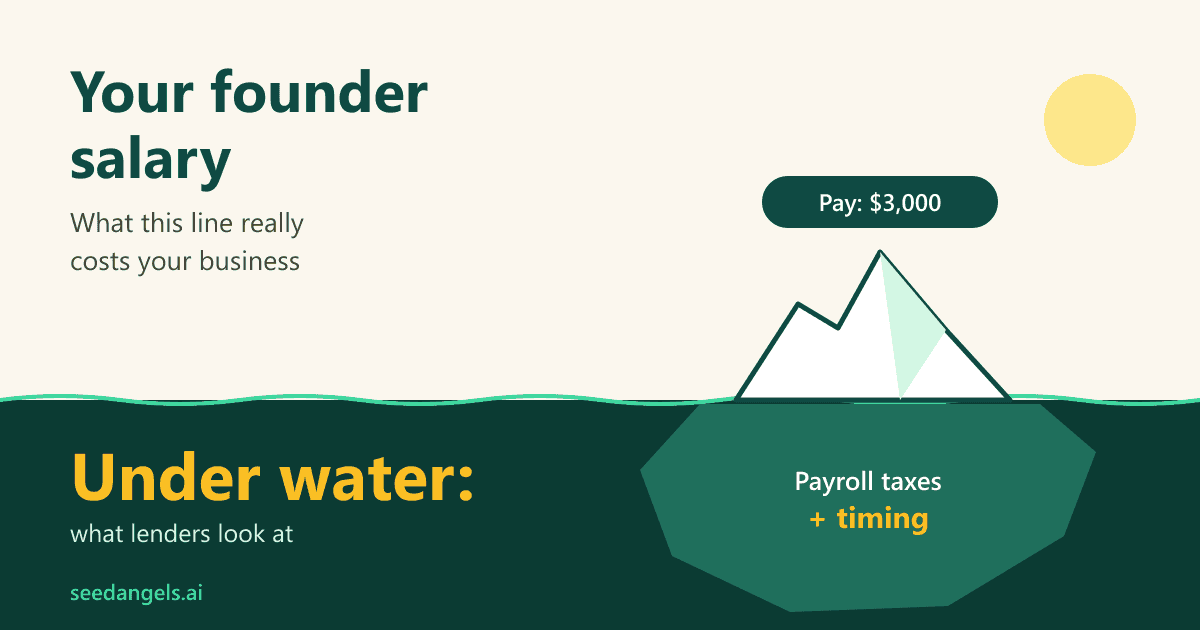
Your own salary is often the largest fixed cost in your forecast, and it is the line founders fill in worst. Many plans reach the lender with the founder's pay at zero, or at a token amount, so the profitability "works". Others enter a take-home figure without payroll taxes, or put the cost in the wrong month. In all three cases, the forecast fails to answer the only question that matters to you: does this business pay you, and from when?
This article does not tell you which legal structure to choose: that is a job for your accountant. It shows you how to write the line, whatever the structure. We follow a single case, a bike repair shop whose founder needs $3,000 a month, and set it up three ways: no salary, a salary on payroll, and an owner's draw. Then we look at what each choice does to cost, to break-even and to the ratio a lender calculates.
1. Why this line is never optional
A forecast exists to prove the business can stand on its own. A forecast without a founder salary only proves it can stand as long as you don't eat.
The line shows up in two places. In the income statement, a payroll salary sits in personnel costs and reduces EBITDA. In the cash flow forecast, it leaves the bank every month, taxes included, at the pace you actually pay them. If you need a refresher on how the three projected financial statements connect, start there: the founder's pay is one of the "HR" assumptions that ties them together.
What the lender reads. A missing or token salary does not make your plan more profitable in their eyes. They add a realistic salary back on their own, recalculate your repayment capacity, and conclude your numbers are fragile.
A zero line can be perfectly legitimate, for instance if savings or a partner's income cover the launch period. But it then needs explaining in the plan: who supports you, for how long, and from which month you start paying yourself.
2. How much to pay yourself: start from your needs, not from what's left
The classic mistake is to fill in every other line, then put whatever is left into your salary. You end up with a number driven by your sales assumptions, not by what you need. Turn the problem around.
How to set the founder salary in a financial forecast:
- Work out your personal monthly need: household costs (rent or mortgage, food, insurance, health cover) minus the household's other income (a partner's salary, rental income).
- Set a floor: the minimum you can live on. It can be zero if savings or a partner cover the launch.
- Set a target two to three years out: what it would cost to hire someone to do your job. Salary benchmarks for the role give you an objective reference point.
- Date the move from floor to target: the month the cash allows it, not the month that suits you.
The target is not vanity: it is a reality check. A business that can never pay its founder the market rate for the job they do is not creating a job, it is subsidizing one. To document this number like the others, with a source and a one-line justification, use the same method as for your other financial forecast assumptions.
In our bike shop, the founder needs $3,000 a month, or $36,000 a year. Their partner works, savings are thin: the floor and the target are the same from year one. It is the most demanding case, and so the most instructive.
3. From take-home pay to fully loaded cost
The amount that matters to the business is not what you take home, it is what you cost. How the two relate depends on how you are paid, and that depends on your legal structure. As the IRS puts it, the way you pay yourself depends on the business structure you elect: an officer of a corporation is generally an employee, while partners are not employees.
The figures below use US federal rules. Payroll taxes vary widely between countries, so keep the method and swap in your own rates.
On payroll: salaried officer (C corp or S corp)
When you are an employee of your own company, the company pays your salary and the employer's share of payroll taxes on top. According to the IRS, Social Security tax is 6.2% for the employer and 6.2% for the employee, and Medicare tax is 1.45% each. The employer's 7.65% is a cost to the company, on top of the gross salary; federal and state unemployment taxes and workers' compensation come on top of that and vary by state.
If you run an S corporation, you cannot set this salary at zero and take everything as distributions. The IRS requires reasonable compensation to a shareholder-employee before non-wage distributions. There is no set amount: the IRS weighs factors such as your duties, your time and what comparable businesses pay, and it can reclassify distributions as wages.
Owner's draw: sole proprietor or partner
In a sole proprietorship or a partnership, you are not on payroll: what you take out is a draw, not wages. It is not an expense in the income statement: it is a withdrawal of profit. But it still leaves the bank account, so it belongs in the cash flow forecast. And the profit it comes from carries self-employment tax (15.3% on most of it, per the IRS), which you pay personally, through estimated tax payments: plan for it in your personal budget, or your $3,000 a month will not be $3,000.
The worked example
Here is what the founder's $36,000 a year looks like in each setup.
| No salary | Salary on payroll | Owner's draw | |
|---|---|---|---|
| Paid to the founder (gross) | $0 | $36,000 | $36,000 |
| Employer payroll taxes | $0 | ≈ $2,750 | none (self-employment tax paid personally) |
| Cost in the income statement | $0 | ≈ $38,750 | $0 (the draw is not an expense) |
| Cash leaving the business | $0 | ≈ $38,750 | $36,000 |
Calculation: 7.65% employer Social Security and Medicare tax (IRS), before federal and state unemployment taxes and workers' compensation.
The draw looks cheaper on paper only because it sits below the profit line. The cash still leaves. Your forecast should carry the real cost of the setup you have actually chosen, in the statement where it belongs, and in the month you pay it.
4. From which month: three timelines
Should founders pay themselves in the first year? Nothing requires it. But the line must exist in your forecast, and it must say how you live while it is at zero. There are three common timelines.
- Zero, supported by savings or a partner. The line stays at $0. Your savings are not company money: mention them in the plan to explain how you live, and put any cash you invest in the business in your funding sources, as we do with the founder's owner equity in the sources and uses of funds.
- Stepped pay. The most common timeline: zero for a few months, a first step, then the target. The rule is simple: set the first step after the lowest point of your cash flow, never before. Open your monthly cash flow forecast, find the month with the lowest balance, and start paying yourself the month after. That low point comes from costs that start before sales, but also from the gap between what you invoice and what you collect, which is what your working capital requirement measures.
- Distributions. Profit distributions need profit first. They cannot fund your first year, and in an S corp they come only after reasonable compensation.
5. What your salary does to break-even
Break-even is the revenue that covers all fixed costs. Your salary is one of them, often the biggest.
The bike shop has $48,000 of fixed costs excluding the founder (rent, insurance, accounting, a part-time employee) and a 55% contribution margin.
| Setup | Total fixed costs | Break-even revenue |
|---|---|---|
| No salary | $48,000 | ≈ $87,270 |
| Salary on payroll | $86,750 | ≈ $157,730 |
| Owner's draw (to fund the $36,000) | $84,000 | ≈ $152,730 |
Calculation: fixed costs ÷ contribution margin (0.55). The draw is not an expense, but the business has to earn it.
With your pay included, break-even comes out 75 to 81% higher than without it. The shop does not need $87,000 of revenue to be viable: it needs $153,000 to $158,000 to pay you.
6. What the lender does with it: debt service coverage
A lender checks that your cash flow covers your loan payments with a safety margin: many lenders look for 1.20 to 1.25 times the annual debt service; the SBA's own floor for larger 7(a) loans has been 1.15. It is one of the ratios lenders calculate on your forecast, and the one your salary hits most directly.
Take the shop at $180,000 of revenue: $99,000 of margin, $51,000 of EBITDA before the founder's pay, and a loan with $14,000 of annual debt service.
| Setup | Cash flow after founder pay | Coverage | Verdict |
|---|---|---|---|
| No salary | $51,000 | 3.64x | On paper only: the lender adds a salary back |
| Salary on payroll ($36,000) | ≈ $12,250 | ≈ 0.88x | Fails |
| Owner's draw ($36,000, subtracted by the lender) | $15,000 | ≈ 1.07x | Fails |
| Stepped salary on payroll ($24,000 in year 1) | ≈ $25,160 | ≈ 1.80x | Passes |
The structure does not make the salary disappear: a lender treats a draw and a payroll salary much the same way, because both are what you live on. What changes the outcome is the amount and the timing. If your ratio does not hold, you have levers:
- Step your pay: a lower salary in year one, rising as revenue follows.
- Extend the loan term: smaller annual payments, a higher ratio.
- Put in more equity: a smaller loan, smaller payments.
- Review the structure with your accountant: it is a lever, not a recommendation, because it also changes your taxes and benefits.
7. Writing the line in your forecast
How to put the founder salary in your financial forecast:
- Create a separate "founder salary" line, distinct from employees.
- Enter the fully loaded cost, payroll taxes included, not the take-home figure.
- Date the start and each step, month by month in year one.
- Place each payment in the month it actually leaves the bank.
- Check the effect on break-even and on debt service coverage.
Before you send your plan, run through the full checklist:
- A "founder salary" line, separate from employees
- Gross pay, employer taxes and total cost, using your country's current rates
- A start month and steps, placed after the lowest cash point
- For a draw: the cash outflow in the cash flow forecast, and the personal tax on the profit in your own budget
- For an S corp: a salary you can defend as reasonable compensation
- A one-line justification: personal need, other household income, market rate for the role
- Debt service coverage checked with your salary, not without it
In SeedAngels, your salary goes in as an expense in the Salaries category, year by year, and the income statement, cash flow and break-even update at once: you see straight away what a salary step does to your break-even and your cash. The loaded cost, however, is yours to set: the tool does not choose your structure or calculate your payroll taxes, so check that figure with your accountant or your tax authority's calculator. You'll find the screens in detail on our financial forecasting software page.
Conclusion: the line that says whether the business pays you
The founder salary is not a plug figure: it is the line that tells you whether your business creates a job, yours. Left at zero without explanation, it weakens the plan instead of flattering it. Entered as take-home pay, it understates your costs by thousands. Put in the wrong month, it moves a cash low that the lender will find anyway.
Start from your personal need, turn it into a fully loaded cost, date each step after the lowest cash point, and check that your break-even and your debt service coverage hold with this line, not without it. To build that forecast and see the effect of each step live, use SeedAngels. Try SeedAngels for free →
FAQ
Should founders pay themselves in the first year?
Nothing requires it, and many founders take little or nothing while the business finds its feet. But the line must exist in your forecast. If it is zero, your plan should say how you live (savings, a partner's income, a side job) and from which month you start paying yourself. A lender will assume you need to live either way.
What is the fully loaded cost of a founder on payroll?
In the United States, an employer pays 6.2% Social Security and 1.45% Medicare tax on wages, on top of the salary, according to the IRS. A $36,000 salary therefore costs the company about $38,750 before federal and state unemployment taxes and workers' compensation, which vary by state. Other countries add very different payroll taxes: check your own rates.
Is an owner's draw an expense in the forecast?
No. In a sole proprietorship or a partnership, you are not an employee of the business: the owner's draw is not wages, it is a withdrawal of profit. It does not appear in the income statement, but it does leave the bank account, so it belongs in the cash flow forecast. Lenders subtract it when they test your repayment capacity.
What is reasonable compensation for an S corp owner?
The IRS requires an S corporation to pay reasonable compensation to a shareholder-employee for the services they provide before making non-wage distributions. There is no set amount: the IRS lists factors such as duties, time devoted to the business and what comparable businesses pay for similar services. Payments labeled as distributions can be reclassified as wages.
Will a lender accept a forecast with no founder salary?
Rarely as it stands. The analyst knows you need to live, so they add back a realistic salary and recalculate your debt service coverage. A plan that only works with a zero salary reads as fragile. It is better to show a modest, dated salary and a ratio that still holds with it.
When should a founder start paying themselves?
Start after the lowest point of your monthly cash flow forecast, not before. Map the month where cash is lowest, set the first salary step the month after, and raise it in steps as revenue grows. The step dates are assumptions like any other: write them down and explain them.