The projections nobody will give you
You are joining a proven concept, yet nobody will hand you your financial projections: you have to build them yourself, from figures the network releases sparingly. In France, the franchisor does not have to give you projected accounts, and case law rather encourages it to stay silent. Your banker, meanwhile, expects a three-year financial plan.
Franchising is a large part of the French economy: 2,035 networks, 93,395 franchised outlets and €93.71 billion in revenue in 2025, according to the indicators published by the French Franchise Federation. Behind those figures, every franchisee went through the same exercise: turning the network's documents into their own forecast.
This guide gives you a four-step method: sort what the franchisor gives you, move from the average outlet to your first year, put the entry fee and royalties on the right lines, then measure their effect on your break-even point. It is applied to a worked example, a dry-cleaning franchise followed over three years. The legal framework is French; the method works in any country.
Outside France. In the United States, the equivalent of the French disclosure document is the Franchise Disclosure Document (FDD). Any figures the franchisor chooses to share about outlet performance appear in Item 19, "Financial Performance Representations" of the FTC Franchise Rule. It must reach you at least 14 calendar days before you sign or pay anything.
Who builds a franchise's projections, and why franchisors stay cautious
The franchisor does not have to provide financial projections. The future franchisee builds them, ideally with an accountant. If the franchisor chooses to share some, they must be honest and serious. Most networks therefore stick to historical data and leave you to build your own projections.
What the rule says
The French government's page on franchisee and franchisor obligations is clear: nothing requires the franchisor to hand over projected operating accounts, but if it does, they must be "sincere and serious". This follows from a simple principle, recalled by Bpifrance Création: the franchisee remains an independent entrepreneur, responsible for running the business and for its results. The network brings you a brand, know-how and support, not a revenue guarantee.
Why franchisors stay silent
Case law explains the networks' caution. In 2012, France's Court of Cassation upheld the annulment of a contract whose projections, supplied by the franchisor, were "excessively optimistic" given the very large gap with actual revenue (Cass. com., 12 June 2012, no. 11-19.047, discussed by La Lettre des Réseaux). The penalty is heavy: if the contract is annulled, the franchisor must return everything it received, entry fee and royalties included, as law firm CMS Francis Lefebvre points out.
Courts do not punish every gap, though. If poor results come from the franchisee's own management, the contract stands. Putting figures on paper commits the franchisor, so many prefer to write nothing.
What this means for you. Your projections are yours. In a dispute, you are only protected if you can show where the figures you were given came from: keep every document and every email, with its date and author. This guide does not replace a review of your contract by a lawyer or an accountant.
Step 1: sort what the franchisor gives you
Before signing, you receive a stack of documents. Some figures can be used as they are, others need a discount, and others only point your own research in the right direction. Your first job is to sort them.
The central document in France is the DIP (document d'information précontractuelle), the pre-contract disclosure document. It must reach you at least 20 days before you sign, and a franchisor that fails to provide it faces a €7,500 fine (service-public). It includes in particular:
- the identity of the franchisor and its managers, with their professional experience;
- the balance sheets and income statements for the last two financial years;
- a description of the concept and of its target market;
- the term of the contract and its renewal, termination and transfer conditions;
- the required investments: initial costs, royalties, advertising and training fees;
- territories and any exclusivity;
- pending litigation involving the franchisor;
- the network's franchisees: number, addresses, transfers and terminations of contracts.
| Document | What it contains | What you do with it in the projections | Reliability for you |
|---|---|---|---|
| Disclosure document: state of the market | General and local presentation of the market | Starting point for your local analysis, never a revenue figure | Indicative |
| Disclosure document: investments, entry fee, royalties | Amounts and calculation rules | Investment and cost lines, used as they are | High (contractual commitment) |
| Disclosure document: franchisor's accounts | Balance sheets and income statements over 2 years | Financial health of the network, not your profitability | High, but irrelevant to your revenue |
| Disclosure document: list of franchisees and leavers | Contact details, opening and exit dates | Who to call, and the network's exit rate | High |
| Model operating account (optional) | Cost structure of an "average" outlet | Useful cost structure, revenue to discount | Medium |
| Accounts filed by franchisees | Real revenue and profit | Your best basis for revenue | High, when published |
The local market section is one of the items the disclosure document must contain, but leaving it out is not automatically sanctioned: in 2016, the Court of Cassation held in several cases that this information had not been decisive for franchisees already experienced in the same field (Cass. com., 5 January 2016, five rulings including no. 14-15.701, presented by CMS Francis Lefebvre). So don't count on a legal remedy: even when complete, it describes a market, not your catchment area: redo the calculation yourself with a trade area analysis, which shows how to estimate the share of local demand your outlet can capture.
The model operating account: what it is really for
Many networks hand over a "model operating account", the income statement of an average outlet. It is valuable for the cost structure: the weight of purchases, payroll, rent and energy. Its revenue figure, on the other hand, does not describe you.
Always ask three questions: how many outlets make up the average, how long they have been open, and what their size and type of location are. A model built on ten-year-old city-centre stores says nothing about your first year in a retail park.
The accounts of existing franchisees
The list of franchisees in the disclosure document is your best source. Pick two or three outlets comparable to yours in size, location and town size, and look first at those that opened recently: their first year is what matters, not their cruising speed. When their annual accounts are filed and published, you will find their real revenue there.
Then call at least three franchisees with a prepared list of questions:
- How long did it take you to reach your current revenue?
- Which cost line did you underestimate the most?
- What did the fit-out really cost, compared with the announced amount?
- Are the mandatory supplies competitively priced?
- Knowing what you know now, would you sign again?
Write down the answers, with the person's name and the date. They are what will justify your assumptions in front of the banker.
Step 2: from the network's average outlet to your first year
The rule of prudence is simple: never use the network's average revenue for year 1. An average outlet has an established customer base and local awareness. Yours starts from zero, even under a well-known brand.
Apply an explicit ramp-up. In our case, we use 65% of cruising revenue in year one, 85% in year two and 100% in year three. These percentages are a case assumption, not a norm: justify yours with the first year of the franchisees you interviewed. If the three recent franchisees reached between 60% and 70% of the network average in their first year, you have your range.
Then cross-check this figure with a second method. The capacity-based method starts from what your outlet can physically handle, in customers per day and opening days: if it gives a much lower result, your ramp-up assumption is too optimistic.
A word on prices. In most networks, the franchisor circulates recommended prices, sometimes maximum prices; in France it cannot impose a minimum resale price on you. It determines your average ticket, not how many customers walk through the door. Volume remains your assumption, and that is what you need to document.
Step 3: the lines specific to a franchise
A franchisee's projections use the three classic financial statements, income statement, cash flow plan and balance sheet, but some lines only exist in a franchise. Put in the wrong place, they distort your profitability and your break-even point.
The entry fee
The entry fee is usually an intangible asset: it pays for a lasting right to use the network's brand and know-how, and it is amortized over the term of the contract. The portion that pays for services used up at opening, such as initial training or launch support, can instead be expensed when the contract prices it separately. The choice changes your profit in the first years.
In France, it ranges from €5,000 to more than €50,000 depending on the sector and the brand's reputation, and it cannot be charged again when the contract is renewed, according to service-public. Have your accountant confirm its treatment, and remember that it carries VAT: you pay it upfront at opening and it weighs on your cash in the first months, as our article on VAT in a cash flow forecast explains.
Royalties
Royalties pay for the network's ongoing support (operating royalty) and national advertising (marketing royalty). They can be fixed or proportional to revenue, capped or not (service-public). When they are proportional, which is the most common case, they can reduce the franchisee's profit margin, as the French government's guide to becoming a franchisee notes.
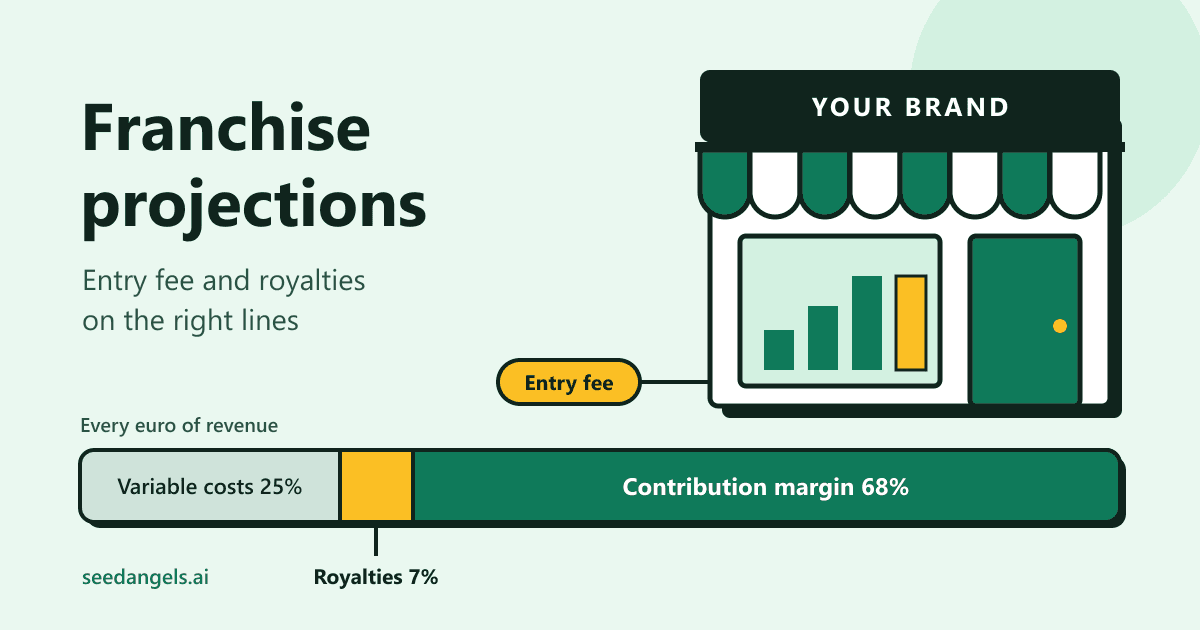
In the income statement, a royalty expressed as a percentage of revenue is a cost proportional to sales. Put it next to purchases, not in fixed costs. The only exception is a guaranteed annual minimum, which behaves like a fixed cost as long as your revenue stays below the threshold. The rates and any minimums are the ones in your contract, not a market average.
In SeedAngels' financial forecasting software, costs are split between those proportional to sales and those that stay fixed: a royalty set as a percentage of revenue goes in the first group, and the income statement, cash flow and break-even point are recalculated at once. The tool does not know your network's terms: the royalty rate, the entry fee and the supply prices come from your disclosure document and your contract, and you enter them yourself. VAT on sales and on costs can also be set in the tool; VAT on investments, like the €32,000 in the case below, is yours to plan for.
Mandatory supplies, fit-out to the concept, training
Three other flows deserve close attention:
- Mandatory supplies. If the contract requires you to buy from the network or from approved suppliers, your purchase costs follow their prices, with no competitive tendering. Use the network's prices, and check them with existing franchisees. The initial stock required at opening is part of your working capital requirement, which must be funded from day one.
- Fit-out to the concept. The premises must follow the network's design and brand guidelines. This is a fixed asset, depreciated over its useful life, and often the first line to overrun: ask franchisees what their fit-out really cost.
- Initial training. It is sometimes included in the entry fee, sometimes billed separately. Check the disclosure document, and also budget for travel costs and the period without revenue it imposes.
| Flow | Where it goes | Treatment | Source of the figure |
|---|---|---|---|
| Entry fee | Funding plan, then income statement (amortization) | Intangible asset amortized over the contract term, usually | Disclosure document and contract |
| Operating royalty | Income statement, cash flow | Cost proportional to revenue (or fixed, depending on the contract) | Contract |
| Marketing royalty | Income statement, cash flow | Cost proportional to revenue, usually | Contract |
| Fit-out to the concept | Funding plan, then income statement (depreciation) | Tangible fixed asset | Quotes, cross-checked with franchisees |
| Mandatory supplies | Income statement (purchases), initial stock in working capital | Cost proportional to sales | Network price list |
| Initial training | Funding plan or income statement | Included in the entry fee or a separate expense | Disclosure document |
| VAT on entry fee and fit-out | Cash flow only | Paid upfront at opening, recovered later | Net amounts × VAT rate |
Step 4: what royalties do to your break-even point
Proportional royalties reduce your contribution margin ratio, the share of each euro of revenue left to pay your fixed costs. They therefore mechanically raise your break-even point, the revenue at which you stop losing money.
The formula is:
Break-even revenue = fixed costs ÷ contribution margin ratio
Take a business with a 60% contribution margin before royalties. With a 5% operating royalty and a 2% marketing royalty, the ratio drops to 53%. Break-even revenue is then multiplied by 0.60 ÷ 0.53, about 1.13: it rises by roughly 13%, with the same fixed costs.
This is the calculation the credit analyst will redo on your file, before checking that your EBITDA covers your loan repayments. Our guide to what the bank checks in your financial forecast details those ratios and the thresholds expected.
The full case: a dry-cleaning franchise over 3 years
The case below is fictional. It illustrates the method, not the terms of any real network. All figures are rounded and consistent with each other.
The assumptions and their source
| Assumption | Value used | Source |
|---|---|---|
| Cruising revenue of a comparable outlet | €300,000 excl. VAT per year | Published accounts of 3 comparable franchisees, median |
| Ramp-up | 65% / 85% / 100% over 3 years | First year of the 3 franchisees interviewed |
| Variable costs before royalties (consumables, machine energy, subcontracting) | 25% of revenue | Model operating account, cross-checked with franchisees |
| Royalties | 5% (operating) + 2% (marketing) of revenue excl. VAT | Contract and disclosure document |
| Entry fee | €20,000 excl. VAT, 7-year contract | Disclosure document |
| Rent and service charges | €24,000 per year | Draft lease |
| Staff (employer costs included) | €30,000, then €45,000, then €60,000 | 1, then 1.5, then 2 employees |
| Manager's pay (social charges included) | €24,000, then €30,000, then €36,000 | Founder's personal needs |
| Other fixed costs (insurance, accountant, bank, maintenance) | €14,000 per year | Quotes |
| Bank loan | €126,000 over 7 years at 4% | Bank simulation |
The manager's pay is a real cost line, even when modest in year one. Our article on setting a founder salary in your financial forecast explains how to go from the net amount you want to the full cost.
The initial funding plan
| Needs | Amount excl. VAT | Resources | Amount |
|---|---|---|---|
| Entry fee | €20,000 | Personal contribution | €45,000 |
| Fit-out to the concept | €60,000 | Honour loan | €9,000 |
| Equipment (machines, presses, conveyor) | €70,000 | Bank loan | €126,000 |
| Signage, IT, furniture | €10,000 | ||
| Rental deposit and set-up costs | €6,000 | ||
| Initial stock | €2,000 | ||
| Opening cash | €12,000 | ||
| Total | €180,000 | Total | €180,000 |
Personal funds (contribution and honour loan) cover 30% of the need. The entry fee, often hard to fund with debt because it has no resale value for the bank, is covered here by the founder's own money. To build and balance this table, follow our guide to the sources and uses of funds.
VAT remains: on the entry fee, fit-out, equipment and signage, €160,000 excl. VAT, there is €32,000 of VAT to pay suppliers before getting it back. That amount does not appear in a funding plan built excluding VAT, and the €12,000 of opening cash cannot advance it: the dry cleaner's file therefore includes a VAT bridge loan of about €32,000, requested together with the bank loan and repaid when the VAT refund arrives.
The income statement over 3 years
| Year 1 | Year 2 | Year 3 | |
|---|---|---|---|
| Revenue excl. VAT | €195,000 | €255,000 | €300,000 |
| Variable costs (25%) | −€48,750 | −€63,750 | −€75,000 |
| Royalties (7%) | −€13,650 | −€17,850 | −€21,000 |
| Contribution margin (68%) | €132,600 | €173,400 | €204,000 |
| Rent and charges | −€24,000 | −€24,000 | −€24,000 |
| Staff | −€30,000 | −€45,000 | −€60,000 |
| Manager's pay | −€24,000 | −€30,000 | −€36,000 |
| Other fixed costs | −€14,000 | −€14,000 | −€14,000 |
| EBITDA | €40,600 | €60,400 | €70,000 |
| Depreciation and amortization (incl. entry fee: €2,857) | −€20,857 | −€20,857 | −€20,857 |
| Loan interest | −€4,750 | −€4,102 | −€3,427 |
| Profit before tax | €14,993 | €35,441 | €45,716 |
Annual loan repayments come to €20,667. From year one, EBITDA covers them almost twice (1.96 times). Look at the royalties line: €21,000 a year at cruising speed, more than the rent.
Break-even before and after royalties
In year 1, total fixed costs, including depreciation and interest, reach €117,607.
| Contribution margin ratio | Break-even revenue, year 1 | |
|---|---|---|
| Without royalties | 75% | €156,810 |
| With royalties (7%) | 68% | €172,952 |
| Difference | −7 points | +€16,142 (+10%) |
With €195,000 of forecast revenue, the dry cleaner clears its break-even point by about €22,000, an 11% safety margin. That is thin: a start at 55% of cruising revenue instead of 65%, i.e. €165,000, would push it below break-even. That is exactly what the banker will test.
Presenting the file to the bank
For a franchise, the banker reviews your projections like those of any founder, but also looks at the network. Attach the disclosure document, the draft contract and anything that shows the brand's strength: age, number of outlets, franchisee exit rate. Some banks know certain networks well and already have their figures: use that to test yours.
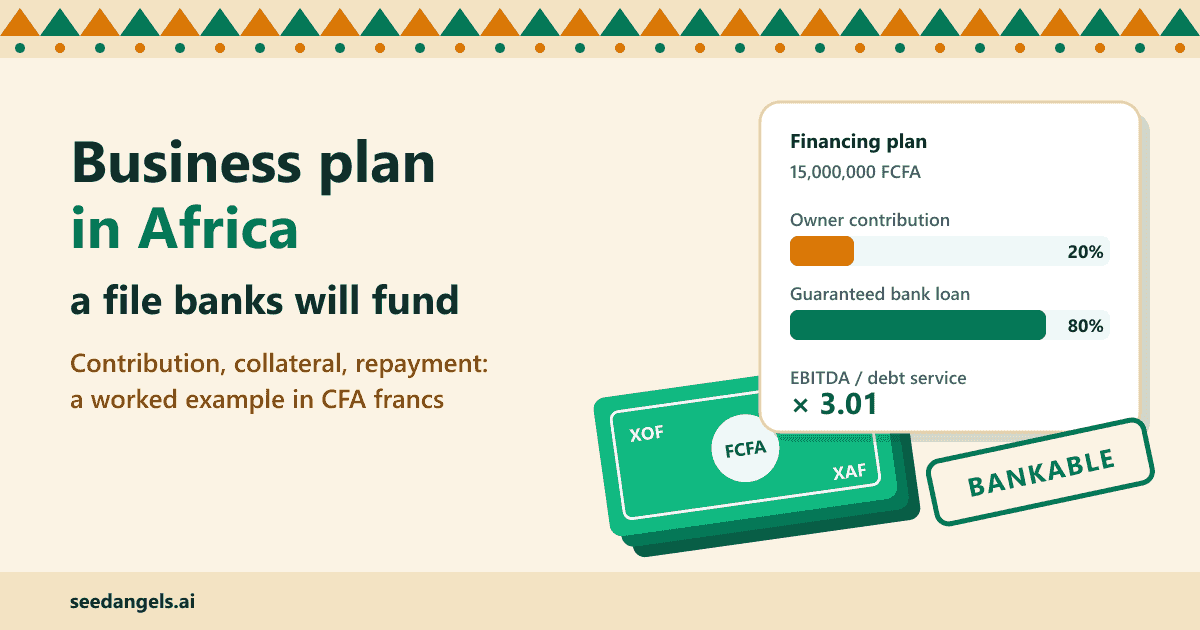
On the personal contribution, around 30% of the total need is common practice rather than a requirement. It reassures all the more when it covers the entry fee, which is no collateral for the bank. In France, a Bpifrance guarantee can also reduce the bank's risk: according to Bpifrance Création, for loans up to €200,000, the bank can use it for up to 60% of the amount without prior review by Bpifrance. The Création Standard guarantee explicitly covers starting a business as a franchise. Your bank applies for it: ask whether it plans to for your file.
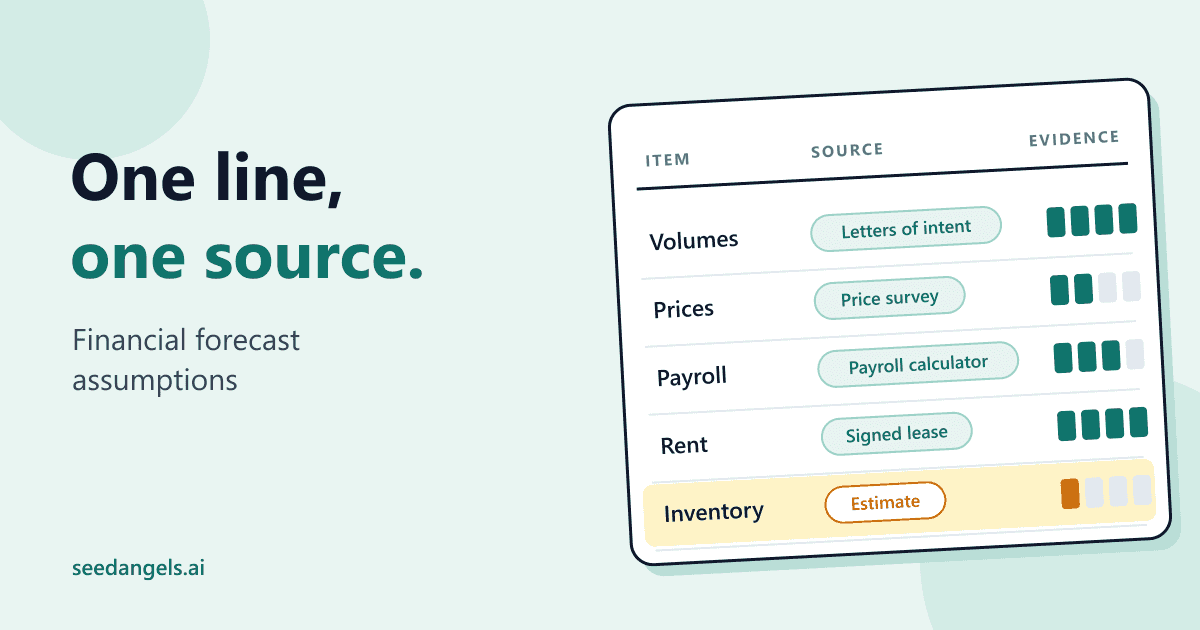
Finally, present your assumptions with their source, as in the case table. A banker who reads "revenue: median of three comparable franchisees, first year at 65%" does not need to take your word for it. For more on documenting each assumption, see our guide to financial forecast assumptions.
The 5 mistakes in a franchisee's projections
- Copying the model operating account. It describes an average outlet, often an old one. Use its cost structure, never its revenue as it stands.
- Using the revenue of the best outlets. The examples showcased when the network presents itself are rarely the most representative. Work with outlets comparable to yours, and with their first year.
- Treating royalties as fixed costs. You then underestimate how your costs grow with revenue, and your break-even point is wrong. A percentage royalty follows your sales.
- Forgetting VAT at opening. The entry fee, fit-out, equipment and signage are invoiced with VAT. In our case, €32,000 leaves the bank account before it is recovered: without planning for it, the first quarter ends in overdraft.
- Not keeping the origin of every figure you receive. A figure given orally proves nothing. Keep documents, emails and call notes, dated and attributed to their author: they are your only protection if the network's figures turn out to be misleading.
Build your franchisee projections with SeedAngels: enter your royalties as a proportional cost, see your break-even point and test your ramp-up. Try SeedAngels for free → And before you submit your file, have it reviewed by our free Business Plan analyzer.
Conclusion
In a franchise, financial projections are not built from scratch: they are a job of sorting and discounting. The franchisor gives you contractual commitments (entry fee, royalties, investments) that you use as they are, and indications (model account, market overview) that you must check and scale down. Your own work comes down to one decisive figure: your first-year revenue, built from comparable franchisees and your local analysis.
Put each flow on the right line, measure what royalties do to your break-even point, and document the source of every assumption. Projections built this way protect you twice: in front of the banker, who sees verifiable assumptions, and in front of the network, should its figures ever prove too optimistic.
FAQ
Does the franchisor have to provide financial projections?
No. In France, no rule requires the franchisor to hand over projected operating accounts: the franchisee builds them, ideally with an accountant. If the franchisor chooses to provide some, they must be honest and serious. That is why many networks only share historical data. In the United States, earnings claims are optional too and, when made, belong in Item 19 of the FDD.
What does the disclosure document contain, and is it enough to build projections?
The French disclosure document (DIP) presents the franchisor, its accounts for the last two financial years, the network and its franchisees, the market, and the investments and royalties to plan for. It must be delivered at least 20 days before signing. It gives you your contractual cost lines, but not your revenue: that still has to come from your own local analysis.
Is the franchise entry fee an expense or an asset?
Usually an intangible asset, amortized over the term of the contract: it pays for a lasting right to use the brand and the know-how. The portion that pays for services used up at opening, such as initial training or launch support, can instead be expensed when the contract prices it separately. Have your accountant confirm the treatment, because it changes your profit in the first years.
How do you include royalties in financial projections?
Operating and marketing royalties are most often a percentage of revenue. Put them in costs proportional to sales, next to purchases, not in fixed costs. They reduce your contribution margin and therefore raise your break-even point. The rates and any minimum amounts are the ones in your contract, not a market average.
Where can you find the real revenue of a network's franchisees?
In the list of franchisees that comes with the disclosure document: call several of them, starting with those who opened recently. Check the annual accounts they file, when they are published. Compare outlets close to yours in size, location and age, and look at their first year, not their cruising year.
What happens if the franchisor's figures were too optimistic?
In France, courts can annul the contract for vitiated consent if the franchisor supplied excessively optimistic projections. A gap with actual results is not enough on its own: it must not stem from your own management. If the contract is annulled, the entry fee and royalties are returned. So keep a written record of where every figure came from.