Many founders size their working capital with a formula found online, an annual average and payment terms they hope for. The lender looks at the month when cash hits its lowest point. The gap between the two runs to thousands of euros, sometimes tens of thousands, and it is what makes a profitable plan look fragile.
The problem is simple: a business that does not exist yet has no inventory, no receivables and no payables to measure. France's public business-creation agency, Bpifrance Création, says it plainly: the initial working capital requirement is "obviously impossible to calculate precisely" and has to be estimated empirically. This article gives you the most solid empirical method: a clear formula, sourced payment terms by sector, and the exact amount to fund. The running example is Atelier Lignes, a French custom shopfitting workshop that only sells to businesses: raw material inventory, jobs in progress, customers paying on terms, everything that makes working capital heavy. Figures are in euros, as in the original case.
Working capital, in one sentence
A new business's working capital requirement is the cash tied up in its operating cycle: inventory paid for but not yet sold, plus invoices issued but not yet collected, minus bills received but not yet paid. It is a permanent need, and it grows with revenue.
A timeline makes it visible. Atelier Lignes buys its material on day 0 and pays its supplier on day 30. The job runs, the invoice goes out, the customer pays 45 days later. Between paying the supplier and collecting from the customer, the business is advancing the money. That gap, multiplied by the volume of activity, is the working capital requirement.
A note on vocabulary. In English, "working capital" usually means current assets minus current liabilities, a balance-sheet figure. What a new business needs to fund is narrower: the operating working capital, which French practice calls the besoin en fonds de roulement. Both show up on the projected balance sheet, and at launch it is your funding plan that must provide the long-term money to cover it before the first customer pays.
Which formula? The sources disagree
Search for "working capital formula" and you will find three or four versions. Even Bpifrance Création gives two formulas on two different pages. This is not a mistake: each answers a different question. You still need to know which one to use.
Operating working capital
This is the formula on Bpifrance Création's working capital page:
Working capital requirement = inventory + trade receivables − trade payables
For a service business, the same page suggests: work in progress + trade receivables − customer deposits. A business like Atelier Lignes, which combines both, adds up all five items: inventory + work in progress + receivables − deposits − trade payables. This formula only keeps the trading cycle: what you buy, make and sell.
The full formula
Bpifrance Création's page on the cash flow plan of a new business gives a broader one:
Working capital requirement = inventory + receivables (trade and other) − trade, tax and payroll payables
It also subtracts VAT due to the tax authority and payroll contributions paid the following month. This is the balance-sheet view, close to the accounting definition of working capital: it describes all the short-term liabilities of a business that is already trading.
What it changes for Atelier Lignes
On the case detailed below, the gap is not trivial. The two tax and payroll amounts are illustrative assumptions: roughly one month of net VAT due and one month of payroll contributions paid in arrears.
| Formula | Calculation | Working capital |
|---|---|---|
| Operating | inventory + work in progress + receivables − deposits − payables | €38,200 |
| Full | €38,200 − €3,600 VAT due − €3,000 payroll contributions | €31,600 |
| Gap | €6,600, or 17% |
Using the full formula means asking for €6,600 less funding. The day those liabilities are not there, your overdraft pays.
Our recommendation
Size your funding with the operating formula. Three reasons. Tax and payroll liabilities are short, non-negotiable, and their amount depends on your VAT scheme and payroll calendar. At launch, VAT often works the other way: your startup investments create a VAT refund due to you, a receivable rather than a liability (we cover this in our guide to VAT in your cash flow forecast). And the operating formula is the prudent one, which is what lenders expect. Keep the full formula for reading your balance sheet once you are trading.
With or without VAT? With
Include VAT in trade receivables and trade payables, and value inventory without it. Your customer pays the invoice including VAT, and you pay your supplier including VAT: that is the amount that goes through your bank account, and that is what is tied up during the payment period. Bpifrance Création recommends amounts including VAT for receivables and payables. Inventory is valued at its purchase cost excluding VAT, since the VAT paid on materials is recovered.
Many templates calculate everything excluding VAT to save time. On Atelier Lignes, that shortcut gives €35,500 instead of €38,200: receivables drop from €37,800 to €31,500, payables from €14,400 to €12,000, deposits from €7,200 to €6,000. The shortcut understates the need by €2,700, and the gap widens with the share of your sales on credit terms. The same logic applies to the sales tax you charge on invoices: it sits in your receivables until customers pay. If you are not VAT-registered, the question does not arise: you neither charge nor recover VAT.
Finding your payment terms before you have customers
Bpifrance Création describes the approach: with no history, start from industry averages or from the assumptions of your income statement. You still need to know where those averages come from. In France at least, there is a free public source updated every year.
Real payment terms by sector
The Banque de France publishes the payment terms of French companies every year. The table below comes from its bulletin no. 266/5 (September–October 2026), 2025 data, excluding micro-enterprises.
French payment-term benchmarks by sector (Banque de France, 2025):
| Sector | Customer terms (days of revenue) | Supplier terms (days of purchases) | Trade balance (days of revenue) |
|---|---|---|---|
| All sectors | 41.5 | 49.2 | 12.0 |
| Manufacturing | 43.9 | 50.9 | 12.2 |
| Construction | 59.7 | 51.2 | 27.3 |
| Retail and wholesale | 24.0 | 41.9 | −8.0 |
| Transport and storage | 50.2 | 40.5 | 26.4 |
| Hotels and restaurants | 5.8 | 43.1 | −17.6 |
| Information and communication | 70.7 | 64.1 | 37.1 |
| Real estate | 30.5 | 62.3 | 5.7 |
| Consulting and business services | 64.1 | 55.9 | 40.0 |
Source: Banque de France, bulletin no. 266/5, 2025 data.
Three caveats before you use these numbers. They are averages for established companies, excluding micro-enterprises: those firms have a track record and bargaining power you do not have yet. The trade balance is not working capital: it leaves out inventory and work in progress, which you must add. And a new business rarely gets average supplier terms. These averages are almost stable from one year to the next: in 2025, customer terms stay at about 42 days of revenue and the trade balance at 12 days. For micro-enterprises, the Banque de France measures shorter terms: 25.6 days of revenue on the customer side and 32.5 days of purchases on the supplier side in 2025, across all sectors (32.6 and 31.4 days in construction). Outside France, these benchmarks are a reasonable order of magnitude for European B2B trade, not a substitute for local data.
The legal cap on payment terms
Statutory payment terms vary by country. In France, the default between businesses is 30 days after delivery, and an agreed term cannot exceed 60 days from the invoice date or 45 days end of month (Service Public Entreprendre). In the UK, payment is late 30 days after the invoice or delivery if no date was agreed, and an agreed date should usually be within 60 days for business transactions, although a longer period is allowed if it is fair to both sides.
Two consequences for your forecast. Do not assume supplier terms beyond what your local rules and your suppliers' terms allow. And expect business customers to pay close to the cap, or later: the Banque de France notes that more than half of large French companies pay their suppliers after 60 days. If you sell to large accounts, take a prudent assumption.
Split by sales channel
A sale paid on the spot, in a shop or by card, creates no receivable. Only the share invoiced on terms counts. Working capital therefore builds on a revenue forecast split by channel, not a single total: 50% of sales to businesses means half the receivables of 100%.
Three sources to check before you put numbers down
- Your future suppliers' quotes and terms of sale: they tell you which terms they really give a new customer, often none at first.
- Two or three interviews with target customers: "how many days do you take to pay your suppliers?" is a question most buyers answer readily.
- A local adviser or accountant who knows your sector: in France, the Banque de France has 102 SME correspondents, one per département, who advise business owners seeking finance free of charge.
Every payment term you choose is an assumption the lender will ask you to defend: write its source next to it, as with every other assumption in your financial forecast.
The calculation in days, step by step: Atelier Lignes
To calculate the working capital of a new business:
- Set annual revenue excluding and including VAT, by sales channel.
- Convert each item into days: inventory, work in progress, receivables, deposits, payables.
- Value each item: annual base × days / 360.
- Add the uses (inventory, work in progress, receivables), subtract the sources (deposits, payables).
- Express the total in days of revenue and compare it with your sector.
Atelier Lignes's first-year assumptions:
| Assumption | Value |
|---|---|
| Revenue | €360,000 excluding VAT, or €432,000 including VAT (20% VAT) |
| Material purchases | 40% of revenue: €144,000 excluding VAT, €172,800 including VAT |
| Material inventory | 30 days of purchases |
| Work in progress | 10 days of revenue (jobs started, not yet invoiced) |
| Customers | 30% deposit on order, received about 20 days before the invoice; 70% balance at 45 days |
| Suppliers | 30 days |
The calculation uses a 360-day year, the most common management convention:
| Item | Annual base | Days | Amount |
|---|---|---|---|
| Material inventory | €144,000 purchases excl. VAT | 30 days | + €12,000 |
| Work in progress | €360,000 revenue excl. VAT | 10 days | + €10,000 |
| Receivables (70% balance) | €432,000 revenue incl. VAT | 70% × 45 d = 31.5 days | + €37,800 |
| Customer deposits (30%) | €432,000 revenue incl. VAT | 30% × 20 d = 6 days | − €7,200 |
| Trade payables | €172,800 purchases incl. VAT | 30 days | − €14,400 |
| Standard working capital | €38,200 |
In days: working capital in days of revenue = working capital / annual revenue excl. VAT × 360, so 38,200 / 360,000 × 360 = about 38 days of revenue. The Banque de France's construction sector shows a trade balance of 27 days, without inventory or work in progress. Add those two items (€22,000, or 22 days) and the sector benchmark rises towards 49 days: Atelier Lignes stays below it thanks to its deposit. Without it, it would be at 62 days.
The effect of the deposit
Without a deposit, with 100% of revenue paid at 45 days, receivables rise to 432,000 × 45 / 360 = €54,000. Working capital climbs to €61,600 (12,000 + 10,000 + 54,000 − 14,400). The 30% deposit alone saves €23,400 of funding. For any business that works from quotes, no other decision weighs as much on working capital.
Opening inventory: one line, not two
If your opening inventory has its own line in the funding plan, do not count it again in working capital. It is a common mistake, covered in our worked example of sources and uses of funds: counting inventory twice inflates the need by the same amount.
The average trap: fund the tightest month
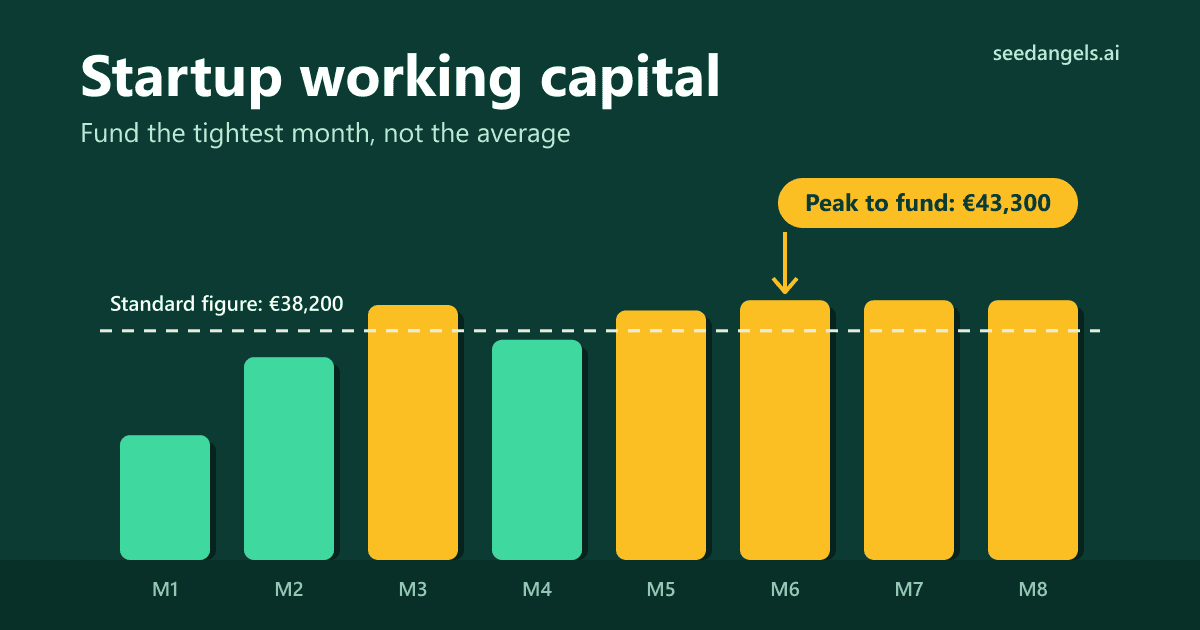
Standard working capital describes a business at cruising speed. A new business is not there yet. Its revenue climbs month after month, and its suppliers, who do not know it, ask for cash on delivery at first. Atelier Lignes starts at €15,000 excluding VAT, then €20,000, €25,000, €30,000, before levelling off at €34,000 a month. Its suppliers require cash payment until month 3, then give 30 days.
Here is working capital at the end of each month:
| Month | Revenue excl. VAT | Receivables | Inventory | Work in progress | Deposits | Payables | Working capital |
|---|---|---|---|---|---|---|---|
| M1 | €15,000 | €12,600 | €8,000 | €5,000 | − €4,800 | €0 | €20,800 |
| M2 | €20,000 | €23,100 | €10,000 | €6,700 | − €6,000 | €0 | €33,800 |
| M3 | €25,000 | €29,400 | €12,000 | €8,300 | − €7,200 | €0 | €42,500 |
| M4 | €30,000 | €35,700 | €13,600 | €10,000 | − €8,200 | − €14,400 | €36,700 |
| M5 | €34,000 | €41,200 | €13,600 | €11,300 | − €8,200 | − €16,300 | €41,600 |
| M6 onwards | €34,000 | €42,800 | €13,600 | €11,300 | − €8,200 | − €16,300 | €43,300 |
Receivables: 70% of the month's revenue including VAT, plus half of the previous month's balance (45 days). Inventory: 30 days of next month's purchases. Deposits: received 20 days before next month's invoice. Payables: the month's purchases, at 40% of that month's revenue. Amounts rounded to the nearest hundred, computed before rounding: a row may differ by €100 from the sum of its columns.
Three takeaways:
- By month 3, working capital already exceeds the standard figure (€42,500 against €38,200), even though revenue is still below the annual average. The reason: suppliers are not giving any credit yet.
- At cruising speed, it settles around €43,300. Working capital follows monthly revenue, not the annual average: at €34,000 a month, the business runs above its €30,000 average.
- The amount to fund is the cruising level, about €43,300, 13% more than the standard figure based on the annual average. A seasonal business follows the same logic: its working capital peaks just before the high season, when inventory is built and sales are not yet collected.
What the lender looks at
A lender does not read your average working capital; they look for the month when your account goes into the red. A profitable forecast can be turned down over your lowest cash month, and that month very often falls during the ramp-up, exactly where working capital climbs.
In SeedAngels, working capital is recalculated every month in the cash flow plan, from three terms you enter (days of inventory, customer days, supplier days) and your VAT rates on sales and purchases: trade receivables and payables are counted including VAT, inventory excluding VAT. The tool also subtracts the month's tax and payroll liabilities (net VAT due and contributions estimated at about 45% of salaries), so its figure follows the full formula and comes out lower than the operating calculation recommended here. When sizing your funding, add that gap to your safety margin. Every assumption you change flows through to the funding need, which you read off those cash flows. What the tool does not do: it applies one term per item across the whole forecast, with no deposits and no supplier moving from cash payment to 30 days mid-year. For the early-month peak, keep your own calculation, and your terms still come from your quotes, your terms of sale and your customer interviews. Details are on the financial forecasting software page.
Negative working capital: good news, with a catch
Negative working capital means you collect from customers before you pay suppliers: the operating cycle generates cash instead of absorbing it. Retailers and restaurants work this way, with trade balances of −8.0 and −17.6 days of revenue according to the Banque de France. It is an asset, as long as revenue does not fall.
The Banque de France notes that these two sectors are the only ones for which inter-company credit is a net source of financing. For a restaurant with €40,000 of monthly revenue, 17.6 days represent about €23,500 of cash "lent" by suppliers (40,000 × 12 / 360 × 17.6), excluding inventory and based on established businesses' terms.
Key point. That cash belongs to your suppliers. If revenue drops, it shrinks and your bank balance falls faster than your profit. Never fund a long-term investment with negative working capital, and do not count it as a source in your opening funding plan: it does not exist before your first sales and your first purchases on credit.
Reduce your working capital before you open
The usual advice (chase late payers, renegotiate with long-standing suppliers) is written for established businesses. A founder has an advantage: they can set the rules before the first customer. Five levers, quantified on Atelier Lignes where possible:
- A deposit on order. A 30% deposit saves €23,400 of working capital. It is the strongest lever for any business that works from quotes.
- Stage billing for long jobs. Invoicing by milestone reduces work in progress and brings collections forward.
- Customer terms written into your terms of sale. 30 days by default, never beyond the legal cap. Moving the balance from 45 to 30 days cuts receivables from €37,800 to €25,200, €12,600 less to fund.
- Negotiate supplier credit as early as you can. Every month paid in cash weighs directly on the peak: on Atelier Lignes, getting 30 days from month 2 instead of month 4 would bring month 3 working capital down from €42,500 to about €30,500.
- Only the inventory you need. Order per job rather than building safety stock: every day of inventory you cut is worth €400 (144,000 / 360).
Bpifrance Création sums up the rule: collect from customers as early as possible, and pay supplier invoices as late as possible.
Funding working capital: what lenders accept
Working capital is not a one-off cost: as long as the business trades, it stays tied up, and it grows with the business. That determines how to fund it.
The structural part, in your funding plan
The permanent part of working capital, the standard figure or better the peak, is funded by long-term resources: equity, honour loans, a medium-term bank loan. Bpifrance Création makes the point: in the opening funding plan, operating working capital is covered by long-term funds. In practice, it becomes one line of the uses, next to fixed assets and opening cash, in your sources and uses of funds. Presented as a calculation, in days and with sources, it reassures more than a round number, because banks prefer to fund long-term assets rather than day-to-day operations.
The peaks, with short-term finance
For Atelier Lignes, the €43,300 is a permanent level: fund all of it with long-term resources. An overdraft arranged before you open covers what the monthly calculation does not show: a large job paid late, a supplier slow to grant its 30 days. Once the first invoices are out, other tools become available: invoice discounting and factoring. In French practice these are all assignments of receivables, as the Banque de France's fact sheet 421 points out: discounting and the French Dailly assignment remain bank credit, while factoring, covered in its fact sheet 422, hands the management of your invoices over to a specialist firm. Ask your bank for terms: they vary too much between lenders and countries to generalise.
Guarantees
Public guarantees often make the loan easier to obtain. In France, Bpifrance Création lists several guarantees to request: the Bpifrance start-up guarantee, France Active guarantees, regional funds and mutual guarantee companies; most countries have an equivalent public scheme. An honour loan, interest-free and without a personal guarantee, strengthens your own contribution: it is often what unlocks the bank loan that will fund working capital.
Before the meeting, have an accountant or your support network review your payment-term assumptions: they are where the lender's questions will land.
SeedAngels recalculates your working capital month by month in the cash flow plan, from your payment terms and VAT rates. Try SeedAngels for free →
Conclusion
Your working capital is a number of days before it is an amount: days of inventory, of work in progress, of customer credit and of supplier credit. Calculate it with the operating formula, sourced payment terms and receivables and payables including VAT. Fund the tightest month, not the average: during the ramp-up, that is the month that decides whether your cash holds. And write your levers, deposits and payment terms, into your terms of sale before you open: that is when they cost the least to get.
FAQ
How do you calculate working capital for a business that has not started yet?
With no balance sheet, start from the timing: days of inventory, customer and supplier payment terms, deposits. Value each item as annual base × days / 360: purchases excluding VAT for inventory, revenue including VAT for receivables, purchases including VAT for payables. Add inventory and receivables, subtract payables and deposits, then check the result month by month while sales ramp up.
Which working capital formula should a business plan use?
To size your funding, use operating working capital: inventory + trade receivables (+ work in progress) − trade payables (− customer deposits). The accounting version also subtracts tax and payroll liabilities, which gives a lower figure. It is the right tool to read an existing balance sheet, but it is less prudent at launch, when VAT often creates a receivable rather than a liability.
Should working capital be calculated with or without VAT?
Include VAT in trade receivables and trade payables, and value inventory without it. Your customers pay you the VAT and you pay it to your suppliers: that is the amount that goes through your bank account. France's Bpifrance Création recommends this convention. With 20% VAT, a calculation without VAT understates receivables by about 17%. If you are not VAT-registered, the question does not arise.
Is negative working capital a good thing?
Yes, if the business is stable: you collect from customers before you pay suppliers, as retailers and restaurants do. But that cash belongs to your suppliers. If sales fall, it disappears fast. Never use it to fund a long-term investment, and do not count it as a funding source at launch.
What is a normal working capital level for my sector?
In France, the Banque de France publishes payment terms by sector every year. In 2025, the trade balance (receivables minus payables) ranged from −17.6 days of revenue in hotels and restaurants to +40.0 days in consulting and business services. Add your inventory: the trade balance leaves it out. Other countries publish similar data less systematically.
How do you fund working capital at launch?
The permanent part of working capital belongs in your sources and uses of funds and is covered by long-term resources: equity, honour loans in France (interest-free personal loans to founders), a medium-term bank loan, possibly backed by a public guarantee. Temporary peaks are covered by an overdraft arranged in advance, then by invoice discounting or factoring once the first invoices are out.
What is the difference between working capital and the working capital requirement?
In accounting, working capital usually means current assets minus current liabilities. The working capital requirement is narrower: the cash tied up in the operating cycle (inventory, receivables, payables). The long-term funding left after paying for fixed assets must cover it. Otherwise the gap ends up on the overdraft, which weakens cash and worries lenders.