Your banker will not redo your math: they will point at four or five lines of your forecast and ask "where does this number come from?" An assumption with no source gets crossed out. An assumption with a source gets discussed, and that is already half the way to a yes.
Every guide says your assumptions must be "realistic and documented". Almost none shows what that documentation looks like. This article gives it line by line: for every item in the forecast, the source to cite, how strong that evidence is, and the sentence to write in your plan. A complete case, a small coffee roastery, shows the sheet filled in, then how to spot the three assumptions that deserve the most effort. The worked example uses French rules and figures where a rule is national; swap in your own country's equivalents.
What an assumption is (and what it is not)
A financial forecast assumption is an input chosen by the founder (a price, a volume, a salary, a payment term, an interest rate) from which every financial statement is calculated. It is justified by a verifiable source: a quote, a contract, a statistic, a comparable business. A calculated result, such as net margin or cash balance, is not an assumption.
That distinction changes how you work. You do not justify $33,000 of operating profit: you justify the price, the volume, the purchase cost, the salaries and the rent that produce it. If every input holds, the result holds. If one input is weak, the lender will find it by working back through the calculation, and lenders always work back through the calculation.
The income statement, the cash flow statement and the balance sheet are just machines that turn your assumptions into numbers. We have covered the three projected financial statements and how to build scenarios from them; here we go one step upstream, to what feeds them.
The evidence ladder: from a signed quote to a hunch
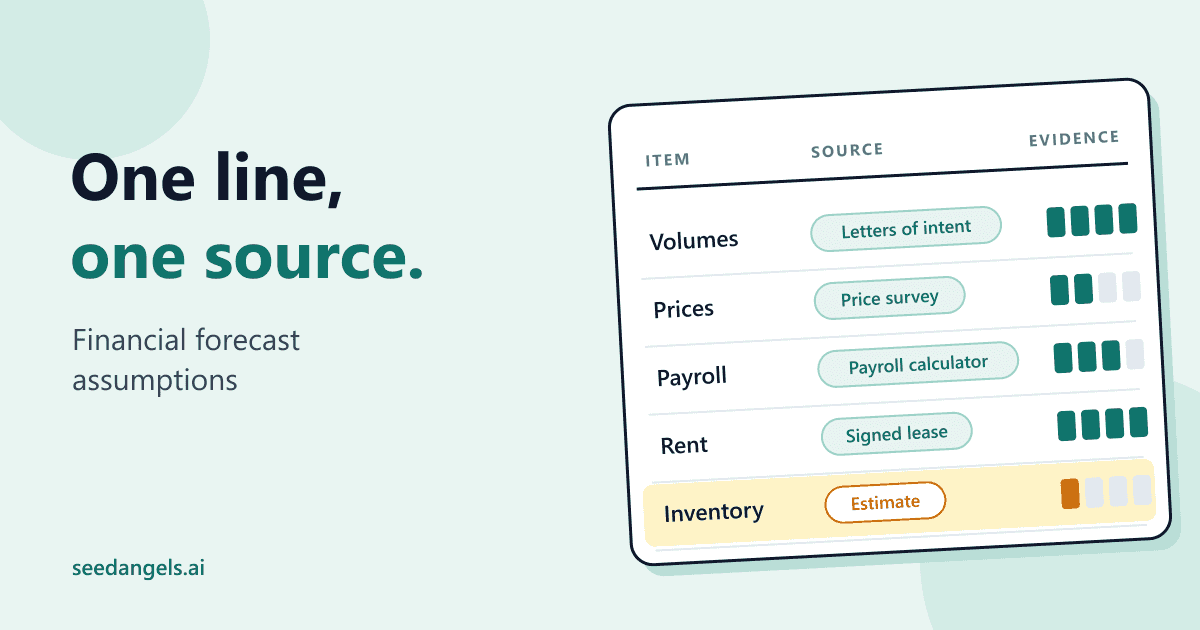
Not all sources are equal. Rank each assumption by the evidence behind it, from strongest to weakest:
- A written commitment from a third party. A quote, a lease or letter of intent for premises, a loan offer, a customer's letter of intent or pre-order. Someone other than you has committed to the number.
- An official figure or published rate. A pay scale, a payroll calculator, a tax rate, legal payment terms, accepted depreciation periods. The number does not depend on your optimism.
- A statistic or a comparable. Industry ratios from a statistics office or central bank, competitors' prices, the filed accounts of similar businesses. The number is real, but it describes other companies.
- A reasoned estimate. Interview feedback, a sales test, a count of passers-by outside the shop. The reasoning is yours: write all of it down.
The rule is simple: aim for the highest level available on the lines that weigh the most. Rent can stay at level 3 while you are still looking for premises; revenue deserves every effort to reach level 1 or 2.
Level 3 is often underused. In many countries, including the UK and France, small companies file accounts that anyone can read, and your competitors' filed accounts give benchmarks lenders recognise: revenue per employee, purchases as a share of sales, the margin of a real business in your town.
The assumptions sheet, line by line
The sheet has five columns: item, value used, source, evidence level and justification sentence. Here are the lines it must contain and the source to aim for on each:
| Item | What you need to set | Source to cite | Target level |
|---|---|---|---|
| Sales volumes | Number of customers and frequency, per channel | Pre-orders, letters of intent, interviews, counts | 1 to 4 |
| Prices | Price per product or plan, excluding tax | Price list, prices observed at competitors | 3 |
| Purchase cost and gross margin | Unit cost of what you resell or transform | Supplier quotes, checked against industry ratios | 1 |
| Salaries | Gross pay and hiring month for each role | Pay scale or market data, employer cost calculator | 2 |
| Founder pay | Net amount and starting month | Legal structure, payroll tax calculator | 2 |
| Rent | Monthly amount, deposit, indexation | Lease or letter of intent, comparable listings meanwhile | 1 or 3 |
| Other fixed costs | Insurance, accountant, bank, energy, software | Quotes, providers' published prices | 1 |
| Equipment | Cost of each asset, excluding reclaimable tax | Quotes | 1 |
| Depreciation | Period per asset | Useful life, confirmed by your accountant | 2 |
| Customer and supplier terms | Days, per type of customer and supplier | Legal limits, suppliers' terms and conditions | 2 or 1 |
| Inventory | Days of purchases held in stock | Suppliers' restocking terms | 1 to 4 |
| Sales tax, VAT, income tax | Applicable rates and filing regime | Official tax rules | 2 |
| Loan | Amount, term, rate | Central bank average rate, then the loan offer | 2, then 1 |
The sections below cover each line, with a model sentence to copy into your plan.
Revenue and gross margin
Revenue is not an assumption: it is the product of two assumptions, a volume and a price, set separately for each sales channel. Volume is the hardest line to prove, and we have a whole article on how to build a revenue forecast from demand, from capacity or from comparables. In the sheet, record only the method used and the evidence behind it.
For gross margin, work from the bottom up: the unit cost of what you buy, taken from a supplier quote, compared with your selling price. Industry ratios are then a cross-check. In France, for example, INSEE, the national statistics office, publishes yearly ratios for market sectors: in 2023 the value added rate was 15.7% in retail and wholesale trade and 41.5% in hotels and restaurants, against 28.3% across all sectors. The Banque de France also publishes sector booklets of about thirty economic and financial ratios for 17 sectors. Mind the vocabulary: INSEE's "margin rate" divides operating profit by value added, it is not your gross margin. These are averages of whole sectors, built to flag a huge gap, not to set your target.
Model sentence: "Average selling price of $9.50 before tax, based on prices observed at five nearby competitors (survey dated October 12); purchase cost of $2.85 from our supplier's quote, i.e. 30% of the price."
Payroll
For each role, two inputs: gross pay and hiring month. Gross pay comes from the applicable pay scale or collective agreement where one exists, otherwise from salary surveys for your area. The employer cost then comes from an official calculator: in France, the Urssaf employer contributions simulator estimates, as Bpifrance Création puts it, the total cost of the pay to budget for a new hire. Tie each hire to a volume of activity: a second shop assistant is justified by customers per hour, not by a round date.
Your own pay is a separate line, and often the worst-set line in the forecast: its cost depends on your legal structure, and its start date on your cash. We explain how to budget founder pay in a forecast and from which month to plan it.
Model sentence: "Full-time sales assistant hired in month 4, gross pay at the level II minimum of the applicable pay scale, employer cost calculated with the official simulator on November 2, 2026."
Fixed operating costs
Rent, insurance, accounting fees, bank fees, subscriptions and software, energy, marketing: each line is proven by a quote or a published price, that is at level 1, without much effort. Rent comes from the lease or letter of intent; until you have premises, note three comparable listings and use the most expensive.
The real risk is forgetting a line. In an interview with Bpifrance Création, France's public business-creation agency, the expert lists rent, marketing, insurance, energy, bank fees, working capital and payroll taxes among the costs founders forget or underestimate, and adds that they often overlook timing gaps in cash flow. The SBA's guide to calculating startup costs makes the same point: before the doors open, you already have bills to pay. Go through the list line by line before closing the sheet.
Model sentence: "Business insurance: $1,180 a year, insurer's quote dated October 20, 2026, attached as appendix 4."
Equipment and depreciation
The cost of each asset comes from a quote, excluding any VAT you will reclaim. Equipment priced at "around $30,000" has no place in a loan application.
The depreciation period is not a free choice either: it follows the asset's normal useful life under your country's rules. In France, the BOFiP, the tax authority's official guidance, sets the straight-line rate at 100 divided by the number of years of normal use, and notes that 10 to 20 years is generally accepted for building fixtures and fit-outs. For other assets, do not invent a period: have your accountant confirm each line. The point is not tax, it is consistency: the lender compares the loan's term with the life of the asset it pays for.
Model sentence: "15 kg coffee roaster: $35,000, manufacturer's quote; depreciated over 7 years, its normal useful life as confirmed by our accountant."
Payment terms and inventory
Payment terms are set in days, per type of customer. Check your country's legal limits for business-to-business terms. In France, as Bpifrance Création summarises, agreed terms cannot exceed 60 days from the invoice date or 45 days end of month, and without an agreement the default is 30 days after delivery. Use your industry's usual terms within those limits, and split them when customers pay differently: in its working capital guide, Bpifrance assumes 40% of customers pay at 30 days and 60% at 60 days.
Inventory is set the same way, in days of purchases, from your suppliers' restocking cycle. These three numbers make up your working capital requirement, calculated on receivables and payables including sales tax or VAT; we walk through how to calculate working capital for a new business step by step.
Model sentence: "Trade customers: paid at 45 days from invoice, the usual term reported by three restaurant owners we interviewed, below the 60-day legal limit."
Sales tax, VAT and income tax
Two rate-based lines, at level 2. For sales tax or VAT, record the rate on each type of sale and your filing regime: VAT never appears in the income statement, but it weighs on cash, especially at launch, when the VAT on equipment is paid out before it is reclaimed. We explain how VAT on startup costs hits your first months of cash.
For income tax, use your jurisdiction's published rates. Our example uses French small-company rates: according to Bpifrance Création, 15% applies up to €42,500 of profit for companies with revenue under €10 million whose fully paid-up capital is at least 75% held by individuals, and 25% above that. Check the rates in force in the year you apply. In autumn 2026, an amendment to France's 2027 budget bill proposed raising this threshold to €49,000; nothing had been passed yet.
Model sentence: "Corporate income tax: 15% up to €42,500 of profit, 25% above; the reduced-rate conditions are met (capital 100% held by the founder)."
Financing
Three inputs: amount, term and rate. The amount comes from your sources and uses statement, the term from the life of the assets financed. For the rate, start from a public statistic until you have an offer. In France, the Banque de France publishes the average cost of new bank loans to businesses every month: 3.66% in August 2026 (and 3.71% for new financing to small and medium-sized companies). Add a safety margin, state the date of the figure, and replace the average with the rate in the loan offer as soon as you have one: the line then moves from level 2 to level 1.
Model sentence: "Loan of $70,000 over 7 years at 4.5%, i.e. the average cost of new business loans in France (Banque de France, August 2026) plus 0.84 points for prudence; use your own central bank's figure, pending the bank's offer."
The worked case: a coffee roastery's assumptions sheet
Let's return to Maison Grain, the small-batch coffee roastery whose startup costs we built up to $120,000. It roasts on site, sells in its shop and supplies cafés, restaurants and offices; it plans $240,000 of revenue in year 1, with the founder and one employee. The amounts below are those of that article; the split of operating expenses between rent and other items, and the sources, are illustrative.
| Item | Value used | Source | Level |
|---|---|---|---|
| Shop sales | $120,000 in year 1 | Count of passers-by outside the premises, competitors' average ticket | 4 |
| Trade sales | $120,000 in year 1 | Interviews with eight restaurant owners, nothing in writing | 4 |
| Purchases (green coffee, packaging) | 30% of revenue, i.e. $72,000 | Importer's price per kilo, packaging supplier's price list | 1 |
| Payroll | $90,000 (founder and one employee) | Pay scale, employer cost calculator | 2 |
| Rent | $1,500 per month | Letter of intent from the landlord | 1 |
| Other operating expenses | $24,000 a year | Insurance and accountant quotes, energy supplier's estimate | 1 and 3 |
| Equipment and build-out | $75,000 | Four quotes (roaster, build-out, counter, IT) | 1 |
| Depreciation periods | 3 to 10 years depending on the asset | Normal useful life, confirmed by the accountant | 2 |
| Payment terms | Shop paid on the spot, trade net 45, suppliers net 30 | Legal limits, the importer's terms | 2 |
| Average inventory | 40 days of purchases | Estimate, no restocking schedule yet | 4 |
| Bank loan | $70,000 over 7 years at 4.5% | Central bank average loan rate, plus a margin | 2 |
| Income tax | 15% up to €42,500, 25% above (French rates) | Official rates | 2 |
The table says something uncomfortable: the two lines that carry all the revenue sit at the weakest level, while rent and equipment, which weigh far less, are proven in writing. That is the profile of most new businesses: you easily get quotes for what you buy, never for what you will sell.
Three actions lift the weak lines before the bank meeting. For trade sales, asking three of the eight restaurant owners for a letter of intent with an indicative monthly volume moves the line to level 1. For the shop, a month at a market stall or a pop-up measures a real average ticket and a real visit frequency. For inventory, a written restocking schedule from the importer replaces the estimate.
Which assumptions to test first: sensitivity
You will not have time to prove everything to the same standard. To decide where to spend the effort, move one assumption at a time by 10% in the wrong direction and see what happens to the result. On Maison Grain's year 1, with operating profit (EBITDA) of $33,000 and annual debt service of $11,676:
| Assumption worsened by 10% | Effect on EBITDA | Year 1 EBITDA | EBITDA / debt service |
|---|---|---|---|
| None (base forecast) | – | $33,000 | 2.83 |
| Prices −10% | −$24,000 | $9,000 | 0.77 |
| Volumes sold −10% | −$16,800 | $16,200 | 1.39 |
| Payroll +10% | −$9,000 | $24,000 | 2.06 |
| Coffee purchase cost +10% | −$7,200 | $25,800 | 2.21 |
| Rent +10% | −$1,800 | $31,200 | 2.67 |
Price comes first: a 10% cut wipes out nearly three quarters of EBITDA, because purchases do not fall with it, and EBITDA no longer covers the loan payments. Volume comes next: a 10% drop also lowers purchases, so the effect is smaller but still heavy. Rent, which founders negotiate for weeks, barely registers. The practical conclusion: the three lines that deserve your best evidence are price, volume and payroll. They are also the ones a lender attacks first, before pushing the test further with the ratios lenders run on your forecast and a full downside scenario.
Rerun this test with every new version of the forecast. In SeedAngels' financial forecasting, products, prices, volumes and costs are pre-filled from your Lean Canvas, every line of the financial statements shows the formula behind it, and a sensitivity table shows the effect of a mis-estimated price or volume. Revenue starts from the prices and volumes you enter and approve. The tool does not replace your quotes, your lease or your customer interviews: finding the source for each assumption, and attaching it to your plan, is still up to you.
Presenting assumptions in your plan
A sheet nobody reads is useless. Three places, depending on the reader:
- An assumptions appendix in the business plan, with the full five-column sheet. This is what the banker or loan analyst opens when a number surprises them. The SBA expects financial projections to back up any funding request and to convince the reader the business will be stable; the appendix is what makes them checkable.
- A note of three or four lines above each financial table, recalling that table's main assumptions: volumes and prices above the income statement, payment terms above the cash flow forecast.
- A short version for investors: keep only three to five assumptions on the financials slide, the most sensitive ones, and put the full sheet in the data room.
In all three, apply the same rules:
- round numbers when precision would be fake ("about 2,000 customers" rather than "2,037");
- a date on every public figure and every quote;
- quotes, lease and letters of intent attached, numbered and referenced in the sheet;
- the evidence level shown honestly: a lender forgives an estimate presented as one, not an estimate dressed up as a certainty.
After launch: when an assumption turns out wrong
Keep the sheet after the loan is approved: it becomes your management tool. A management dashboard, as Bpifrance Création describes it, compares forecasts with actual results so that gaps show up quickly. The sheet tells you where each forecast number came from, so where to look when actuals drift away from it.
When a line drifts, correct the source and not just the number. If restaurant owners pay at 60 days instead of 45, the new source is the term you actually see on your first invoices; update it, recalculate cash for the following months, and warn your lender if the gap threatens a repayment. A gap flagged early can be managed; a gap the bank discovers on its own costs you trust.
Conclusion
A forecast is only as good as its assumptions, and an assumption is only as good as its source. The method fits in one rule: one line, one source, one evidence level, one sentence. Start with the blank sheet, fill in everything that can be proven in writing, then spend the time left on the three lines that move the result, nearly always price, volume and payroll. You, not your spreadsheet, will defend these numbers in the meeting: every source you find is a question you will be able to answer.
To build a forecast where every line shows the formula behind it, SeedAngels links your prices, volumes and costs to the three financial statements and to your business plan. Try SeedAngels for free → And if your plan is already written, the Business Plan Analyzer gives it a critical review.
FAQ
What are the main assumptions in a financial forecast?
Sales volumes and prices, the cost of what you buy, headcount and its cost, fixed costs (rent, insurance, accounting fees), equipment and how long you depreciate it, customer and supplier payment terms, inventory levels, sales tax or VAT, income tax and the terms of any loan. Everything else in the forecast, from operating profit to cash, is calculated from these inputs.
How do you justify an assumption to a lender?
With the strongest evidence you can get: a quote, a lease or a loan offer beats an industry average, which beats an estimate. For each line, write down the source and one sentence of explanation, and attach the quotes as appendices. Put most of your effort into the lines that weigh the most: volumes, prices and payroll.
Where can I find free industry benchmarks?
National statistics offices and central banks publish them. In France, for example, INSEE releases yearly ratios by broad sector (value added rate, margin rate) and the Banque de France sector booklets of about thirty ratios. They describe existing companies: use them as a sanity check on your numbers, not as a target for your first year.
How do you estimate costs before you have started?
Get a quote for every item (premises, insurance, accountant, equipment, software), start from the applicable pay scale and an employer cost calculator for salaries, and compare the total with the filed accounts of similar-sized competitors. Founders often forget bank fees, energy, marketing and the timing gap between paying suppliers and getting paid.
Should assumptions go in the business plan?
Yes. An assumptions appendix, or a short note above each financial table, lets the reader follow your reasoning without opening the spreadsheet. Give each line its value, its source and a date. In a pitch deck, keep only the three to five most sensitive ones.
What loan interest rate should I use in a forecast?
Until you have an offer, start from the average rate on new business loans published by your central bank (3.66% in France in August 2026, per the Banque de France), add a safety margin and state the date of the figure. As soon as you receive a loan proposal, replace the average with the actual rate.
What should I do when an assumption turns out to be wrong?
Compare actuals with the forecast every month, find the line that is drifting, then correct the source of the assumption (the price you actually charge, the payment term you actually see) rather than just the number. Then update the cash forecast for the following months and warn your lender early if the gap threatens a repayment.