The £16,400 hole nobody planned for
Your forecast is profitable, your sources and uses of funds balance to the penny, and yet your bank account is close to empty in month two, before you've even opened. It isn't a calculation error or a forgotten expense. It's the VAT you paid on the build-out and the equipment. You paid it to your suppliers, the tax authority will give it back, but not right away.
The income statement doesn't show it, and neither does your funding plan, since both are built net of VAT. Only a monthly cash flow forecast, built gross, reveals the dip. And that's the table your lender opens first.
This article shows where VAT goes in each part of your forecast, how to find the month where it weighs most, and how to fund that dip. It works through a month-by-month example, using UK rules as the reference, with a note for US founders on sales tax.
Why VAT isn't in your income statement, but is all over your cash flow
VAT doesn't appear in a forecast income statement, which is built net of VAT, because it is neither revenue nor a cost for a VAT-registered business. It appears in the cash flow forecast, built gross, in the month it is paid or collected, and on the balance sheet as an amount owed to or by the tax authority.
A VAT-registered business only collects VAT on its sales on the government's behalf and reclaims the VAT on its purchases. The balance is settled with each VAT return. Your profit doesn't change by a cent, but your bank account sees every pound of VAT go through, with a lag.
Here is how VAT splits across the three statements of a financial forecast and your funding plan:
| Part of the forecast | Net or gross | What VAT represents there |
|---|---|---|
| Income statement | Net | Nothing: it isn't there |
| Cash flow forecast | Gross | Monthly flows, plus a "VAT paid / refunded" line |
| Balance sheet | Net + balances | VAT owed to you as an asset, or VAT to pay as a liability |
| Sources and uses of funds | Net | A temporary cash need, to cover until the refund arrives |
The last line is the one founders miss. Your funding plan lists equipment net of VAT, which is correct, but the VAT on that equipment still leaves your account. It has to be funded, even though it comes back.
The startup VAT credit: where it comes from
A VAT credit arises when the VAT you pay on purchases and equipment in a period exceeds the VAT you charge on your sales. For a new business it is almost automatic: the build-out and equipment are paid for months before the first sale.
Spending before selling
A new business spends first: fit-out works, machines, furniture, IT, branding. Every invoice carries VAT, usually at the standard rate. Meanwhile, no sales generate any output VAT.
The result is mechanical. On your first return, the VAT you reclaim far exceeds the VAT you owe, which is zero. The difference is money the tax authority owes you. The heavier your startup spending, the bigger that amount, and the harder it hits your first months of cash.
The worst case: zero-rated or reduced-rate sales, standard-rated costs
In most businesses, the credit clears quickly once sales start: the VAT you charge exceeds the VAT on your running costs, and the surplus offsets the startup credit within a few months.
That stops being true when you sell at a low rate and spend at the standard rate. In the UK, most food is zero-rated, and HMRC's guidance states that zero-rating "extends to coffee beans". A coffee roaster selling beans charges no VAT on those sales, yet pays 20% on its fit-out and equipment. With no output VAT to offset it, the credit never clears on its own: the business depends entirely on refunds.
Does this apply to you?
- Not VAT-registered: no. You can't reclaim VAT, so it's simply part of what you pay.
- Zero-rated or reduced-rate sales (most food in the UK, food and restaurant meals at reduced rates in many other VAT countries) and heavy startup spending: very much. That's the example below.
- Standard-rated services with little equipment: barely. The startup credit clears within a few months.
How often you file decides when the cash comes back
UK rules: quarterly by default, monthly on request
Three rules from GOV.UK set the calendar:
- Returns are quarterly by default. You "usually need to send a VAT Return to HMRC every 3 months", and the deadline is "usually one calendar month and 7 days after the end of an accounting period", according to GOV.UK.
- Refunds take about a month after the return. HMRC says "repayments are usually made within 30 days" of receiving your VAT Return, and longer if it checks the return.
- You can switch to monthly periods. The VAT Guide (Notice 700) states that you "can ask for monthly tax periods if you normally expect to receive repayments", at the cost of filing 12 returns a year instead of 4.
Put together: with quarterly returns, VAT paid in the first month of a quarter can be out of your account for three to four months. With monthly returns, it's closer to two. For a business that is permanently owed VAT, monthly periods are the obvious choice. Check with your accountant before you register.
Not VAT-registered? Forecast gross
In the UK, registration is compulsory once taxable turnover over the last 12 months passes £90,000, according to GOV.UK, and voluntary below it. If you stay unregistered, VAT on your equipment is a permanent cost: put every purchase into your forecast at its VAT-inclusive price, and there's no credit to plan for. If you expect heavy startup spending, ask your accountant whether registering voluntarily makes sense.
US founders: sales tax works differently. Sales tax paid on equipment is generally part of its cost, as IRS Publication 551 explains: include it in your startup costs directly. There's no VAT-style credit to forecast, only a higher upfront spend.
Worked example: Maison Grain's VAT, month by month
Let's take the roastery from our sources and uses of funds example: Maison Grain, a small-batch coffee roaster that opens after a three-month build-out. We place it in the UK and keep the same figures, now in pounds. Its equipment and setup costs total £82,000 net of VAT, which means up to £16,400 of VAT to pay upfront. It plans £240,000 of first-year sales, half in its shop and half to cafés and restaurants, and keeps a £16,500 cash reserve in its funding plan.
The question is simple: how much of that £16,500 is left once the VAT is paid?
The VAT assumptions
| Assumption | Value used |
|---|---|
| Equipment and setup costs (20%) | £50,000 net in month 1, £32,000 net in month 2 |
| Opening stock of green coffee (zero-rated) | £8,000 in month 3 |
| Opening | Month 4 |
| Coffee bean sales (zero-rated) | £12,000, £16,000 then £20,000 in months 4, 5 and 6 |
| Running costs at 20%, rent included (landlord has opted to tax) | £3,500 net per month from opening |
| Payroll | Outside the scope of VAT |
| Refund timing | Paid about one month after the return is filed |
One simplification: hot drinks served at the counter follow different VAT rules and are left aside. The refund timing is a working assumption based on HMRC's usual 30 days: a first repayment claim may be checked, which takes longer. It's exactly the kind of figure you should be able to justify in your forecast assumptions, because it decides your lowest month.
Scenario A: monthly returns
VAT paid in month 1 goes on the return filed in month 2, and the refund arrives in month 3. The same logic applies every month. Here is the VAT line:
| Amounts in £ | M1 | M2 | M3 | M4 | M5 | M6 |
|---|---|---|---|---|---|---|
| VAT paid on purchases (input VAT) | 10,000 | 6,400 | 0 | 700 | 700 | 700 |
| VAT charged on sales (output VAT) | 0 | 0 | 0 | 0 | 0 | 0 |
| VAT owed to you for the month | 10,000 | 6,400 | 0 | 700 | 700 | 700 |
| Refund received | — | — | 10,000 | 6,400 | — | 700 |
| VAT tied up at month end | 10,000 | 16,400 | 6,400 | 700 | 1,400 | 1,400 |
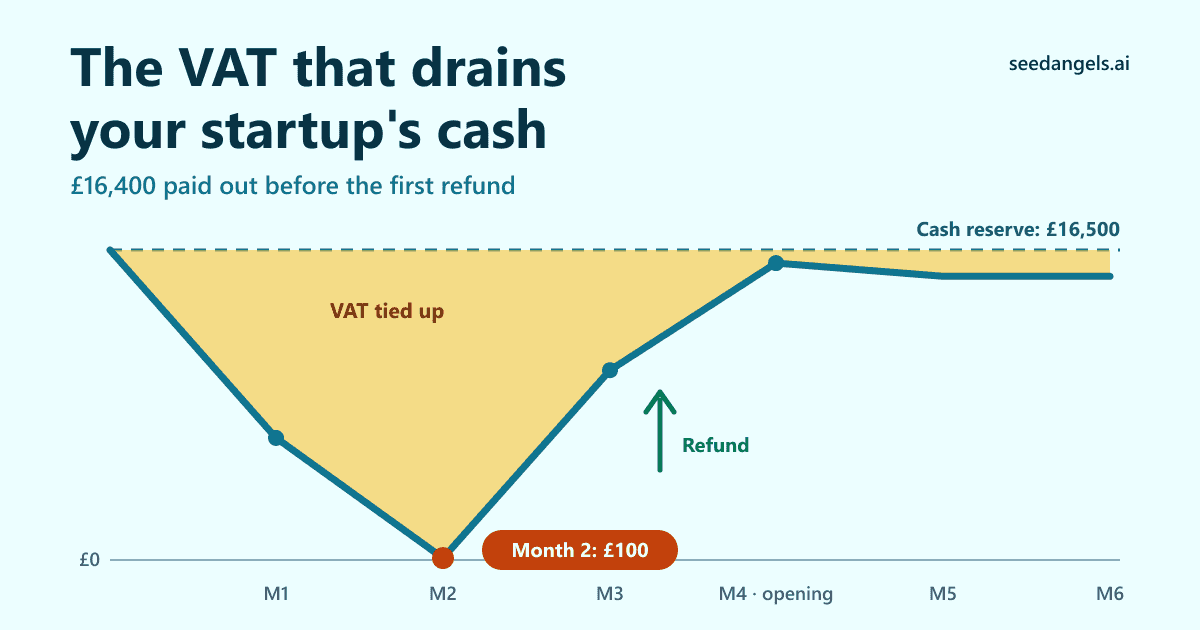
| Cash reserve left (out of £16,500) | 6,500 | 100 | 10,100 | 15,800 | 15,100 | 15,100 |
The low point falls in month 2: £16,400 of VAT paid out and not yet refunded, nearly the whole cash reserve. £100 is left, two months before opening, just when that reserve was meant to fund the ramp-up.
After opening, Maison Grain is in a permanent repayment position: about £700 a month of VAT on running costs, and nothing charged on its sales. That's normal for a zero-rated business, and it's why it should file monthly.
Scenario B: quarterly returns
Now the same business on the default quarterly cycle. The return for months 1 to 3 is filed in month 4, and the refund arrives in month 5.
| Amounts in £ | M1 | M2 | M3 | M4 | M5 | M6 |
|---|---|---|---|---|---|---|
| VAT tied up at month end | 10,000 | 16,400 | 16,400 | 17,100 | 1,400 | 2,100 |
| Cash reserve left (out of £16,500) | 6,500 | 100 | 100 | −600 | 15,100 | 14,400 |
The reserve stays almost empty for three months in a row, and goes negative in the month the shop opens. The £16,400 stays with HMRC until month 5, and the next quarter's credit starts building straight away.
Compare a business selling at the standard rate. On £20,000 of monthly sales it would charge £4,000 of VAT against about £1,900 of input VAT, and the startup credit would clear by offset in about 8 months even without a refund. With zero-rated sales, there's no offset at all: the refund timetable is your cash flow.
The two scenarios side by side
| Indicator | A: monthly returns | B: quarterly returns |
|---|---|---|
| VAT tied up at the low point | £16,400 (month 2) | £17,100 (month 4) |
| Months with the reserve below £1,000 | 1 | 3 |
| Lowest cash reserve left (out of £16,500) | £100 | −£600, in the month of opening |
VAT doesn't change Maison Grain's profitability. It only decides whether its £16,500 reserve still exists on the day it's needed.
Building the VAT line of your cash flow forecast in 5 steps
- Enter customer receipts gross in the month customers actually pay, not the month you invoice.
- Enter payments gross (suppliers, running costs, equipment) in the month you pay them.
- Work out each period's output VAT minus input VAT: that's the balance of your VAT return.
- Put any VAT to pay in the month the return is due, not in the month of the sale.
- Put any refund in as a receipt, with a cautious delay of about a month after the return, more for a first claim.
Invoice or payment: when VAT becomes due
Step 3 hides a trap: the output VAT on your return isn't always VAT you've been paid. Under standard UK accounting, the VAT you pay HMRC is the difference between your sales invoices and purchase invoices, and you report it "even if the invoices have not been paid", as GOV.UK explains. A business that sells to trade customers on 45-day terms can pay VAT on invoices its customers haven't settled yet.
The Cash Accounting Scheme reverses this for eligible businesses, with VAT taxable turnover of £1.35 million or less: you pay VAT on sales when your customers pay you, and reclaim VAT on purchases when you've paid your supplier. Note the flip side for a startup: under that scheme, you only reclaim VAT on equipment once the supplier is paid, never before.
Where VAT meets working capital
Once you're trading, VAT doesn't leave your cash flow. In your working capital requirement, receivables count gross. VAT payable only enters the full working capital formula, which you shouldn't use to size your funding. The startup credit is a one-off need; VAT in the operating cycle comes back every period.
Financing the VAT dip: cash reserve or bridge loan
Work out the need. The amount to fund is the peak of VAT paid out and not yet refunded, read off your monthly cash flow forecast. For Maison Grain, it's £16,400 with monthly returns and £17,100 with quarterly ones. That number appears in no annual total.
In SeedAngels, VAT is set in the forecast settings: two rates, both 20% by default: a "tax on sales" rate, which you set to 0% for zero-rated sales like Maison Grain's, and a single "tax on costs" rate, which you set to the weighted average of your purchases and running costs. The tool then books customer receivables and supplier payables gross, records the month's net VAT among the balance sheet's tax liabilities, and carries the effect into your month-by-month cash flow through working capital. VAT paid on equipment, and therefore the startup VAT credit and its refund, are not modelled: the dip calculated above is yours to cover, with one of the two options below.
Option 1: build it into your cash reserve. The simplest route: your funding plan includes a reserve large enough to absorb the VAT paid out and the ramp-up. For Maison Grain, £16,500 only covers the VAT. A reserve sized on the lowest month, VAT included, would be noticeably higher.
Option 2: a VAT bridge loan. Some banks offer short-term financing for the VAT on equipment, repaid when the refund comes in. It saves you from tying up equity in money that will come back. Ask for it alongside your equipment loan, with the refund timetable taken from your cash flow forecast.
What your lender checks about VAT in your forecast
A credit analyst won't check your VAT rate. They'll check that your forecast accounts for VAT, with three tests:
- Net and gross are consistent: revenue net of VAT in the income statement, receipts gross in the cash flow, and a gap that matches the rate you state.
- There's a monthly VAT line: without it, your cash flow forecast is wrong from the first month of the build-out.
- The lowest month is funded, VAT included: it's the number that decides, and we cover your lowest cash month among the ratios lenders run on your forecast.
A forecast shown in annual totals hides the VAT dip completely. An experienced lender knows it and will ask for the monthly detail.
The 6 most common VAT mistakes in a forecast
- Entering revenue gross in the income statement. Revenue, margin and profit are all inflated by the VAT. Fix: the income statement is always net.
- Leaving the VAT on equipment out of the cash need. The funding plan is net, but the VAT leaves your account. Fix: calculate it and fund it.
- Assuming an instant refund. The claim goes on the next return, then gets processed. Fix: allow about a month after the return, more for a first claim.
- Counting on offset when your sales are zero-rated or reduced-rate. There's little or no output VAT to absorb the credit. Fix: plan on refunds, and ask for monthly periods.
- Forecasting net when you aren't VAT-registered. VAT is then a real cost. Fix: put everything in gross.
- Paying VAT in the month of the sale. It's paid with the return, after the period ends. Fix: shift the VAT line to the return's due date, and check whether you account on invoices or on payments.
Conclusion
VAT doesn't change a pound of your profit, but it decides your lowest month. For a business that spends before it sells, it can swallow the entire cash reserve two months before opening, and for longer still if your sales are zero-rated and you file quarterly.
Before you send your plan, check three things: your cash flow forecast has a monthly VAT line, your filing frequency suits a business that will be owed VAT, and the VAT dip is funded, by the reserve or by a bridge loan. To build the monthly forecast that shows that dip, use SeedAngels. Try SeedAngels for free →
FAQ
Does VAT belong in a forecast income statement?
No. The income statement is built net of VAT: the VAT you charge doesn't add to your revenue, and the VAT you pay isn't a cost, because a VAT-registered business passes it on or reclaims it. VAT shows up in the cash flow forecast instead, gross, and on the balance sheet as an amount owed to or by the tax authority. If you aren't VAT-registered, the VAT you pay is a real cost.
Should a cash flow forecast be net or gross of VAT?
Gross. Cash moves with VAT included, so every receipt and payment goes in at its VAT-inclusive amount, in the month it actually happens. You then add one line for VAT paid to, or refunded by, the tax authority in the month of the return. It's the only way to see the dip that VAT on startup equipment creates before it comes back.
Why do startups usually start with a VAT credit?
Because spending comes before sales. The build-out, equipment and setup costs carry VAT, often at the standard rate, while you haven't invoiced anything yet. The difference is money the tax authority owes you. It lasts longer when your sales carry a reduced or zero rate, as food does in many VAT countries, because there is little output VAT to offset it.
How long does a VAT repayment take?
In the UK, HMRC says repayments are usually made within 30 days of receiving your VAT Return, and longer if it checks the return. Add the time until the return itself: with quarterly returns, VAT paid in the first month of a quarter can stay out of your account for three to four months. Build that delay into your cash flow forecast.
Can a startup file monthly VAT returns to get refunds faster?
In the UK, yes: HMRC's VAT Guide says you can ask for monthly tax periods if you normally expect to receive repayments, at the cost of filing 12 returns a year instead of 4. For a business with zero-rated sales and standard-rated costs, which is in a permanent repayment position, it shortens the time cash is tied up with HMRC.
Does sales tax work the same way in the US?
No. Sales tax paid on equipment is generally part of its cost, so it goes straight into your startup costs, at its full amount. There's no VAT-style credit or refund to plan for: your forecast simply carries a higher upfront spend. Check the rules of your state with your accountant, since sales tax is set state by state.
How do I finance the VAT on startup costs until it's refunded?
Two options. Include it in the cash reserve of your sources and uses of funds, sized on the lowest month of your monthly cash flow forecast. Or ask your bank for a short-term VAT bridge loan, repaid when the refund arrives. Either way, the amount to cover comes from your monthly cash flow forecast, not from an annual total.