A list of terms, and no order
You know what you want to build, and you do not know where to start. Market research, feasibility, financial forecast, business plan, legal structure, registration: the terms have piled up, and nobody has told you in what order to tackle them or how long each one takes. That is exactly the gap this article fills. Going from idea to business plan is a sequence, and that sequence has a timeline.
You are far from alone on this path. According to Eurostat, the EU business economy counted more than 33 million active enterprises in 2023, of which 3.5 million were newly created that year, a birth rate of 10.5 %. The question is not whether the route is passable, but in which order to walk it.
One message before everything else, because it changes how you approach the whole subject: the long stretch is in the preparation, not in the paperwork. Administrative formalities today are measured in days or weeks. It is the months preceding them that decide whether the project holds up. What follows is the six steps, a realistic duration for each, what can run alongside what, and the marker that tells you whether you are skipping one.
The sequence at a glance
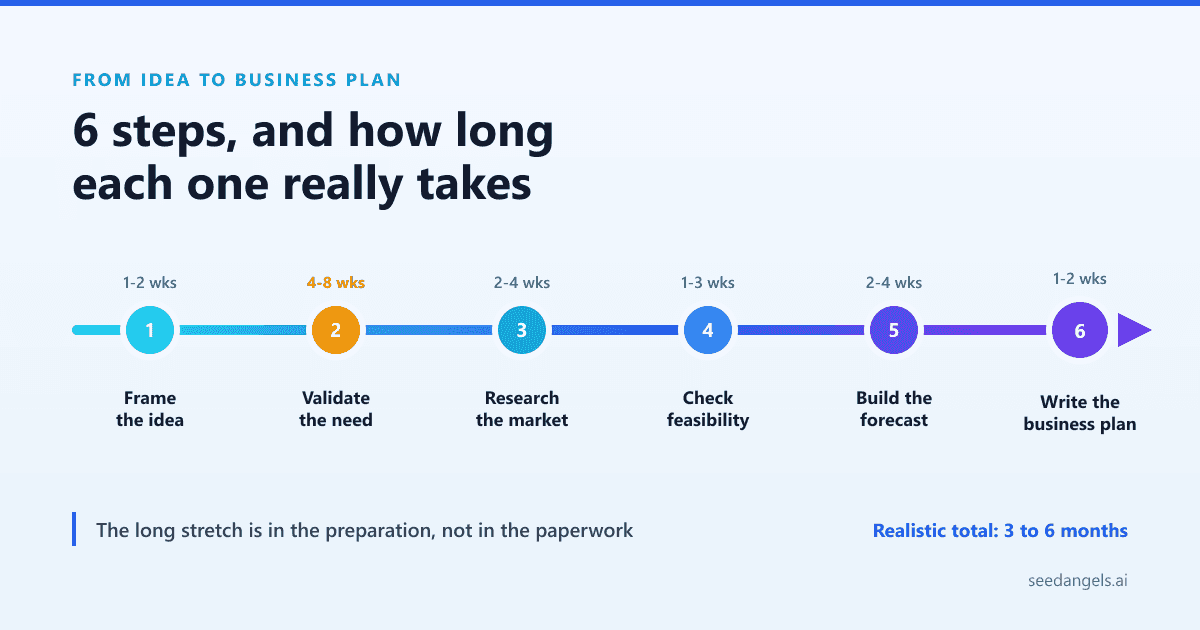
From idea to business plan, the route comes down to six steps:
- Frame the idea and the problem it solves
- Validate the need with real customers
- Research the market and the competition
- Check the feasibility of the project
- Build the financial forecast
- Write the business plan
Each one produces a deliverable that feeds the next. Here is how long to allow:
| # | Step | Deliverable | Indicative duration |
|---|---|---|---|
| 1 | Frame the idea and the problem | Problem stated, target identified | 1-2 weeks |
| 2 | Validate the need in the field | Evidence of commitment | 4-8 weeks |
| 3 | Research the market | Demand and competitive analysis | 2-4 weeks |
| 4 | Check feasibility | Feasibility assessment | 1-3 weeks |
| 5 | Build the financial forecast | Financial statements | 2-4 weeks |
| 6 | Write the business plan | Complete file | 1-2 weeks |
Two clarifications are essential to read this table correctly. These ranges assume a founder working on the project alongside a job, meaning a few hours a week rather than full days: full-time, they compress considerably. And they do not add up, several steps overlap, as the section on what can run in parallel details. Expect rather three to six months between the decision and a file you can put in front of a funder.
Step 1: frame the idea before defending it
Indicative duration: 1 to 2 weeks. Deliverable: a problem stated in one sentence, and a named target.
The first step is not about describing your product, but about describing the problem it solves. The shift looks minor; it conditions everything that follows. "I want to open a property management service" is not a workable starting point. "Short-let owners in my city lose their weekends handling guest arrivals, roughly forty times a year" is one: it names specific people, a pain, a frequency.
Three elements should fit on one page by the end of this step:
- The problem, stated from the point of view of whoever suffers it, not yours.
- The target, precise enough to be counted later: an occupation, a company size, a geography.
- The frequency and cost of the problem, even approximately, an annual irritant and a daily one do not produce the same business.
Criterion for moving on: your problem fits in one sentence that someone in your target recognises without you needing to explain it. If it takes three minutes of context, the framing is not finished. Watch for the reverse case: a problem everyone recognises instantly and nobody has solved often belongs to a structurally trapped category of idea, where the apparent obviousness is exactly what has drawn founders in for twenty years.
Step 2: validate the need with real customers
Indicative duration: 4 to 8 weeks. Deliverable: evidence of commitment.
This is the longest of the six steps, by a wide margin. It does not depend on your own pace but on other people's: you have to find contacts, get meetings, absorb refusals, start again. No method genuinely compresses that delay.
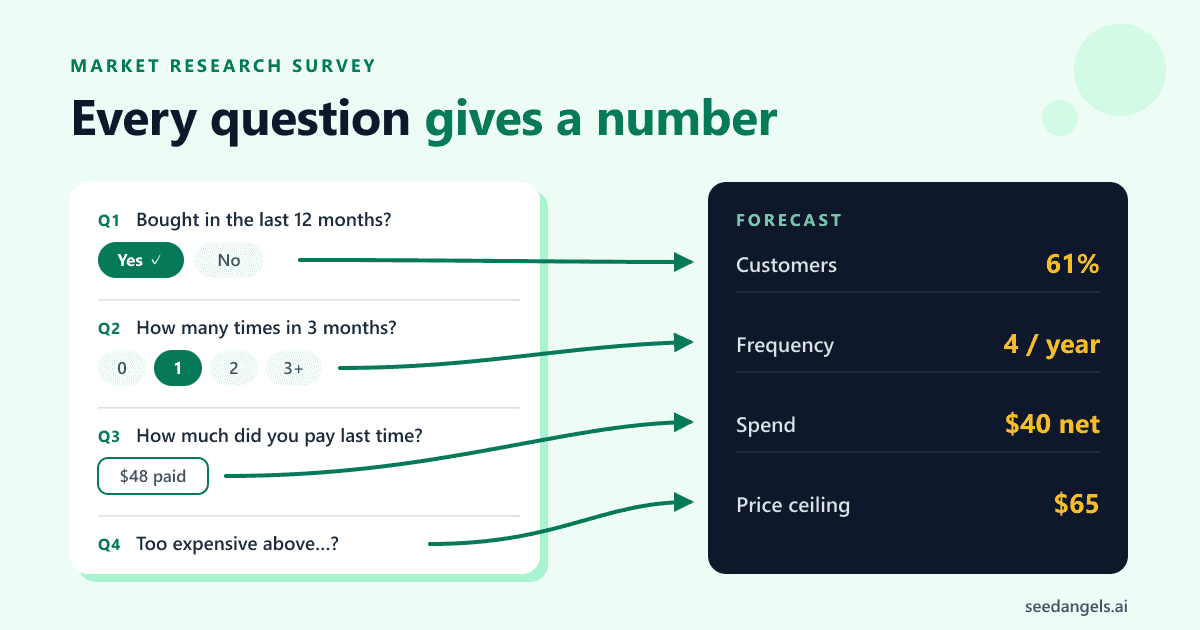
What this step proves is very specific: somebody is prepared to commit. Not to find the idea pleasant, to put money, time or a signature behind it. That distinction separates a validation from polite encouragement, and it is also what makes the step impossible to skip: every assumption in your forecast, from price to conversion rate, will come out of these conversations. Financial modelling built without them is just a series of guesses arranged in a spreadsheet. Our method for validating a business idea in four stages sets out the questions to ask in interviews and the level of proof each stage demands, from framing the problem to the price customers actually accept.
Criterion for moving on: you hold concrete commitments, pre-orders, letters of intent, signed waiting lists, first paying customers, rather than a collection of favourable opinions.
Step 3: research the market
Indicative duration: 2 to 4 weeks. Deliverable: a quantified market size and a map of competitors.
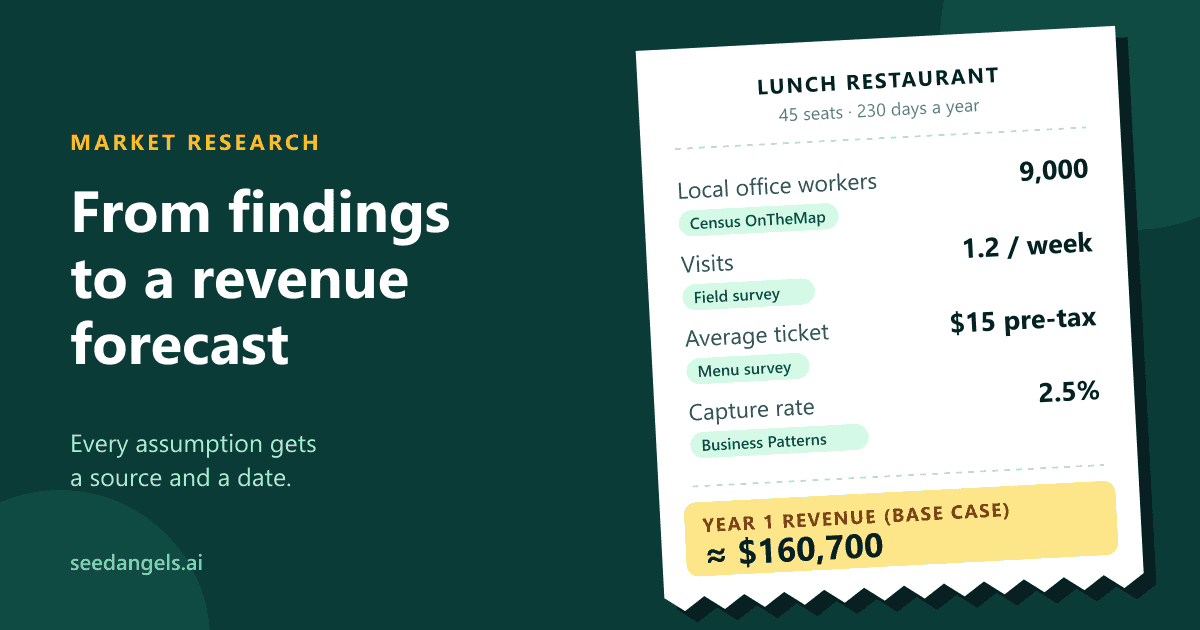
Yes, market research always comes before the business plan. A business plan turns market-derived assumptions into numbers: without prior research, those assumptions rest on nothing and do not survive the first meeting with a lender. The order is not a convention, it is a data dependency. Each finding must therefore come out as a dated, sourced assumption, which is what our method to turn market research into forecast assumptions covers.
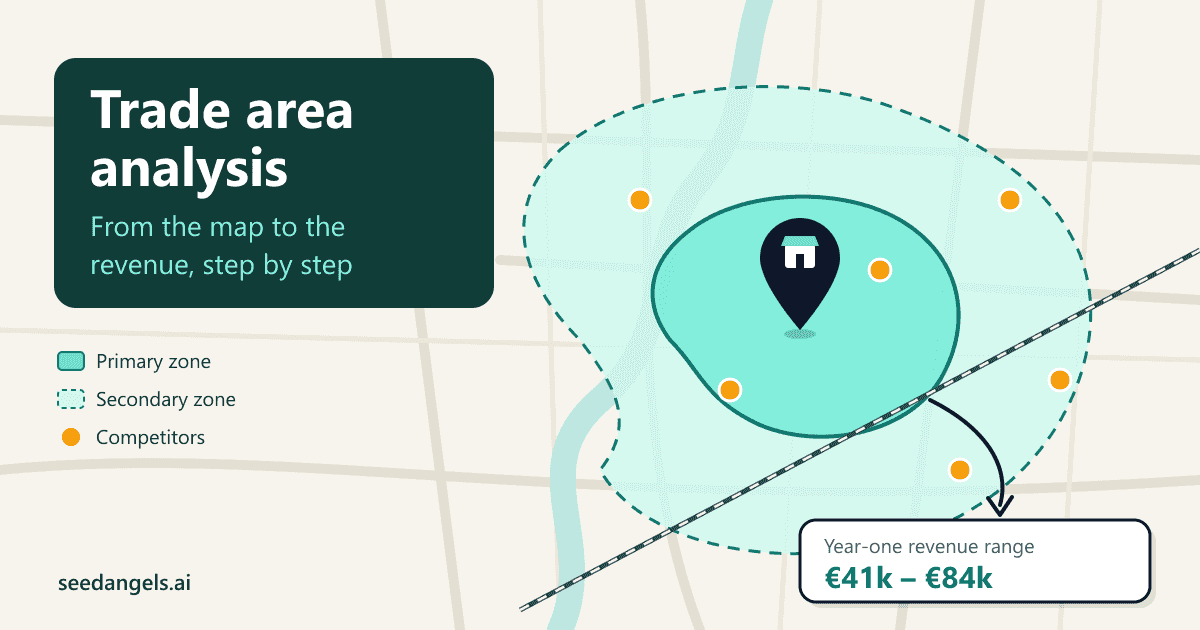
This step does not duplicate the previous one. Validation proves that one customer pays; market research measures how many there are and who already serves them. Two distinct questions, two distinct methods. Sizing is built by cutting the total market into nested circles, an exercise our guide to calculating your TAM, SAM and SOM works through in detail, that figure is the one your forecast will later have to match. The competitive side means mapping who already answers the need and by what means, including the workarounds your future customers cobble together today; our article on competitive analysis lays out the framework.
Good news on budget: most of the data is free. The U.S. Small Business Administration points to federal business statistics you can use directly, and national statistics offices publish enterprise counts by industry and size class at no cost.
Criterion for moving on: you can state how big your market is, how you arrived at that number, and who your three main competitors are. Discovering at this point that a player already occupies your position does not invalidate the previous step: an established competitor has to be qualified before you draw any conclusion about your own project.
Step 4: check feasibility
Indicative duration: 1 to 3 weeks. Deliverable: a feasibility assessment.
The market exists and customers are willing to pay. A separate question remains: can you, specifically, serve that market? Feasibility is examined along four dimensions, legal, technical, commercial and financial, each capable on its own of stopping a project. Our guide to the business feasibility study provides the matching scoring grid and shows why a legal blocker is never offset by a strong score elsewhere.
This step deserves particular attention on the timeline front, and that is why it sits here rather than later. This is where the constraints that push everything back appear: a licence to obtain, a mandatory qualification, premises that must meet standards, compulsory professional insurance. Some of those procedures take months. Discovering them at the end of the road, with the funding file ready, costs far more than a week of checking upfront. Licence and permit requirements vary by activity and by jurisdiction, so start with your national or state business portal, in the United Kingdom, for instance, GOV.UK's guide to setting up a business lists the licences and rules that apply before you trade.
Criterion for moving on: none of the four dimensions presents a prohibitive obstacle, and each identified constraint has a quantified lead time and a slot in your calendar.
Step 5: put numbers on the project
Indicative duration: 2 to 4 weeks. Deliverable: the financial statements.
This is where everything preceding turns into numbers. Every assumption in the model should trace back to a customer conversation from step 2 or a market data point from step 3, that traceability is what separates a defensible forecast from an optimistic spreadsheet.
Five statements answer the five financial questions you will be asked:
- The initial funding plan, what do you need to start, and can you raise it?
- The projected profit and loss account, will the business generate a profit?
- The break-even point, at what sales volume does it become profitable?
- The monthly cash flow plan, do receipts cover payments, month by month?
- The three-year funding plan, does financial solidity hold over time?
The starting point for the whole set is revenue: it is the assumption that feeds the other four statements and the first one your counterpart will test, which makes it worth knowing how to build a revenue forecast from your real capacity rather than from a target. For assembling the full set and connecting the statements to each other, our guide to financial forecasting walks through the complete method.
One thing to know before you start, because it prevents a lot of discouragement: this is an iterative exercise. You will run these statements several times, and you will adjust the project when the numbers do not hold, revisit a price, delay a hire, scale back the launch. That is not a failure of the modelling, it is its purpose.
Criterion for moving on: the five statements exist, they are consistent with one another, and you can explain where each assumption comes from.
Step 6: write the business plan
Indicative duration: 1 to 2 weeks. Deliverable: the complete file.
Here is the central message of this article: writing is a formatting step, not a thinking step. If the five preceding steps are done, you are creating nothing at this stage, you are assembling, drafting, making things consistent. It goes quickly.
And the reverse is equally true, which makes it an excellent diagnostic tool. If writing is painful, it is almost never a writing problem. A blank page on the market section signals absent market research. Getting stuck on sales assumptions signals skipped customer validation. When writing hurts, go back a step.
On format, the U.S. Small Business Administration describes two accepted approaches: the traditional business plan, which follows a standard structure of nine common sections and can run to dozens of pages, and the lean startup plan, which summarises only the key elements and often fits on a single page. Choose the traditional format if you are approaching conventional lenders, the lean format if you need to move fast and expect to revise constantly. Our complete guide to writing a business plan details what each section should contain.
Criterion for moving on: an outside reader understands your project and can find, for every claim, its justification inside the file.
A business plan does not validate your idea
A useful clarification, because the confusion costs months. Steps 2 and 3 are what validate the need, the field and the market. The business plan demonstrates the means of making the project viable: it sets out how you intend to serve an already-established need, with what resources and along what trajectory. It formalises a validation obtained elsewhere.
The nuance is worth stating, because the plan does carry one kind of validating role: it validates the project's overall coherence, testing the initial idea against market reality, operational constraints and financial balance. It does not tell you whether the need exists. It tells you whether the whole thing stands up.
What can run in parallel
This is where weeks are won, and it is the point most published roadmaps pass over in silence. Not every step follows the previous one: some depend strictly on what came before, others can run alongside.
The strict dependencies form a short, incompressible chain: you cannot put numbers on a market you have not researched, and you cannot write a business plan you have not costed. Market, then modelling, then writing is an order nothing lets you get around, because each step produces the raw material of the next.
Everything else is free. Here is the split:
| Cannot be parallelised | Can advance in parallel |
|---|---|
| Framing → customer validation | Choosing a legal structure |
| Validation → market research | Finding support or mentoring |
| Market research → financial modelling | Assembling the funding file |
| Modelling → writing the business plan | Long regulatory procedures (licences, qualifications) |
| Making first contact with funders |
The consequence is concrete. A founder who starts regulatory procedures at step 4, rather than after writing, often saves several weeks on the overall timeline. Another who waits until the business plan is finished to consider which legal structure to choose sometimes discovers that the choice changes the forecast, and has to go back.
The habit to build is simple: as soon as a task has a lead time that does not depend on you, start it now.
And the formalities, how long do they take?
Draw a clear line between the two phases of the project. Preparation, the six steps above, takes three to six months for a founder working alongside a job. Registration is measured in days or weeks: roughly one to two weeks for a sole trader or equivalent simplified status, two to four weeks for a company whose file is complete.
Those durations are observed orders of magnitude, not official commitments: they vary by legal form, by activity, by jurisdiction, and by how complete the file is. What is established is the circuit. Registration goes through your national or state business register, the SBA sets out the sequence for the United States, from choosing a structure and registering the business to obtaining tax identification numbers.
Above all, remember this: the leading cause of delay is not the administration, it is an incomplete file. One missing document, one non-compliant certificate, and the application goes back into the queue. The time you think you lose in formalities is actually decided in preparing them, and that is the part you control.
The 3 most common sequencing mistakes
These three mistakes share one trait: they are not about the content of the work, but about its order. They cost more than most substantive errors, because they force you to redo things.
1. Writing the business plan first. The symptom is recognisable: a third party asked for "a business plan", the bank, an accelerator, a relative, and you open a document the next day. What you produce is a file of unverified assumptions that looks like a business plan without having its substance. The first competent reader will spot it in ten minutes, at the first question about where a number came from.
2. Skipping field validation and going straight to desk research. This is the comfortable mistake, the one you can make sitting down. Public data is accessible, sector reports are reassuring, and you quickly obtain an impressive market size. But you still have no proof that a single customer will pay. A market worth millions in which nobody has validated your offer is still a market where you sell nothing.
3. Pushing legal feasibility to the end. The project is mature, the forecast finished, and you discover you need a licence, a professional qualification or premises meeting a standard. Depending on the case, that means several months of waiting or outright abandonment. Ten minutes of checking at step 4 is enough to remove the risk.
What these three mistakes put at stake goes beyond the calendar. Across the EU, Eurostat put the enterprise birth rate at 10.5 % in 2023 against a preliminary death rate of 8.5 %, the gap between starting and lasting is decided in large part by the preparation that precedes launch, precisely what these shortcuts sacrifice.
Conclusion
Order matters more than speed. The six steps are not six boxes to tick: each one produces the raw material of the next, and skipping one does not save time, it moves the work further down the line, where it costs more to redo.
Keep two markers. The first is a test: a business plan that is hard to write is almost always the sign of a step skipped upstream, when the writing stalls, go back rather than push on. The second is a relief: the long stretch sits before registration, never during it. The formalities are not the obstacle they are imagined to be.
Go back over the six steps now and ask yourself one question: which one have you genuinely reached? Not the one you are currently drafting, the one whose deliverable exists and whose exit criterion is met. That is where your timeline starts.
When you reach step 6, SeedAngels, our online business plan software, assembles the file from what you gathered in the five preceding steps, financials included, and flags inconsistencies along the way. You can also start from our free business plan templates to see the document you need to produce. Try SeedAngels for free →
FAQ
How long does it take to go from idea to business plan?
Plan for three to six months if you are working on the project alongside a job, with customer validation alone taking up half that time. Registration formalities, by contrast, are measured in days or weeks. The long stretch sits before incorporation, never during it.
Should you do market research before the business plan?
Yes, always. A business plan turns market-derived assumptions into numbers: without prior research, those assumptions rest on nothing and will not survive the first meeting with a lender. Market research feeds your revenue forecast directly, and that forecast then structures the entire financial section.
Does a business plan validate my idea?
No. Customer validation and market research are what validate the need. The business plan demonstrates the means of making the project viable and checks its overall coherence, testing the idea against commercial, operational and financial reality. It formalises a validation obtained elsewhere; it does not replace it.
Can you start a business without a business plan?
Legally, yes: no rule requires one and registration does not ask for it. In practice it becomes essential the moment outside funding is involved, a bank loan, a public grant, an investor. Even when self-funded, the financial modelling is the only way to know at what volume the business becomes profitable.
Which steps can run in parallel?
Choosing a legal structure, finding support or mentoring, assembling the funding file and starting long regulatory procedures can all run alongside the other steps. The sequence of market research, then financial modelling, then writing, however, cannot be compressed: each one produces the data the next one needs.
When should you get outside help?
The most useful moment is the start of the financial modelling phase: that is where an outside view, an accountant, a support network, a chamber of commerce, prevents expensive mistakes. Too early and the project is still vague, so the discussion stays theoretical; too late and the structural decisions are already locked in.